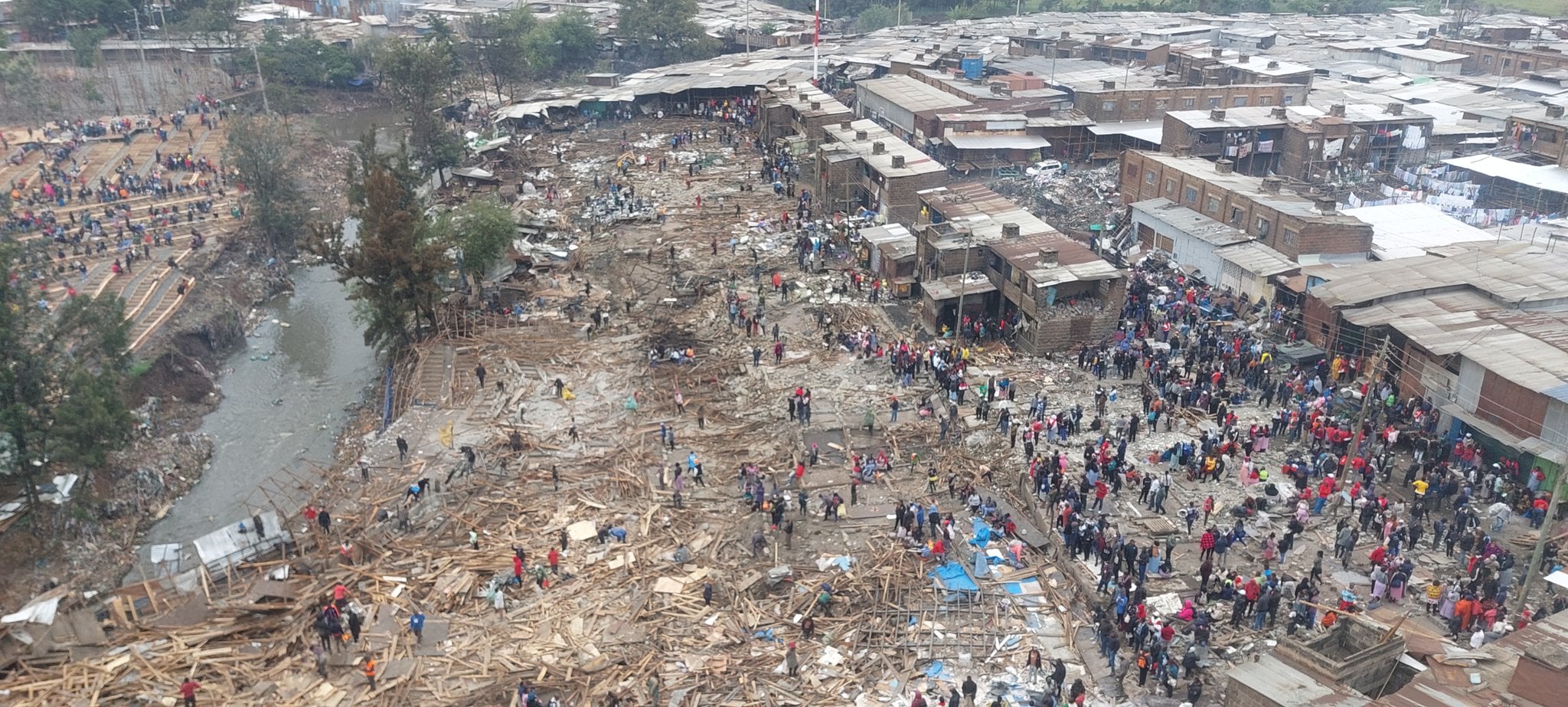

A wave of destructive floods that killed more than 100 people nationwide, including at least 37 fatalities in the Kenya’s capital, has triggered an aggressive campaign by authorities to reclaim river corridors in Nairobi, culminating in the demolition of sections of the sprawling Gikomba Market built along the Nairobi River.
Often described as one of the largest open-air markets in East Africa, Gikomba Market plays a central role in the region’s informal economy, handling vast volumes of second-hand clothing, footwear, textiles, household goods, and recycled materials. The market supports tens of thousands of traders directly and sustains a wider ecosystem of transporters, tailors, recyclers, food vendors, and micro-financiers, making it a critical source of employment and affordable goods for low- and middle-income households across Nairobi and beyond.
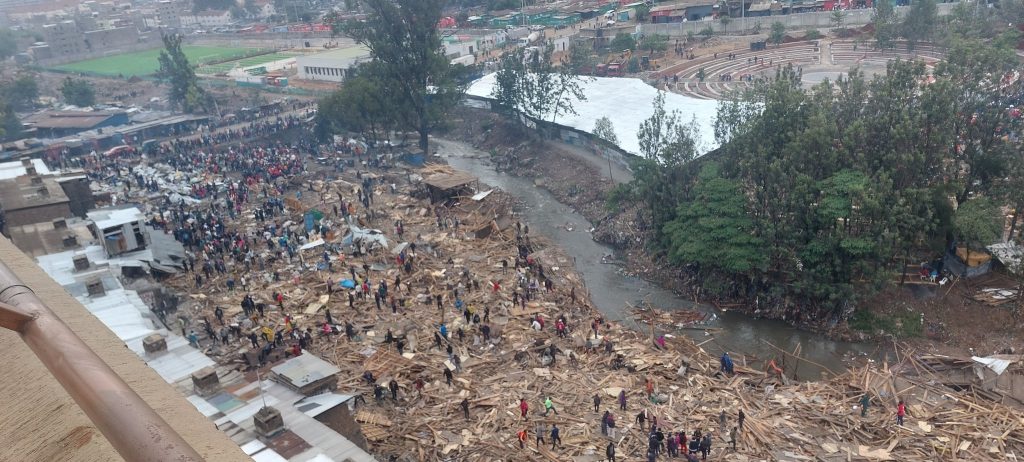
The overnight demolition of stalls in the market’s shoe section on 30th March 2026, marked one of the most visible actions yet in a wider flood mitigation strategy now reshaping urban planning in Kenya’s capital. County officials say the move is part of a sustained effort to restore natural drainage systems and reduce the risk of future disasters in a city increasingly vulnerable to extreme weather events.
Read also: Kenya adopts world-first automated waste segregation tech in push for circular economy
The demolitions followed weeks of severe rainfall that submerged homes, displaced families, and exposed long-standing weaknesses in Nairobi’s stormwater infrastructure. Informal settlements and trading centers located along waterways were among the hardest hit, reinforcing warnings from environmental planners that decades of encroachment on riparian land have narrowed rivers and reduced their capacity to absorb heavy flows.
Governor Johnson Sakaja of Nairobi County had ordered the immediate removal of illegal structures along riverbanks after receiving a rapid-response report from a county infrastructure task force. The directive formed part of a broader emergency plan to prevent further loss of life and property as climate-driven floods become more frequent across East Africa.
“This is not a one-off exercise,” Sakaja said during an inspection of flood-prone areas. “It is a sustained effort to reclaim our rivers and prevent further tragedies.”
Nairobi’s flood crisis reflects a growing pattern across African cities where rapid urbanisation, weak enforcement of land-use regulations, and climate variability are converging to create new risks. The city’s population has expanded sharply over the past two decades, pushing housing and commerce into wetlands, riverbanks, and drainage corridors once reserved for water flow.

Urban planners note that the transformation of natural waterways into narrow channels has amplified the impact of heavy rains. In many cases, solid waste, informal construction, and road development have blocked drainage systems, turning seasonal storms into life-threatening emergencies.
Across Africa, similar interventions are emerging. In Accra, authorities have undertaken periodic demolitions of structures along flood-prone waterways following repeated disasters. In Lagos, state agencies have cleared informal settlements from drainage channels to protect critical infrastructure. These actions highlight a continent-wide shift toward stricter land-use enforcement as climate risks intensify.
For thousands of small-scale traders, however, the demolition campaign has triggered immediate economic shock. Gikomba Market is not merely a commercial site but a critical livelihood ecosystem supporting families, transport workers, suppliers, and informal financiers across the city.
Many traders arrived at the site to find flattened stalls and scattered merchandise after bulldozers moved in overnight, leaving them scrambling to recover stock and secure temporary shelter for their businesses. For some, the losses represented years of savings invested in inventory, tools, and storage infrastructure. Others reported losing their only source of daily income, raising fears of deeper poverty and financial instability.
Read also: A city built on hills and rivers: How a century-old geography shapes a modern disaster
The demolitions have drawn sharp criticism from political leaders, civil society groups, and sections of the public, who argue that enforcement, while necessary, has been implemented without adequate consultation, compensation, or relocation planning. Critics contend that the sudden displacement of traders risks undermining economic resilience in a city where informal enterprises account for a significant share of employment.
Community advocates have also questioned the timing and method of the demolitions, describing the operation as abrupt and disruptive. Some traders acknowledged receiving eviction notices but said they had hoped for phased relocation or support to transition into safer trading areas.
The controversy has highlighted a deeper governance dilemma facing rapidly urbanising African cities: how to protect lives from climate disasters while safeguarding the livelihoods of vulnerable populations. Authorities insist that clearing riparian land is essential to preventing future floods, yet the social costs of enforcement remain politically and economically sensitive.
Earlier in March, the Environment and Land Court temporarily halted planned demolitions along parts of the Nairobi River after residents and traders challenged the legality of eviction notices, arguing that they had legally occupied the land for years. Although enforcement has since resumed in high-risk areas, the legal dispute underscores the complexity of balancing environmental protection with property rights and economic survival.
The clearing of structures along Nairobi’s waterways forms part of a broader rehabilitation effort that includes dredging rivers, expanding drainage capacity, and restoring wetlands. National and county agencies have framed the programme as a long-term climate adaptation strategy rather than a short-term emergency response.
Environmental experts emphasise that restoring riparian buffers, natural vegetation zones along rivers, can significantly reduce flood risk by absorbing excess water and stabilising soil. These measures are increasingly recognised as cost-effective alternatives to purely engineered solutions such as concrete drainage systems.
The recent floods, and the decisive response that followed, have placed river restoration at the centre of city planning, forcing policymakers to confront the difficult trade-offs between environmental safety and economic survival.
For many African cities facing similar pressures, the lesson is becoming clearer: climate resilience will depend not only on rebuilding infrastructure, but on managing land use in ways that protect both ecosystems and the people whose livelihoods depend on them.
Engage with us on LinkedIn: Africa Sustainability Matters