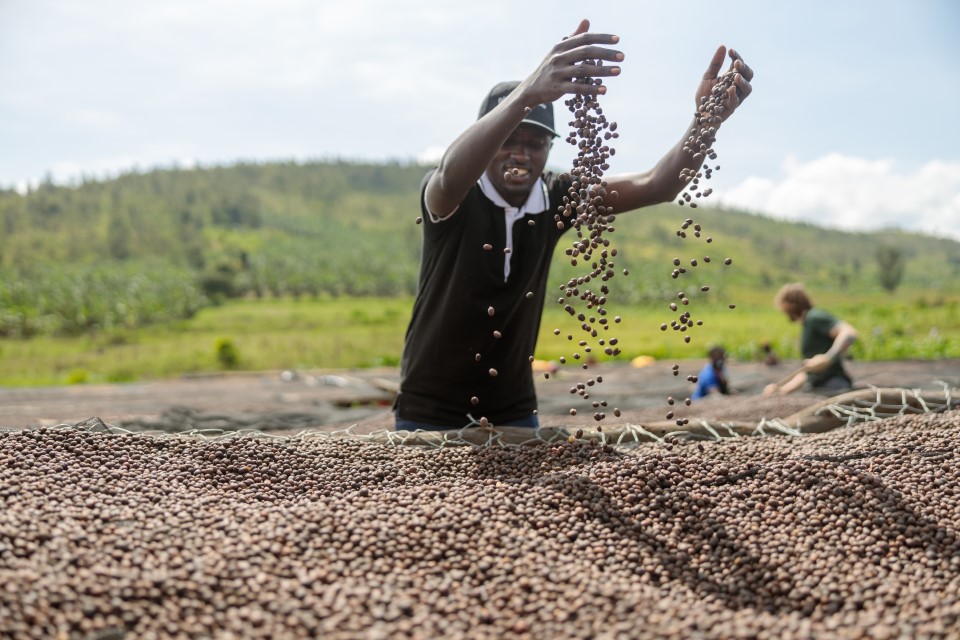

East Africa’s agricultural economy is confronting a turning point as new EU traceability and due-diligence laws take effect, forcing exporters, farmers, processors and regulators across Kenya, Uganda, Tanzania, Rwanda and Ethiopia to prove where their crops come from, when and how they were grown, and who handled them along the way.
The shift matters now because the European Union, which imports a significant share of the region’s coffee, tea, cocoa, cereals, horticulture and timber, has already begun adjusting buying patterns in response to the rules. Only 15 percent of agribusinesses in the region fully understand what the regulations require or how to comply, raising the prospect of more than €2.75 billion in annual export value slipping out of reach.

Read also: How EU’s softer pollution rules could hurt Africa’s green exports
The numbers tell a story of an economy deeply tied to agriculture but poorly equipped for a new compliance-driven trading system. Agriculture contributes roughly 32 percent of East Africa’s GDP and employs over 80 percent of its people.
It is the region’s backbone, yet the majority of its supply chains run on analogue processes; paper records, informal aggregation, and fragmented sourcing. That ecosystem was functional as long as buyers were willing to overlook the gaps. Under the EU’s incoming Deforestation Regulation (EUDR) and the Corporate Sustainability Due Diligence Directive (CSDDD), the gap has become a commercial liability.
Interviews and assessments feeding into the recent industry brief show that most exporters are unsure where to begin. About 65 percent of surveyed agribusinesses said they need clearer explanations of what the EU rules actually demand. More than half lack systems to capture the data that European buyers now insist on. A Danish Industry report shows that 65% of companies need clearer guidance and 57% require practical compliance frameworks, and 52% lack access to the digital tools necessary to meet these new expectations.

Farmers interviewed in Uganda and Tanzania reported being asked by exporters to provide exact farm coordinates despite lacking smartphones, formal land documents or reliable connectivity. Smartphones remain out of reach for many rural households, and rural internet penetration in East Africa lingers below 30 percent, making digital mapping an operational challenge rather than a simple technological upgrade.
The effect of this readiness gap is already visible. European buyers have slowed purchases of crops that cannot be traced back to a mapped farm. Coffee and tea exporters in Kenya report receiving provisional contracts that become firm only once they supply verifiable geolocation data. Some timber shipments have been held until exporters prove legal origin. These delays cascade through the system.
Cooperatives depending on predictable payments struggle with cash flow; processors face bottlenecks in production planning; and smallholders, often operating with thin margins, absorb the shock through lower or delayed payments. A single rejected shipment for lack of documentation can alter an entire season’s income for a rural community.
Read also: EU sets 2040 climate target and launches simplification package for green legislation
Traceability is emerging as a defining feature of market access. The industry brief quotes Koltiva’s chief executive describing digital traceability as “the price of participating in the world’s most valuable markets.” That assessment reflects a global shift: buyers in Europe want a supply chain they can audit, verify and defend to regulators and consumers.
For East Africa, where smallholders produce the bulk of export crops, building that chain requires more than technology. It demands coordination among cooperatives, exporters, aggregators, government agencies and buyers. A coffee cherry may pass through multiple hands before reaching a processor. If any link fails to record or transmit the required data, the entire lot can be deemed non-compliant.
Some exporters have begun investing in farmer mapping and digital onboarding, but the financial burden is steep. Field mapping teams must travel to remote villages, register farmers, capture coordinates and document land-use history. The cost per farmer ranges widely depending on terrain, remoteness and system requirements.
For exporters operating on narrow margins, scaling these investments without shared financing is difficult. Yet the alternative, losing access to the EU market, is far costlier. That reality has given rise to new experiments in shared-cost models where buyers co-finance data collection or offer long-term contracts to anchor the investment.
Governments in the region are starting to coordinate responses, though progress is uneven. Some national task forces are exploring unified data standards and centralized traceability platforms to give European buyers a single point of verification. Without harmonized approaches, exporters risk building parallel systems that satisfy one buyer but fail under another’s audit.
Read also: UNEA-7 to launch GEO-7 report and announce 2025 Champions of the Earth in Nairobi
A regional framework could reduce duplication and increase trust in African-origin data, but developing such a system requires political alignment, technical capacity and funding, all of which remain work in progress.
What stands out across the findings is that the challenge is not about the willingness of farmers or exporters to comply but about the practicality of doing so at scale. Many smallholders farm on inherited land without formal titles; mapping such plots requires sensitivity to local land-tenure realities.

Collectors and aggregators, often operating informally, must be brought into digital systems without disrupting their livelihoods. Exporters need training on verification protocols, while buyers must signal clearly which data formats, thresholds and evidence they will accept.
If the region succeeds in organising this transition, the long-term benefits could be substantial. Verified traceability can unlock price premiums, preferred-supplier status and entry into other regulated markets. It can improve planning, reduce losses and tighten forecasting. However, those benefits remain theoretical unless the immediate gaps are addressed with urgency.
The story unfolding now is not one of impending crisis but of a narrowing window. East Africa’s agricultural export economy has the talent, land and global demand it needs. What it does not yet have is the interconnected system required by a new generation of trade rules.
The decisions made in the coming months; how to fund mapping, how to build shared infrastructure, how to protect smallholders from bearing disproportionate costs, will determine whether the region consolidates its place in European markets or watches those opportunities pass elsewhere.
Engage with us on LinkedIn: Africa Sustainability Matters
Engage with us on LinkedIn: Africa Sustainability Matters