


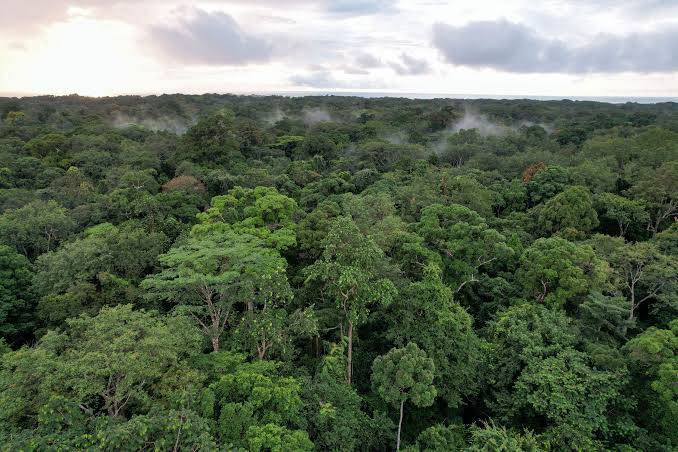
Gabon has agreed to sell approximately 6 million tonnes of forest carbon credits to German state-owned energy company SEFE, in a transaction the government describes as Africa’s first sovereign forest carbon credit sale, as the Central African country seeks to generate revenue from forest conservation while strengthening the financial value of its natural resources. The agreement, announced on November 4, 2026, could provide a new route for African governments to mobilise climate finance, although its economic significance will depend on the undisclosed sale price, the distribution of proceeds and the effectiveness of safeguards for communities and forests.
According to Reuters, the credits are linked to Gabon’s national forests and represent a sovereign transaction, rather than credits issued through an individual private conservation project. The agreement marks a shift towards governments participating directly in carbon markets, where forest protection can become an asset capable of generating revenue alongside traditional sources of public finance.

The financial terms of the transaction have not been disclosed, leaving the potential value of the sale uncertain. However, the scale of the credits places Gabon among African countries seeking to establish more direct links between natural capital and climate-related financing, at a time when governments face competing demands for infrastructure investment, public services and environmental protection.
The credits are associated with the preservation of existing forests rather than new tree planting. Gabon’s forest cover and relatively low historical deforestation rates underpin its position as a High Forest, Low Deforestation country, a classification that distinguishes countries with substantial forest resources and limited forest loss from those pursuing large-scale restoration.
The credits are certified under the Architecture for REDD+ Transactions’ TREES standard and are eligible under the Carbon Offsetting and Reduction Scheme for International Aviation, which governs carbon offsetting requirements for participating airlines. According to carbon market reporting, delivery is expected by the first quarter of 2027, although the financial terms remain undisclosed.
The arrangement reflects the growing role of carbon markets in financing climate action, particularly in countries where forests represent a significant share of national natural capital. For Gabon, the transaction offers an opportunity to convert the environmental value of its forests into financial resources without relying exclusively on extractive industries or conventional external borrowing.
However, the extent to which the sale contributes to public finances will depend on the amount received, the costs of monitoring and verification, and the rules governing how revenue is allocated. Without disclosure of the transaction price and its fiscal treatment, it remains difficult to assess whether the agreement will generate material resources for conservation, public investment or community development.
The government has indicated that proceeds will be held in a dedicated account until a national regulatory framework governing their distribution, including payments to local communities, comes into effect. That approach places the development of clear financial and institutional rules at the centre of the transaction’s implementation.
For communities living in and around forest areas, the distribution framework will be particularly important. Forest conservation can affect access to land, livelihoods and natural resources, while restrictions on forest use may impose costs on households that depend on agriculture, timber and other forest products. Transparent rules for allocating carbon revenue could help ensure that conservation benefits extend beyond government accounts and international buyers.
The transaction also raises questions about how Gabon will demonstrate that the credits represent credible climate benefits. Carbon markets depend on the ability to measure forest emissions and removals, establish reliable baselines and ensure that credited reductions are not overstated. In countries with extensive standing forests, the challenge is not simply to protect trees, but to demonstrate that conservation outcomes are durable and that carbon claims are supported by credible monitoring.
These considerations have wider implications for Africa’s participation in international carbon markets. Forest rich countries across Central and West Africa are exploring ways to attract climate finance through conservation, restoration and land use programmes. Yet the ability to secure revenue depends on the credibility of national institutions, the quality of carbon accounting and the confidence of buyers in the environmental integrity of the credits.
Gabon’s agreement also comes as African governments seek greater control over the financing of their development priorities. Climate finance remains difficult to access for many countries, particularly where debt burdens and limited fiscal space constrain public investment. Carbon markets offer an alternative source of funding, but they are unlikely to replace concessional finance or provide predictable revenue on their own, given the volatility of demand and the importance of contract terms.
For Gabon, the transaction could support efforts to diversify its economy and strengthen the financial value of forest conservation. The country’s broader development challenge is to translate natural resource wealth into sustainable public revenues, economic opportunities and resilient institutions. Whether carbon credit sales can contribute meaningfully to that objective will depend on how proceeds are managed and whether conservation commitments remain effective beyond the period covered by the agreement.

The deal therefore represents both a market opportunity and a governance test. Its significance for Africa will extend beyond the volume of credits sold to the capacity of governments to establish transparent revenue systems, protect community interests and maintain the environmental integrity of forests. As Gabon moves towards delivery, the price, distribution arrangements and monitoring framework will determine whether the transaction becomes a durable source of climate finance or a limited carbon market agreement.


