


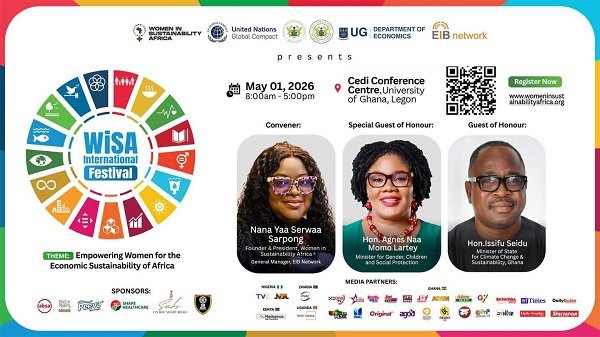
On May 1, 2026, at the Cedi Conference Centre of the University of Ghana in Accra, something quietly significant happened. The 2026 Women in Sustainability Africa (WiSA) International Festival brought together government ministers, development partners, civil society leaders, traditional authorities, students, and women-focused organisations to do something that too few climate events do: put women front and centre not as beneficiaries, but as architects of Africa’s sustainable future. The Office of the Minister of State for Climate Change and Sustainability formally backed the festival, lending the weight of state recognition to a movement that has been building quietly since WiSA’s founding launch in May 2025.
The festival ran under the theme “Empowering Women for the Economic Sustainability of Africa”a framing that deliberately fuses climate resilience with economic agency. Rev. Nana Yaa Serwaa Sarpong, WiSA’s Founder and President, described the event as evidence that the organisation’s vision was steadily becoming reality. Her call was direct: more funding, more partnerships, and more pathways to bring women particularly those at the grassroots into sustainability conversations and decision-making. She also announced that the WiSA International Festival would henceforth be held annually on May 1, cementing its place in Africa’s sustainability calendar as a fixed moment of reckoning and renewal.
Ghana’s Climate Change Minister, Seidu Issifu, used his address at the festival to underscore why this matters beyond symbolism. Women, he noted, continue to bear the heaviest burden of climate impacts while remaining locked out of the finance and leadership structures that shape the response. His government’s answer or at least in part is a GH¢400 million allocation in the 2026 national budget toward a Women’s Development Bank. The minister also pledged support for a proposed WISA Resource and Research Centre to anchor evidence-based policymaking on sustainability. The Ministry of Gender, Children and Social Protection, represented by Dr. Naa Momo Lartey, reinforced the message: the Mahama administration’s commitment to women’s empowerment is being translated into concrete institutional mechanisms.
The stakes behind these pledges are stark. According to UN Women’s research, by 2050 under a worst-case climate scenario, more than 158 million additional women and girls could be pushed into extreme poverty nearly half of them in Africa. A separate peer-reviewed study in PMC documents that women already make up over 60 percent of the agriculture workforce in Sub-Saharan Africa, yet face climate-induced crop losses far exceeding those faced by men ranging from 48 percent in Burkina Faso to 73 percent in the DRC. In Kenya, climate-induced droughts have forced women and girls to walk up to 30 kilometres in search of water, a burden that dramatically increases their exposure to gender-based violence.
The policy architecture to address this is slowly being built. A UNDP Climate Promise report found that 40 of 41 African countries that submitted updated Nationally Determined Contributions (NDCs) have included gender considerations in them, with 25 incorporating gender-responsive adaptation actions. Meanwhile, UN Women’s Gender Equality and Climate Policy Scorecard which has trained 674 policymakers and advocates across 20 sub-Saharan African countries is expanding to cover 100 countries by the end of 2026. Real examples of impact are emerging: in Rwanda, women have been trained to convert organic waste into cooking gas and bio-fertilisers, cutting both emissions and unpaid domestic labour. In Cameroon, women’s organisations helped develop national forest protection strategies and now hold seats in major decision-making bodies.
What WiSA represents and what Ghana’s government endorsement amplifies is a growing continental consensus that climate action without women’s leadership is neither just nor effective. The UN Women Gender Snapshot for West Africa estimates that achieving gender equality across the region requires $360 billion annually in transformative investment a figure that underscores the scale of the opportunity being left on the table. WiSA’s model convening governments, diaspora, civil society, traditional leaders, and private sector voices in the same room is precisely the multi-stakeholder architecture that global climate frameworks like the UNFCCC’s Belém Gender Action Plan adopted at COP30 envision. The festival in Accra was a local event with continental implications. For Africa to meet its climate commitments, it will need many more of them.


