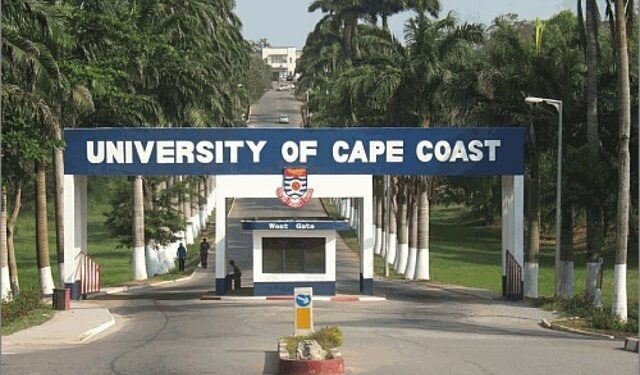

University of Cape Coast has established the Africa Ocean Institute to consolidate marine and coastal research under a single institutional framework, as Ghana and other African states seek to strengthen governance of ocean resources amid rising climate and economic pressures. The institute, announced on February 11 in Cape Coast, has received approval from the Ghana Tertiary Education Commission and will operate within UCC’s College of Agriculture and Natural Sciences.
The new body brings together three existing university units, the Centre for Coastal Management, the Department of Fisheries and Aquatic Sciences and the Centre for Marine Affairs, in an effort to align research, policy advisory work and capacity development. According to Professor Denis Worlanyo Aheto, Acting Vice-Chancellor of UCC, the consolidation is intended to strengthen Ghana’s institutional role in ocean governance and sustainable marine development.
Africa’s coastal and marine zones underpin food systems, employment and trade. Fisheries contribute significantly to protein intake across West Africa and support millions of livelihoods, particularly in artisanal communities. Yet marine ecosystems face mounting stress from overfishing, pollution, habitat degradation and climate change.
According to the African Union and regional fisheries bodies, declining fish stocks in parts of the Gulf of Guinea and other coastal waters have heightened pressure on public finances and food security, with governments compelled to increase imports to stabilise domestic supply.
The Africa Ocean Institute has identified food security, biodiversity conservation, marine pollution, habitat degradation, climate resilience and policy integration as its thematic priorities. Its mandate includes providing technical advice to government, running specialised training programmes and conducting outreach to fishing communities. That approach reflects a broader policy challenge across Africa: the persistent gap between scientific research and regulatory enforcement.
Ghana’s coastline, stretching more than 500 kilometres along the Gulf of Guinea, supports a complex network of fisheries, ports and offshore energy assets. The sector is economically material. According to Ghana’s Ministry of Fisheries and Aquaculture Development, fisheries account for a substantial share of agricultural GDP and are a major employer in coastal regions. However, illegal, unreported and unregulated fishing has eroded stocks, affecting incomes and increasing social tensions in some communities.
Professor Joseph Aggrey-Fynn of UCC’s Department of Fisheries and Aquatic Sciences said Ghana has yet to fully explore the economic potential of its marine environment, citing opportunities in marine biotechnology, renewable ocean energy and eco-tourism.
While such prospects remain at an early stage, several countries outside Africa have integrated wave energy research and marine-based pharmaceutical development into broader blue economy strategies. Replicating elements of those models would require capital investment, regulatory clarity and long-term research funding.
UCC disclosed that it had secured more than $500,000 over the past six years to support internationalisation and regional collaboration initiatives linked to marine research. While modest relative to infrastructure financing needs, the funding underscores growing interest in positioning African institutions within global ocean governance processes, particularly as debates intensify over marine biodiversity beyond national jurisdiction and climate adaptation finance.
For Ghana and other coastal states, the institute’s significance lies in its potential to inform evidence-based fisheries management and marine spatial planning. Weak data systems and fragmented oversight have historically constrained enforcement and resource allocation. According to development economists, improving governance of marine assets can yield fiscal dividends by reducing revenue leakage, strengthening licensing systems and stabilising export earnings.
Read also: Ghana bans mining in forest reserves, testing the future of environmental enforcement
The Africa Ocean Institute is also expected to document indigenous marine knowledge and integrate it with scientific research, an approach aimed at improving compliance and community engagement. In many coastal settlements, livelihoods depend directly on daily fish landings, making sustainability a matter of economic survival rather than environmental abstraction.
Across the continent, the blue economy has been framed as a growth frontier. Its viability, however, rests on institutional capacity and credible research foundations. By centralising expertise and linking policy advisory functions to academic research, UCC is seeking to position Ghana as a regional node in ocean governance.
Engage with us on LinkedIn: Africa Sustainability Matters