
Guinea-Bissau’s transitional government has issued an immediate, nationwide ban on the production of fish meal and fish oil, according to a January 29 directive that aims to halt a clandestine offshore processing industry threatening the country’s maritime food security.
The order, implemented following the November 2025 coup, suspends all land-based and sea-based factory operations as well as the licenses of industrial purse seine vessels supplying them. The move reveals the extent to which West Africa’s controversial fish meal sector has migrated from regulated jurisdictions to the porous waters of Guinea-Bissau, utilizing massive factory ships to bypass land-based scrutiny.
While Guinea-Bissau has long been viewed as a nursery for regional fish stocks rather than a processing hub, marine traffic data and drone surveillance have confirmed the presence of large-scale industrial activity 50 kilometers off the Bijagós Archipelago.
According to Global Fishing Watch, two factory vessels, the 147-meter Tian Yi He 6 and the 125-meter Hua Xin 17, have been operating in Bissau-Guinean waters since 2019 and 2024, respectively.
Records from the Ministry of Fisheries indicate these vessels were operated by Shanghai Pesca SARL and Global Fisher SARL, entities with documented Chinese ownership. These offshore plants were serviced by at least six Turkish-flagged industrial purse seiners, many of which relocated to Guinea-Bissau after Mauritania tightened its sector regulations in 2021.
The transition of the fish meal industry from land to sea represents a significant shift in the regional “blue economy” landscape, carrying profound fiscal and environmental implications.
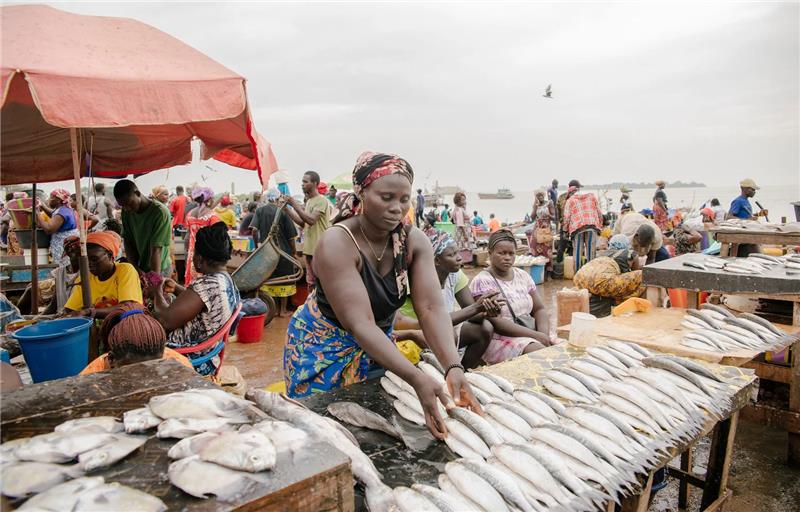
For Guinea-Bissau, where the fisheries sector accounts for a substantial portion of state revenue and provides the primary source of animal protein for the population, the overexploitation of small pelagics, specifically Sardinella aurita and S. maderensis, threatens both public health and long-term economic stability.
A February 2025 resource assessment, conducted under a bilateral agreement with the Russian Federation, indicated a “considerable decline” in these stocks, attributing the scarcity directly to the rise in meal and oil production.
According to Amadú Djaló, Guinea-Bissau’s director of industrial fishing, the ban was motivated by the detrimental impact on the “disadvantaged population,” for whom small pelagic fish are a staple food.
The economic logic of the fish meal industry, which converts high-grade protein into feed for international aquaculture and livestock markets, often creates a net loss for African domestic markets by driving up local prices and depleting artisanal catches.
This creates a governance challenge where short-term licensing fees from industrial fleets are weighed against the long-term costs of food insecurity and the degradation of the Bijagós Archipelago, a UNESCO Biosphere Reserve critical to the region’s ecological health.
The proliferation of this industry was not limited to the sea; in April 2025, the previous administration inaugurated a Chinese-owned plant near Bissau, with further facilities under construction as recently as last month.
However, the current ban reflects a growing recognition among West African coastal states that the environmental and social externalities of fish meal production may outweigh its immediate fiscal benefits.
As the Tian Yi He 6 and Hua Xin 17 remain anchored near the port of Bissau following the directive, the regional focus shifts to whether this suspension will be sustained as a permanent policy or if the industry will once again migrate to find less regulated waters along the Atlantic coast.
Engage with us on LinkedIn: Africa Sustainability Matters