


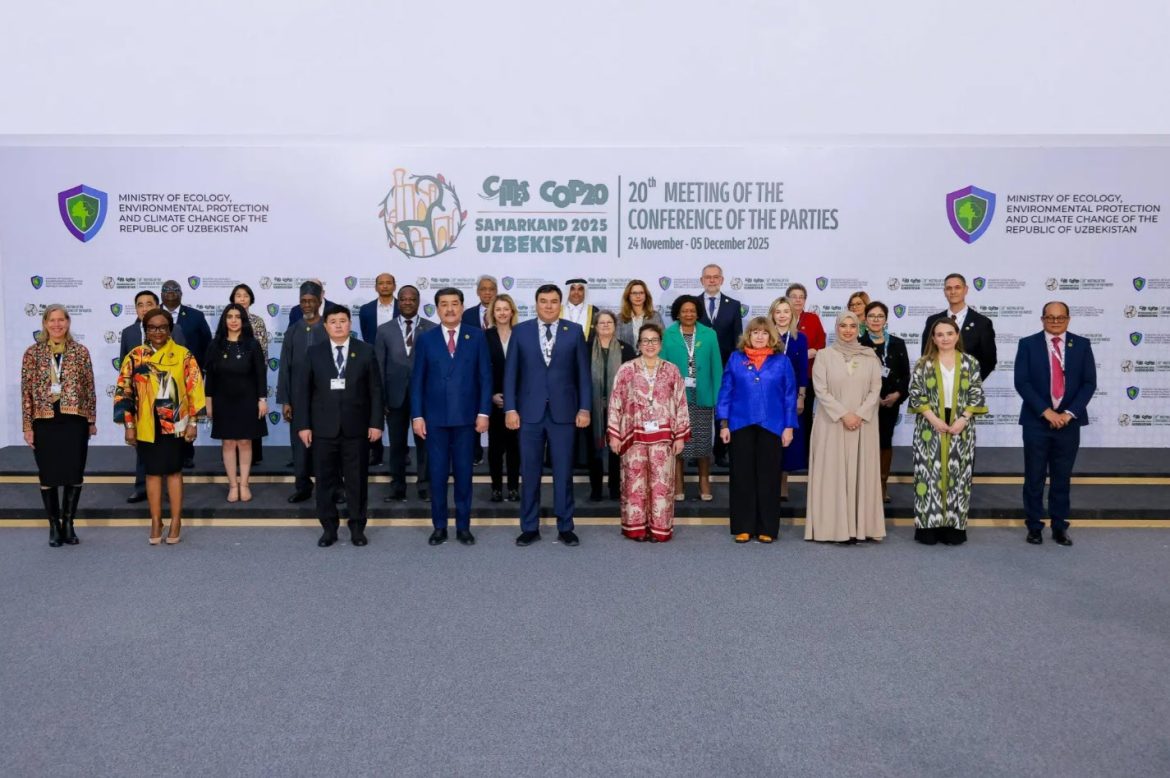
The Convention on International Trade in Endangered Species of Wild Fauna and Flora moved to close one of the quiet gaps in global conservation enforcement in late November, when its Secretariat unveiled new digital training tools during the 20th Conference of the Parties in Samarkand, Uzbekistan, aiming to strengthen how countries, particularly in Africa, regulate wildlife trade in practice and not just on paper.
Announced on the sidelines of the meeting that ran from November 24 to December 5, the two self-paced e-learning courses are designed to explain how CITES actually works on the ground: how permits are issued, how scientific assessments are made, and how national authorities apply the rules that govern trade in thousands of protected species.

Hosted on UNEP’s Information Portal on Multilateral Environmental Agreements, the courses are open to government officials, customs officers, conservation groups, researchers and students, reflecting an acknowledgement that wildlife trade governance depends on far more than ministries alone.
For Africa, where biodiversity is both a natural asset and a source of economic pressure, the move addresses a long-standing weakness. The continent accounts for more than a quarter of all CITES Parties, yet enforcement capacity varies sharply between countries.
In major wildlife-rich states such as Kenya, Tanzania, South Africa and the Democratic Republic of Congo, customs officials and wildlife authorities handle complex trade cases involving ivory, timber, reptiles, medicinal plants and live animals, often with limited access to specialised legal or scientific training. In smaller or conflict-affected states, the challenge is even greater, with understaffed agencies expected to implement rules negotiated at global level.
CITES Secretary-General Ivonne Higuero framed the launch as part of a broader shift toward accessibility as the treaty marks its 50th anniversary. Her point was less ceremonial than practical. Many of the disputes that arise around wildlife trade do not stem from deliberate non-compliance but from misunderstandings of how the system is meant to function, particularly around non-detriment findings, which determine whether trade will harm a species’ survival. These assessments require ecological data that is often scarce in African range states, and officials are frequently required to make decisions under time pressure at borders and ports.

The new courses focus on those mechanics. One provides a general grounding in the structure of the Convention, the role of national management and scientific authorities, and the permit system that underpins legal trade.
The second focuses on how species are added to or moved between CITES Appendices I and II, a process that can carry significant economic consequences for countries that rely on wildlife-based exports. African states have repeatedly raised concerns at CITES meetings about proposals driven by consumer countries, arguing that listing decisions sometimes fail to account for local livelihoods or conservation investments.
By placing this material online, CITES is responding to a reality that has become more visible over the past decade. Illegal wildlife trade remains a multibillion-dollar global industry, and Africa remains one of its primary source regions.
According to UN estimates, illegal trade in wildlife, timber and fisheries generates up to $280 billion annually worldwide. While enforcement crackdowns have increased, weak administrative systems continue to allow illegal trade to pass through legal channels, often through falsified permits or misclassified shipments.
Digital training is not a cure-all, but it lowers barriers in regions where in-person training is costly and inconsistent. For African governments facing constrained budgets and competing development priorities, the ability to train customs officers, forestry officials and environmental prosecutors without relying on donor-funded workshops matters. It also creates a shared reference point between countries, reducing the interpretive gaps that traffickers exploit when goods cross borders.
The timing also matters in the context of broader sustainability commitments. Many African countries are aligning wildlife protection with climate and development strategies, recognizing the role of forests, wetlands and intact ecosystems in carbon storage, tourism revenue and rural employment. Poorly regulated trade undermines those gains.
At the same time, legal and sustainable trade in products such as timber, skins and live plants remains an important source of income for some communities, making accurate application of CITES rules essential.
By embedding the courses within the UNEP InforMEA platform, the Secretariat is also signalling a more integrated approach to environmental governance. Wildlife trade does not exist in isolation; it intersects with climate policy, land use, agriculture and organized crime. For African policymakers and practitioners, access to consistent, practical guidance strengthens their ability to navigate those overlaps and defend national positions in international negotiations.
The launch in Samarkand was modest compared to the headline-grabbing debates over species listings, but its implications are more enduring. If widely adopted, the courses could gradually narrow the gap between global agreements and local enforcement across Africa’s ports, borders and markets, where the fate of endangered species is often decided one shipment at a time.
Engage with us on LinkedIn: Africa Sustainability Matters


