


The global Artificial Intelligence race is frequently framed as a contest for data-center supremacy and hyperscale server farms. For much of the African continent, however, the primary bottleneck sits one layer below the cloud: the physical silicon itself.
While Silicon Valley and Shenzhen optimize for hyperscale cloud environments, African infrastructure is defined by intermittent connectivity, ambient heat that routinely exceeds the commercial operating envelope of imported silicon, and a fragile power grid.
The current reliance on general-purpose, foreign-designed semiconductors creates a structural vulnerability in which critical systems, from utility meters to agricultural sensors, depend on remote firmware control, cloud workloads, and external update systems thousands of miles away.
Africa currently relies overwhelmingly on imported semiconductor technologies. That dependence drains capital, exposes the continent’s digital transition to global supply-chain shocks, and embeds hardware-level security risks that foreign manufacturers rarely prioritize for the local context.
Read also: Africa Launches $10 Billion AI Initiative for Digital Transformation
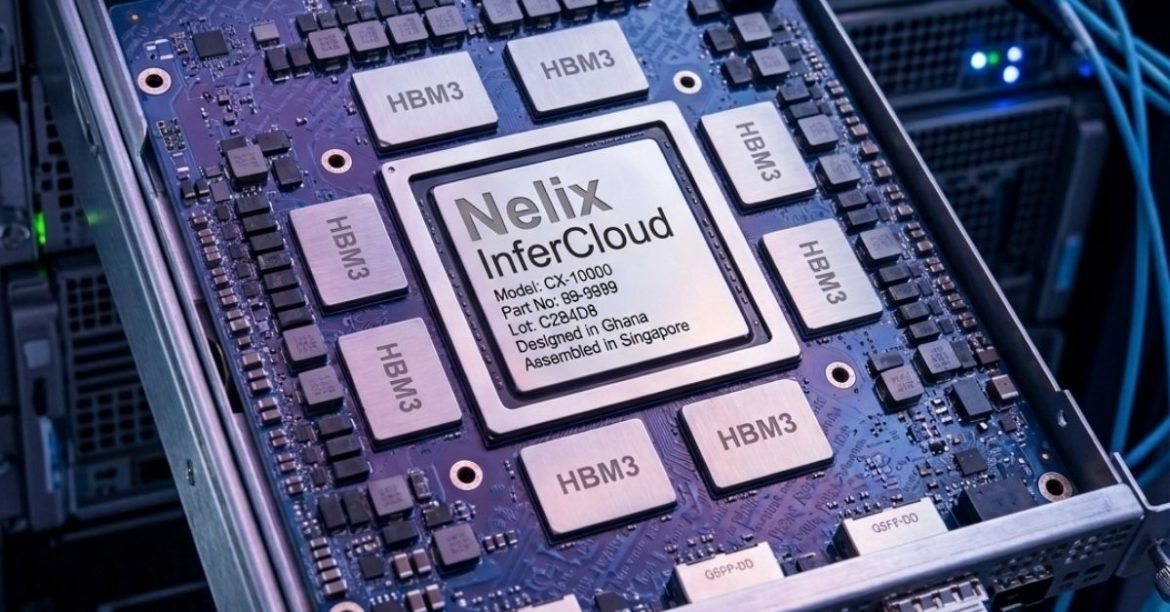
Recognizing these systemic barriers was the catalyst for Nelix Chip Design Ltd., a fabless semiconductor company founded on the premise that Africa cannot achieve durable digital or economic resilience while operating on “black-box” hardware designed for temperate, high-connectivity environments.
Founded by Dr. Michael Apasiku, Nelix is supported by engineers with experience from Intel, AMD, NVIDIA, Texas Instruments, and Microchip Technology. The company is building indigenous semiconductor capability for critical African infrastructure, moving beyond the “app economy” to address the underlying circuitry on which Africa’s digital future will rest, with silicon designed for African operating conditions and engineered to world-class standards.
Nelix’s advantage lies in combining world-class semiconductor experience with architectures designed specifically for African operating realities.
Central to that mission is hardware security. Traditional approaches rely on cryptographic keys stored in conventional memory, which can be extracted or cloned. Nelix, by contrast, designs chips with a unique, unclonable identity derived from nanoscale manufacturing variation, effectively a silicon fingerprint. The Physical Unclonable Function (PUF) engine derives device-unique cryptographic material from natural silicon variation rather than storing static keys in conventional memory.
Physical tampering attempts can disrupt the device’s trusted state or trigger hardware protections, making intrusion attempts self-evidencing. By moving security protocols directly into the physical hardware via this hardware root of trust, Nelix is working to secure Africa’s critical infrastructure from the inside out.
This hardware root of trust has its most immediate application in African energy infrastructure, where revenue integrity and grid resilience are national-scale challenges.
Publicly reported estimates suggest that distribution and commercial losses in several African markets run from roughly 20 percent to over 30 percent of dispatched electricity. In Nigeria, industry estimates indicate that aggregate technical, commercial, and collection losses approach 50 percent, with meter tampering and theft alone valued by the Nigerian Electricity Regulatory Commission at roughly ₦150 billion (about US$390 million) per year.
In Ghana, various market reports indicate that the Electricity Company of Ghana collects only around 62 percent of power revenue, contributing to billions of dollars in sector arrears.
Through Nelix’s SecureGrid™ platform, PUF-based smart meters are engineered to be significantly more resistant to the bypass and fraud techniques that currently plague regional grids, a level of integrity that is increasingly a prerequisite for the bankability of African utilities and for protecting the revenue meant to fund renewable energy transitions.
The shift toward secure local compute infrastructure also addresses the inherent limitations of cloud-first AI in regions where high-speed internet remains inconsistent.
For a smallholder farmer needing real-time crop-disease detection, or a healthcare worker in a remote clinic requiring rapid AI diagnostics, a low-latency connection to a data center in Europe is effectively non-functional. Through Nelix’s InferEdge™ platform, on-device AI inference is enabled by embedding optimized compute directly into the chip.
Designed for edge deployment, this architecture delivers inference latency in milliseconds rather than seconds, reduces reliance on continuous internet connectivity, and makes AI practical in environments with limited or intermittent network infrastructure.
The environmental cost of the status quo is equally significant. Global chip incumbents design for air-conditioned data halls, yet African hardware must operate in ambient temperatures that frequently exceed 40°C across the Sahel and coastal West Africa, well beyond the commercial operating envelope of most imported silicon.
Nelix is engineering silicon with localized thermal resilience and energy-aware scheduling, allowing a chip to pause and resume operations from its last saved state during a power brownout. This ruggedization extends the lifecycle of devices that would otherwise fail under the continent’s rigorous environmental and electrical stresses, reducing e-waste and lowering total cost of ownership for operators.
The implications of this shift extend to national security and long-term economic competitiveness. As African nations advance the goals of the African Continental Free Trade Area (AfCFTA) and the African Development Bank’s broader AI agenda, indigenous semiconductor capacity ensures that critical infrastructure, from defense systems to national ID registries, is not exposed to kill switches or data backdoors embedded in foreign silicon.
As Africa digitizes payments, energy, identity, mobility, and AI services, demand for secure localized compute infrastructure will only accelerate.
Nelix is currently advancing prototype development, ecosystem partnerships, and stakeholder engagement across secure infrastructure and AI systems. Its phased technical roadmap begins with FPGA-based validation of the SecureGrid™ and InferEdge™ architectures before transitioning toward production silicon, with parallel workstreams on talent development, regional IP ownership, and supply-chain readiness across the continent.
Since its inception in Accra, Ghana, Nelix has been building indigenous engineering capacity, creating high-skilled jobs, and anchoring locally owned semiconductor IP. This intellectual property is natively resilient to the continent’s climatic and electrical volatility, and it strengthens Africa’s position in the global value chain.
Africa’s next digital era will not be secured by software alone. It will depend on a resilient compute stack designed for local realities; infrastructure that creates jobs, builds indigenous IP, and anchors long-term economic competitiveness. Nelix aims to help build that foundation. The next phase of Africa’s digital transformation will be shaped not only by software platforms, but by who designs the silicon beneath them.
“Africa cannot build a resilient digital economy on chips designed by someone else. The AI systems powering African fintech, healthcare, and education should run on chips designed by African engineers, for African conditions.” ~ Dr. Michael Apasiku, CEO & Co-Founder, Nelix Chip Design Ltd.


