

The intensification of military conflict between Iran, the United States and Israel in late February 2026 has sharply elevated the risk of global energy supply disruptions, with potential spill‑over effects for African economies heavily dependent on imported fuels and maritime trade.
The crisis, triggered by coordinated strikes on Iranian strategic infrastructure and followed by retaliatory Iranian attacks across the Gulf, has throttled vessel movements through the Strait of Hormuz, a strategic oil transit chokepoint, and renewed threats against shipping in the Red Sea and Suez Canal corridor; compounding inflation pressures and logistical costs for economies from Lagos to Mombasa.
The Strait of Hormuz, a narrow waterway between Iran and Oman, is central to the global petroleum trade. In 2025, roughly 20 million barrels per day (b/d) of crude oil transited the strait, amounting to an estimated around 20% of global oil consumption and more than a quarter of all seaborne oil trade, according to data from the U.S. Energy Information Administration and related industry estimates.
Read also: Nairobi city floods expose Kenya’s urban planning failures amid intensifying climate risks
14.2 million b/d of this traffic consisted of crude oil, with additional flows of refined products, liquefied petroleum gases and condensates moving through the same channel. Disruptions in this corridor therefore carry immediate repercussions for markets worldwide, since there are no readily scalable alternative routes for such volumes.
The strategic importance of Hormuz was underscored in early March when maritime insurers withdrew or sharply elevated war‑risk premiums for Tankers approaching the strait, and major shipping groups suspended transits. Brent crude prices responded swiftly, climbing past $107 per barrel amid widening market risk premia, up sharply from about $70–80 in late February, reflecting both real and perceived supply constraints.
For many African countries, these price changes are not abstract figures: most are net importers of refined fuels, meaning that higher global benchmarks translate directly into larger import bills and stress on foreign exchange reserves.
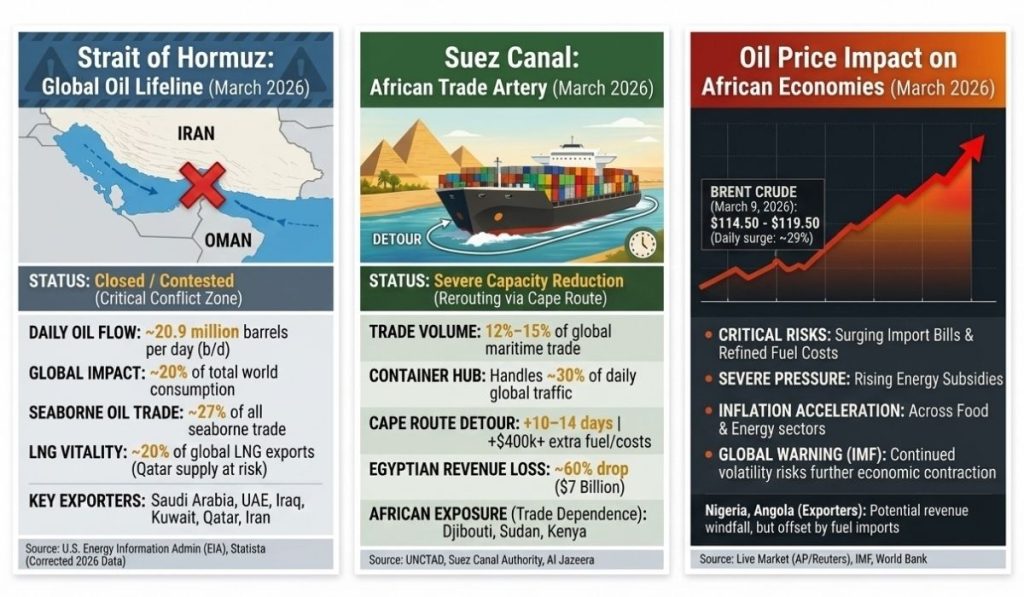
African states’ exposure to spiking oil prices varies with their production and refining profiles. Oil exporters such as Nigeria, Angola and Algeria may see fiscal accounts buoyed by higher export revenues even as prices climb, but net importers across East and West Africa, including Kenya, Senegal and Uganda, face tighter policy choices.
Elevated energy costs typically feed into broader cost structures: diesel used in transport and power generation becomes more expensive, freight charges rise and, crucially, food prices climb as the cost of agricultural inputs and logistics increases.
The International Monetary Fund has previously documented how energy price shocks have expanded budget deficits in sub‑Saharan Africa through subsidies and higher import costs.
Compounding energy price risk is the vulnerability of the Red Sea–Suez Canal maritime corridor. Groups aligned with Tehran, including the Houthi movement in Yemen, have intensified attacks on commercial shipping, forcing many carriers to reroute around the Cape of Good Hope. The Suez Canal itself accounts for around 12–15% of global maritime trade and nearly 30% of container traffic, and is a crucial conduit for goods moving between Asia, Europe and Africa.
Read also: Egypt’s green canal gambit: How mega-ports will reshape Africa’s sustainable trade routes
Egyptian authorities estimated that security disruptions in 2024–25 reduced canal revenues by nearly 60%, representing an annual shortfall in foreign exchange amounting to billions of dollars. According to the United Nations Conference on Trade and Development, some East African countries are particularly exposed, up to one‑third of Djibouti’s external trade and more than 10% of Kenya’s and Tanzania’s trade flows transit the Suez route, with Sudan’s exposure even higher.
The potential for a “double chokepoint shock”, one affecting both the Strait of Hormuz and the Suez Canal, would impose simultaneous energy and logistical strains on African economies. Around 80% of global merchandise trade moves by sea, meaning that larger freight bills and longer transit times would be transmitted through supply chains, exacerbating inflationary pressures on imported goods ranging from agricultural fertiliser to industrial inputs.
For countries dependent on imported cereals and foodstuffs, increased freight costs and oil prices risk heightened food insecurity and fiscal stress.
Currency markets may also react. Higher oil import costs increase demand on foreign exchange reserves, which in turn can weaken local currencies, a dynamic already visible in some African currencies as global risk sentiment deteriorates. The World Bank and IMF have repeatedly flagged such pressures as key determinants of inflation and debt sustainability in low‑income and emerging economies.
For policymakers across Africa, the current crisis underscores a persistent vulnerability: the heavy reliance on global maritime energy corridors and commodity price benchmarks that are susceptible to geopolitical shocks. While some countries are advancing plans to expand domestic refining capacity and diversify energy sources, such transitions are medium‑ to long‑term endeavours.
In the short term, the interplay between heightened Middle Eastern tensions and global energy markets is likely to shape fiscal strategies, inflation trajectories and external balances across the continent well into 2026.
Engage with us on LinkedIn: Africa Sustainability Matters