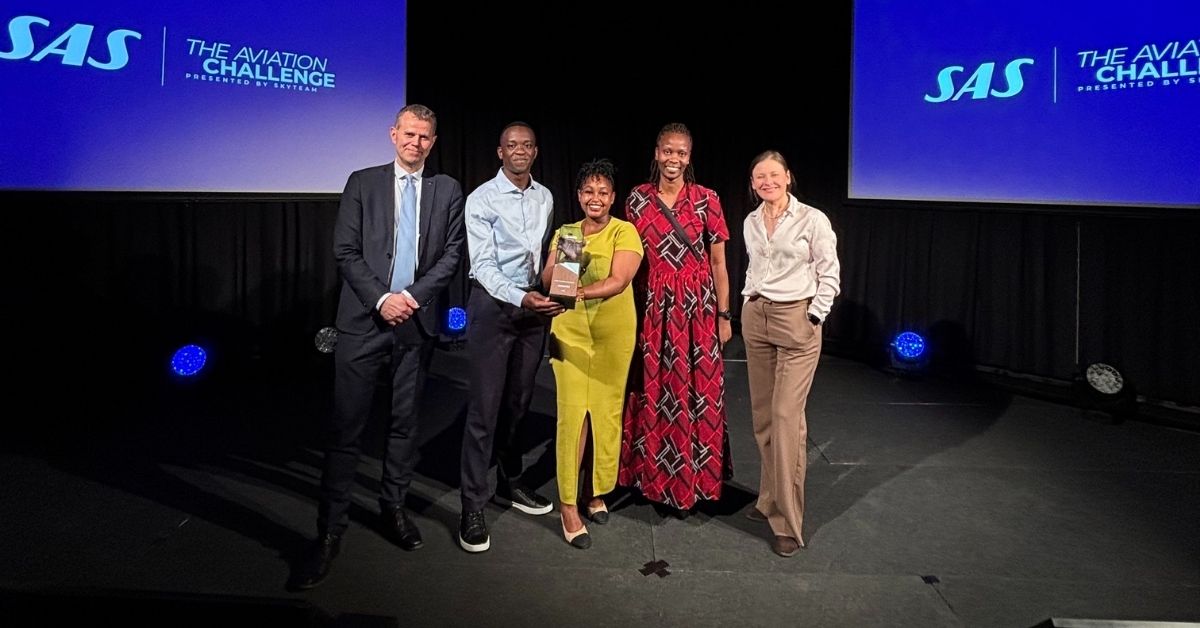

Jambojet, a Kenya-based low-cost airline, has been awarded the “Most Compelling Story” at The Aviation Challenge in Denmark, recognising a collaboration between the airline and Plastiki Rafiki, a people-driven circular economy initiative that transforms plastic waste into practical products while creating learning opportunities for students and income for community artisans. The recognition was announced in Copenhagen, where airlines from across the world gathered to showcase sustainability solutions tested within their operations and communities.
The story behind the award began in Nairobi’s informal settlements, university workshops, airport facilities and coastal cleanup sites. Over several months, students working with Plastiki Rafiki partnered with artisans from Mathare to collect and upcycle more than 1,000 kilograms of plastic waste into everyday items such as keychains and fridge magnets. The raw material came from multiple sources; beach clean-ups along Kenya’s coastline, discarded plastics from airport operations, and contributions from Jambojet staff, reflecting a model in which sustainability is embedded across communities, institutions and corporate systems.
Read also: Kenya Airways flies first African route, from Nairobi to Cape Town, on sustainable fuel
For Kenya, where plastic pollution remains a visible and persistent challenge despite regulatory efforts such as the ban on plastic carrier bags, the initiative speaks to a broader gap between policy and practice. According to the United Nations Environment Programme, Africa generates more than 17 million tonnes of plastic waste annually, with only a fraction recycled. In Kenya alone, urban centres like Nairobi and Mombasa produce thousands of tonnes of plastic waste each day, much of it ending up in landfills, waterways and informal dumpsites. Against this backdrop, the Jambojet–Plastiki Rafiki collaboration represents a practical attempt to connect environmental action with economic opportunity.
What distinguished the initiative within the Aviation Challenge was its integration of social, environmental and operational realities. Students involved in the project gained hands-on exposure to sustainability beyond theory, learning how waste streams can be mapped, processed and converted into marketable products. Artisans in Mathare, many of whom operate within precarious informal economies, accessed new income streams through the production of upcycled goods. For the airline, the initiative provided a pathway to rethink waste generated within its own operations and to engage staff in sustainability beyond corporate reporting frameworks.

The Aviation Challenge itself has emerged as a global platform where airlines are required to design and implement sustainability initiatives within a defined period, often under resource constraints. Unlike traditional corporate social responsibility programmes, the challenge emphasises experimentation, cross-sector collaboration and measurable impact. Jambojet’s recognition in Copenhagen therefore signals more than a symbolic award; it reflects a growing expectation that African companies should articulate sustainability in ways that are locally grounded yet globally credible.
The implications extend beyond aviation. Across Africa, infrastructure sectors, from transport and energy to water and urban development, are under pressure to demonstrate environmental responsibility while responding to rapid population growth and urbanisation. The African Development Bank estimates that the continent faces an annual infrastructure financing gap of over $100 billion. At the same time, climate-related risks are intensifying, with African economies disproportionately exposed to floods, droughts and extreme weather events despite contributing minimally to global emissions.
Read also: EU commits $4.3M to help African states develop sustainable aviation fuels
Within this context, circular economy models like the one demonstrated through Plastiki Rafiki offer a practical lens through which sustainability can be understood not as an abstract concept, but as an economic strategy. By turning waste into value, such initiatives reduce environmental pressure while creating livelihoods. Countries such as Rwanda and South Africa have begun integrating circular economy principles into national strategies, while cities like Lagos and Accra are experimenting with community-based recycling enterprises. However, many of these efforts remain fragmented, underfunded or disconnected from mainstream corporate and policy frameworks.
Jambojet’s project illustrates how corporate actors can bridge this gap by working with grassroots innovators rather than operating in isolation. It also raises questions about scalability. While 1,000 kilograms of plastic diverted from landfill is modest compared to national waste volumes, the underlying model, linking corporate waste streams, educational institutions and informal sector artisans, offers a replicable framework. If adopted across multiple industries and cities, such collaborations could gradually shift how African economies manage waste and resource efficiency.

The recognition in Copenhagen also highlights the changing nature of corporate credibility in Africa. Investors, development partners and regulators increasingly scrutinise not only financial performance but also environmental and social impact. For airlines, which face mounting pressure to decarbonise and improve environmental practices, initiatives rooted in local realities may become as important as technological innovations such as sustainable aviation fuel or fleet modernisation.
Ultimately, the Jambojet-Plastiki Rafiki story is not about an award ceremony in Europe, but about a quiet experiment in Kenya that connects plastic waste, student learning, informal livelihoods and corporate responsibility. It reflects a broader shift in how sustainability is being defined across Africa, not as a distant policy goal, but as a set of everyday choices shaped by communities, businesses and institutions navigating complex economic and environmental realities.
As African economies continue to grapple with the dual pressures of development and climate risk, such stories may offer clues about where sustainable growth will actually come from: not only from large-scale infrastructure projects or international financing pledges, but from local innovations that reimagine waste, work and value in tangible ways.
Engage with us on LinkedIn: Africa Sustainability Matters