


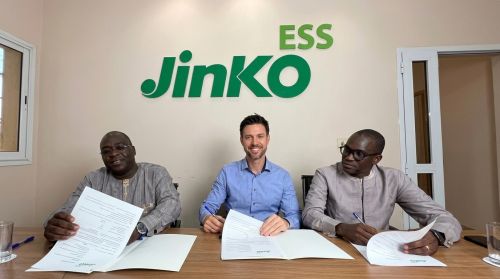
Chinese energy storage provider Jinko ESS has agreed to supply 34 battery storage systems with a combined capacity of 18 megawatt-hours (MWh) for a telecommunications project in Mali, adding to investment aimed at reducing diesel dependence across Africa’s mobile networks.
Announced on 17 October 2026, the agreement covers Jinko ESS’s SunGiga G2 Plus systems. The company, a subsidiary of solar manufacturer Jinko Solar, has not disclosed the project partner, contract value or installation sites. The announcement comes as telecommunications operators and infrastructure providers seek more reliable and cost-effective ways to power network equipment in markets where grid electricity can be inconsistent and fuel delivery expensive.
The deal reflects a wider shift in how energy is managed across Africa’s telecommunications sector. Mobile towers require continuous power to maintain voice and data services, including in rural and remote areas where grid connections may be weak or unavailable. Diesel generators have traditionally filled that gap, but their operating costs, maintenance requirements and exposure to fuel supply disruptions have encouraged companies to consider solar generation and battery storage.

According to a July 2025 analysis by CrossBoundary Energy, approximately 70% of Africa’s 500,000 telecommunications towers rely on diesel. At remote sites, fuel can account for between 30% and 60% of operating expenditure. The cost of transporting fuel adds further pressure, particularly where sites are difficult to reach or supply routes are disrupted. These expenses can make energy one of the most significant controllable costs in operating a telecommunications network.
Battery storage can help address some of these challenges by storing electricity generated from solar panels or drawn from the grid when available, then supplying power when generation falls or the grid fails. In hybrid systems, batteries can reduce the hours diesel generators need to operate, while solar generation can lower the amount of fuel consumed. The extent of the savings depends on local solar resources, electricity demand, battery configuration, generator efficiency and the reliability of existing power infrastructure.
Jinko ESS has not disclosed whether the 34 SunGiga G2 Plus systems will be installed alongside new solar capacity, integrated into existing hybrid power systems or deployed as part of a broader network upgrade. Without details on the sites and system configuration, the project’s expected reduction in diesel consumption, operating costs and emissions cannot yet be quantified.
The agreement comes amid a series of investments in renewable energy for Mali’s telecommunications infrastructure. In March 2025, the Facility for Energy Inclusion (FEI) and Norfund signed financing agreements totalling US$40 million with Communication and Renewable Energy Infrastructure (CREI), an asset management company specialising in energy infrastructure for telecommunications. The financing supports CREI’s Telecom Energy Service Company model, under which it develops, builds, operates and maintains energy assets for mobile network operators.
CREI said the wider investment programme would modernise telecommunications tower infrastructure in Mali through hybrid renewable energy systems incorporating solar and battery storage. The approach allows network operators to obtain energy services without necessarily financing and managing all the underlying power equipment themselves. For providers of distributed energy infrastructure, such arrangements can create opportunities to aggregate sites and deliver energy solutions at scale.
Further financing followed in November 2025, when the International Finance Corporation (IFC) and the West African Development Bank (BOAD) announced an €80 million financing package for Orange Mali. The investment is intended to support the installation of 300 new 4G towers, expand fibre connectivity and improve access to digital services, particularly in rural areas. As part of the project, Orange Mali is expected to replace diesel generators with solar-powered systems, with the IFC estimating that the change will reduce carbon dioxide emissions by more than 8,000 tonnes annually.
These investments demonstrate how energy infrastructure and digital connectivity are increasingly linked. Reliable mobile networks support financial services, education, business transactions and access to information. Where electricity supply is unstable, network operators must invest in backup power and fuel logistics to maintain service. Those costs can affect the commercial viability of expanding coverage into remote communities, where average revenues per user may be lower and infrastructure more expensive to operate.
The transition to solar and battery-based systems is therefore not only an emissions issue. It is also a question of network resilience and the economics of extending digital services. Lower fuel consumption can reduce exposure to price volatility and delivery delays, while battery systems can provide a buffer against grid interruptions. However, energy storage introduces its own costs, including equipment procurement, replacement over time, maintenance and the need for appropriate system monitoring.
For investors and equipment suppliers, the opportunity lies in delivering solutions that remain reliable under local operating conditions. Telecom sites can differ considerably in electricity demand, climate, security risks and accessibility. Systems installed in remote locations must be designed for limited maintenance access and must maintain performance over years of continuous operation. Procurement price alone will not determine the long-term economics; equipment durability, warranties, service capacity and battery lifecycle costs will also matter.

Mali’s investment activity also reflects the broader energy challenges facing the Sahel, where difficult operating environments can increase the cost of delivering essential infrastructure. Renewable energy projects must account for security, transport, financing and maintenance alongside the technical requirements of power generation and storage. Partnerships between telecommunications operators, energy service companies, development finance institutions and technology suppliers can help distribute those responsibilities and mobilise capital for projects that may otherwise be difficult to finance.
For Jinko ESS, the 18 MWh agreement provides another opportunity to deploy battery storage in a sector where power reliability has direct consequences for service continuity. But the absence of disclosed project details makes it too early to assess the deal’s precise contribution to Mali’s energy transition or the scale of its expected savings.
The broader direction is clearer: as mobile data demand and network coverage expand, telecommunications companies are under pressure to make their energy systems more efficient and dependable. The next measure of progress will be whether solar and battery investments deliver sustained reductions in diesel consumption and operating costs while maintaining the network availability on which businesses and communities increasingly depend.


