
Table of Contents
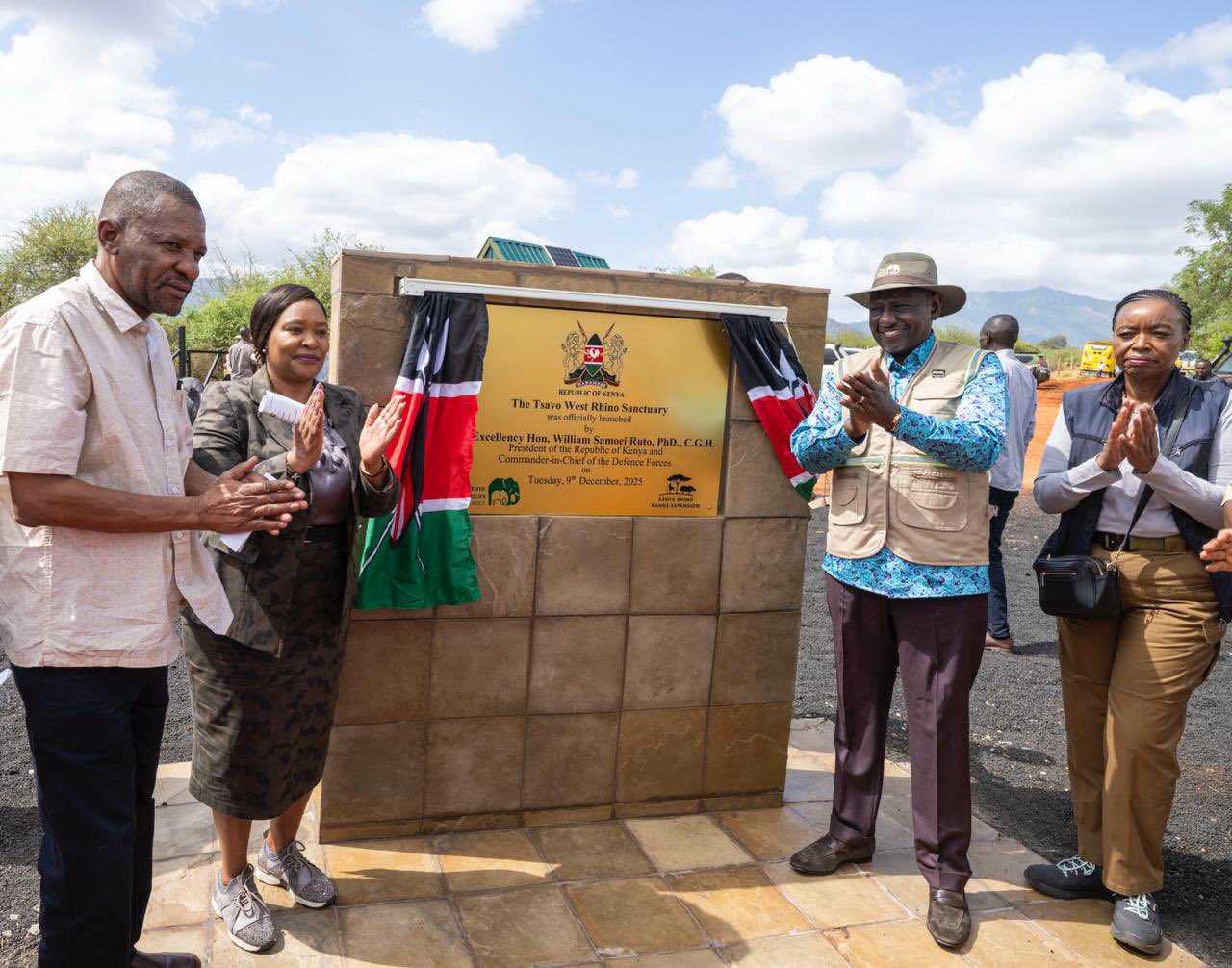
Kenya has taken a monumental step in global wildlife conservation with the official opening of the expanded Tsavo West Rhino Sanctuary, now the largest rhino sanctuary on the planet. President William Samoei Ruto presided over the launch, calling it a strategic investment that unites wildlife protection, climate resilience, national security, and sustainable development.

Covering 3,200 square kilometres, the sanctuary represents a dramatic scale-up from the former 92 km² Ngulia Rhino Sanctuary, which had exceeded its ecological carrying capacity for years. The new landscape creates a more sustainable home for one of the world’s most threatened species: the Eastern black rhino.
A founder population of 200 Rhinos
The expanded sanctuary merges 150 black rhinos from the former Ngulia Sanctuary with 50 animals from the Tsavo West Intensive Protection Zone, creating a genetically stronger founder population of 200 black rhinos. This is now Kenya’s largest intact black rhino population and one of the most significant on the African continent.
Read also: Urgent action needed as West African Lion population faces critical decline
Kenya currently hosts approximately 2,000 rhinos, including more than 1,000 black rhinos and 1,000 southern white rhinos. The country protects 78 percent of the global Eastern black rhino population, underscoring its central role in the species’ survival.
For decades, overstocked sanctuaries have constrained rhino recovery nationwide. Ngulia alone held more than 2.5 times its ecological capacity, limiting breeding, increasing conflict, and reducing calf survival. The expanded Tsavo landscape directly addresses these challenges.

Restoring a historic stronghold
President Ruto of Kenya highlighted the ecological significance of the Tsavo region, which once supported over 8,000 black rhinos in the 1970s. A devastating wave of poaching reduced the population to fewer than 20 by 1989, prompting the establishment of the Kenya Wildlife Service (KWS).
“The restoration of Tsavo as a continental stronghold for Africa’s rhinos is both a national duty and a global responsibility,” the President said, noting that the sanctuary safeguards natural heritage while stimulating local economic opportunities.
Science-driven planning and advanced wildlife security
The transition from a compact sanctuary to a fully connected landscape followed rigorous ecological and technical preparation. Kenya undertook:
- A full Environmental and Social Impact Assessment
- Independent risk reviews
- Broad community consultations across Taita Taveta
- The world’s largest recorded rhino monitoring and tagging operation
During this operation, 90 rhinos were immobilised and 89 fitted with modern tracking devices, enabling real-time movement, security, and health monitoring.

KWS Director General, Professor Erustus Kanga, said the upgraded protection system integrates AI-enabled surveillance cameras, drone patrols, a fixed-wing rapid response aircraft, enhanced LoRaWAN and VHF tracking, encrypted digital radio networks, and extensive ranger infrastructure.
Over 250 km of new fencing, 40 ranger houses, upgraded access roads, cutlines, and water points have been constructed to enable effective management.
Through the Kenya Rhino Range Expansion (KRRE) Initiative, more than USD 4.7 million has been invested in protection, monitoring, and long-term ecological planning, making Tsavo one of Africa’s most technologically advanced wildlife security landscapes.
KRRE Chief Executive Officer, Jamie Gaymer, said successful conservation is “nation building,” adding that each rhino protected enhances both environmental resilience and economic stability.
Read also: IUCN confirms extinction of Slender-billed Curlew, once common across North Africa
Accelerating Rhino population recovery
The expanded sanctuary is expected to raise Kenya’s annual black rhino population growth rate from 5 percent to 8 percent, advancing the country toward its national targets of 1,450 rhinos by 2030 and 2,000 by 2037.

Improved habitat size, reduced territorial conflict, and stronger genetic diversity are anticipated to boost breeding success and long-term viability.
Kenya’s Cabinet Secretary for Tourism and Wildlife, Hon. Rebecca Miano, noted that the sanctuary aligns with the Kenya Rhino Range Expansion Strategy, the Black Rhino Recovery and Action Plan, and the National Wildlife Strategy 2030. She emphasized that community benefit-sharing remains central to conservation in the Tsavo region.

Economic transformation through conservation
Beyond ecological gains, the sanctuary is poised to stimulate significant economic activity. Job opportunities have emerged in surveillance, ranger deployment, construction, mapping, monitoring, and logistics.
By 2030, the initiative is projected to generate more than 18,000 jobs and more than USD 45 million in tourism and conservancy-related revenue.
The President affirmed that the sanctuary’s opening represents a transformative moment not only for Kenya, but for global conservation efforts. “This expansion secures our heritage and strengthens our contribution to global biodiversity,” he said.
A global benchmark for large-scale conservation
With Tsavo West now home to the world’s largest rhino sanctuary, Kenya has set a new benchmark in science-based, technologically enhanced, landscape-level conservation. The initiative demonstrates how biodiversity protection, climate action, and economic growth can reinforce each other when grounded in long-term planning and national commitment.
The newly opened sanctuary places Kenya firmly at the forefront of global rhino recovery, and signals what integrated conservation can achieve across Africa and beyond.
Read, press release by Kenya Wildlife Service.
Engage with us on LinkedIn: Africa Sustainability Matters
Engage with us on LinkedIn: Africa Sustainability Matters