


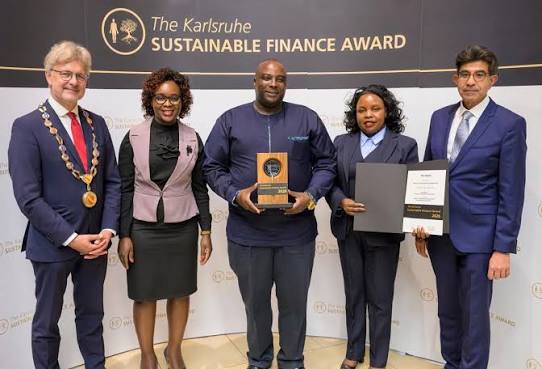
Kenya’s Agricultural Finance Corporation (AFC) has received the Outstanding Business Sustainability Achievement award at the 2026 Karlsruhe Sustainable Finance Awards in Germany, highlighting the growing role of sustainability standards, climate-risk management and responsible lending in agricultural development finance. The recognition, presented at the Global Sustainable Finance Conference in Karlsruhe on August 27, comes as Kenya’s agriculture sector faces rising climate exposure, financing constraints and pressure to direct more capital towards resilient production and inclusive value chains.
The award was presented by Karlsruhe Lord Mayor Dr Frank Mentrup and Arshad Rab, Chairman of the International Council of Sustainability Standards for Value-Driven Financial Institutions and Chief Executive of the European Organisation for Sustainable Development (EOSD). AFC Managing Director George Kubai received the award alongside Chief Finance and Investment Officer Betty Suge and Senior Credit Officer Junetapelin Karimi. According to the conference organisers, the 2026 event brought together development finance institutions, commercial banks, regulators and other investors to examine how capital can be mobilised into productive sectors, infrastructure and scalable investment opportunities.
 For Kenya, the significance of the recognition lies less in the award itself than in what it says about the changing requirements facing development finance institutions. Agriculture remains central to employment, food security, exports and rural incomes, but its financial performance is increasingly exposed to drought, floods, changing rainfall patterns, land degradation and disruptions to agricultural supply chains. Financing decisions therefore increasingly have to account for environmental and climate risks that can affect borrowers’ ability to produce, repay loans and maintain productive assets.
AFC said it has integrated climate-risk management into its operations and financing decisions and currently supports 213,740 active borrowers through an agricultural financing portfolio of about KES13 billion ($99 million). The corporation has also made environmental and social management screening mandatory for all loan applications, placing environmental considerations within the credit-assessment process rather than treating them as a separate corporate responsibility activity.
That approach reflects a wider shift in sustainable finance across Africa, where development lenders are increasingly expected to demonstrate how environmental and social safeguards influence the allocation of capital. For financial institutions, this can change the way agricultural projects are assessed, particularly where climate exposure threatens collateral values, cash flows or repayment capacity. For borrowers, it can also introduce additional requirements around land use, environmental management and resource efficiency.
AFC’s lending model includes several programmes aimed at sectors and communities that conventional finance can struggle to reach. Its DRIVE programme focuses on climate-smart financing for pastoral economies in arid and semi-arid counties, while the SAFER programme provides financing to micro, small and medium-sized enterprises with a focus on women- and youth-owned businesses. Its RK-FINFA programme channels green finance through savings and credit cooperative organisations to underserved rural communities and currently reaches 5,870 beneficiaries, 65% of whom are women, according to AFC.
The financing gap these programmes seek to address is particularly important in rural economies, where smallholders and agricultural enterprises often lack the collateral, financial records or predictable cash flows required by commercial lenders. Climate shocks can compound those constraints by increasing production volatility and weakening repayment capacity. Development finance can therefore play a role in absorbing some of the risk that commercial capital may otherwise avoid, provided the institutions involved maintain strong credit discipline and effective risk-management systems.
AFC has also linked its financing operations to environmental restoration. Under an environmental stewardship requirement, borrowers plant one tree for every KES10,000 advanced. The corporation says more than 1.49 million trees were planted by AFC, its clients and local communities across all 47 branch locations during the 2024/25 and 2025/26 financial years. The initiative aligns with Kenya’s national tree-growing agenda while linking lending activity to land restoration and carbon-reduction objectives.
The relationship between agricultural lending and environmental restoration is becoming increasingly relevant as Kenya seeks to strengthen the resilience of its food systems. The country has committed to restoring degraded landscapes and expanding tree cover, but implementation depends partly on whether environmental objectives can be integrated into economic activity at scale. Linking financing conditions to land-management practices provides one mechanism, although its long-term effectiveness will depend on monitoring, survival rates and whether farmers have sufficient incentives and resources to maintain restored landscapes.
The corporation has also reported an example of how risk-sharing mechanisms can mobilise considerably more agricultural investment than the initial public or development contribution. Through a $77,370 credit guarantee facility for climate-resilient irrigation, AFC says it mobilised KES161.8 million, or about $1.25 million, representing leverage of more than 16 times the guarantee amount. Such structures are important in markets where lenders may be reluctant to finance climate-resilient infrastructure because of perceived borrower or project risks.
For Africa’s wider sustainable-finance market, the case illustrates the importance of development finance institutions as intermediaries between policy objectives and private capital. The African Development Bank has similarly promoted the expansion of sustainable and circular finance mechanisms as governments seek to mobilise capital for productive sectors while addressing climate and development constraints. The challenge is not simply to label more loans as green or sustainable, but to establish credible systems for assessing risk, measuring outcomes and ensuring that financing reaches productive economic activity.
The Karlsruhe conference itself reflects that shift in priorities. Organised by the Association of National Development Finance Institutions in Member Countries of the Islamic Development Bank, the Association of African Development Finance Institutions, the Association of Development Financing Institutions in Asia and the Pacific and EOSD, the 2026 conference focused on the difficulty of getting sufficient capital into productive sectors and infrastructure despite large global pools of liquidity. Discussions centred on building investment-grade pipelines and strengthening development finance institutions so they can mobilise capital at greater scale.
That issue is particularly relevant to African economies, where infrastructure and productive-sector financing gaps remain significant while public budgets face competing demands. Agriculture sits at the intersection of these challenges because it requires investment not only in farm production but also in irrigation, storage, transport, processing, digital services and market infrastructure. Financing resilience at the farm level without addressing these wider systems can limit the economic returns from individual interventions.
The evolution of AFC’s sustainability strategy also points to a broader institutional question. Development finance institutions increasingly face expectations from governments, investors and international partners to demonstrate measurable environmental and social performance alongside financial results. That requires stronger data systems, internal expertise, safeguards and reporting processes. AFC says it has responded by establishing the AFC E-Academy, a digital learning platform covering ESG priorities, climate finance and responsible business practices, while digitising loan processing and procurement to reduce paper use and operational emissions.
For Kenya, the more consequential test will be whether sustainability-linked finance can translate into stronger agricultural productivity and resilience without increasing the cost or complexity of credit for smaller borrowers. Climate-smart finance has to remain commercially workable for farmers while also giving lenders sufficient protection against increasingly volatile environmental conditions.
 The Karlsruhe award therefore provides a snapshot of a larger transformation in African development finance. Sustainability is moving deeper into the institutions that determine where capital flows, how borrowers are assessed and which economic activities receive support. For Kenya’s agricultural sector, where climate exposure and financing constraints are closely connected, the integration of those considerations into development lending could influence the resilience of farms, rural enterprises and agricultural value chains. The longer-term significance will depend not on international recognition alone, but on whether sustainability standards improve the quality, reach and economic resilience of the capital deployed into the real economy.


