


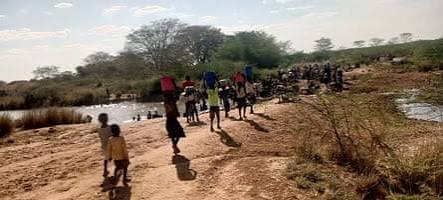
In Malawi’s lower Shire River basin, worsening food insecurity is pushing households to harvest wild water-lily tubers from increasingly hazardous wetlands as high maize prices, costly agricultural inputs, climate shocks and constrained public food supplies reduce access to basic food. The development, reported in Chikwawa district, illustrates how a combination of agricultural disruption, weak purchasing power and pressure on food-distribution systems can turn climate and economic shocks into an immediate livelihood and public-health risk.
Communities along the Shire River have traditionally harvested nyika, the edible tuber of the water lily Nymphaea petersiana, during severe food shortages. But according to reporting from the lower Shire, the practice has become more frequent and commercial as households that once depended primarily on maize struggle to afford it. Families collect the tubers from marshes and sell them in local markets, while others process them into a porridge ingredient.
The pressure is being intensified by the cost of maize. From earlier reports that a 50-kilogram bag was selling for between 69,000 and 72,000 Malawian kwacha in some open markets, compared with 39,500 kwacha for a 50-kilogram bag sold through the state-backed Agricultural Development and Marketing Corporation, or ADMARC, in July. Public sales were rationed, limiting the ability of households to rely on subsidized supplies.

Independent market data shows that the price pressure has been broad-based. According to the International Food Policy Research Institute’s October 2026 maize market report, retail maize prices increased by 7% during the month across monitored markets despite continued imports from neighbouring countries. The average national price reached 1,072 kwacha per kilogram, up from 1,001 kwacha in September.
The situation reflects a wider deterioration in household purchasing power rather than simply a shortage of maize. The International Food Policy Research Institute has linked the latest price increases to rising demand and continued pressure in domestic markets, while maize prices are expected to rise further through the 2026/27 lean season as households increasingly depend on markets for food.
Agricultural production has also been affected by the cost of farming. Delayed rainfall and crop damage associated with El Niño conditions contributed to food losses in southern Malawi, while high fertilizer and fuel costs making it more difficult for smallholders to maintain production. For households dependent on rain-fed agriculture, a poor harvest can therefore translate quickly into reduced income, depleted food stocks and greater dependence on markets.
The scale of the food-security problem is reflected in national assessments. Malawi’s latest Integrated Food Security Phase Classification analysis estimates that 1.9 million people experienced Crisis-level acute food insecurity between April and September 2026. The projection for October 2026 to March 2027 rises to about 2.6 million people, or 14% of the analyzed population, as households enter the lean season with weaker purchasing power and declining food stocks.
Public institutions are attempting to rebuild food reserves, the government allocated 60 billion kwacha for ADMARC to procure 65,000 tonnes of maize and other crops during the June-September marketing season, alongside an additional 100 billion kwacha allocation for maize purchases intended to replenish the Strategic Grain Reserve. ADMARC and the National Food Reserve Agency are also expected to maintain stocks during the lean season.
The challenge, however, is not only how much maize is available but how effectively it can be purchased, stored and moved to households at affordable prices. Malawi’s dependence on public procurement, private traders and imports means that foreign-exchange availability, fuel costs, transport expenses and the financial position of state marketing institutions can all affect the price ultimately paid by consumers.

Climate variability is adding another layer of risk in the lower Shire. According to Malawi’s government economic reporting, Lake Malawi recorded water levels of 475.86 metres above sea level in April 2025, with levels still around 475.30 metres in January 2026. The government has also highlighted the role of the Kamuzu Barrage in regulating flows from Lake Malawi into the Shire River for hydropower and downstream water demands.
In the lower Shire, changes in river and marsh conditions can affect both access to food and the safety of traditional livelihood activities. The Guardian reported that higher water levels have altered the areas where communities collect nyika, increasing exposure to crocodiles and deeper river channels. District officials also cited limited vehicles and field equipment as constraints on their ability to respond to growing risks.
For Malawi, the immediate issue is food access, but the wider policy question is whether agricultural, social-protection and climate-adaptation systems can absorb repeated shocks before households are forced into increasingly precarious coping strategies. The country’s experience also highlights a broader vulnerability across climate-exposed African economies: a disruption to rainfall can become a food-price problem, a food-price problem can become an income problem, and an income problem can eventually place pressure on public institutions and essential infrastructure.
The lower Shire communities therefore offer a measure of how well Malawi’s food-security system is functioning beyond official reserve figures. When households turn to a wild food once associated mainly with severe shortages, the signal is not simply that food is scarce. It indicates that the gap between what the formal food system can provide and what households can afford is becoming increasingly important to the country’s resilience.


