


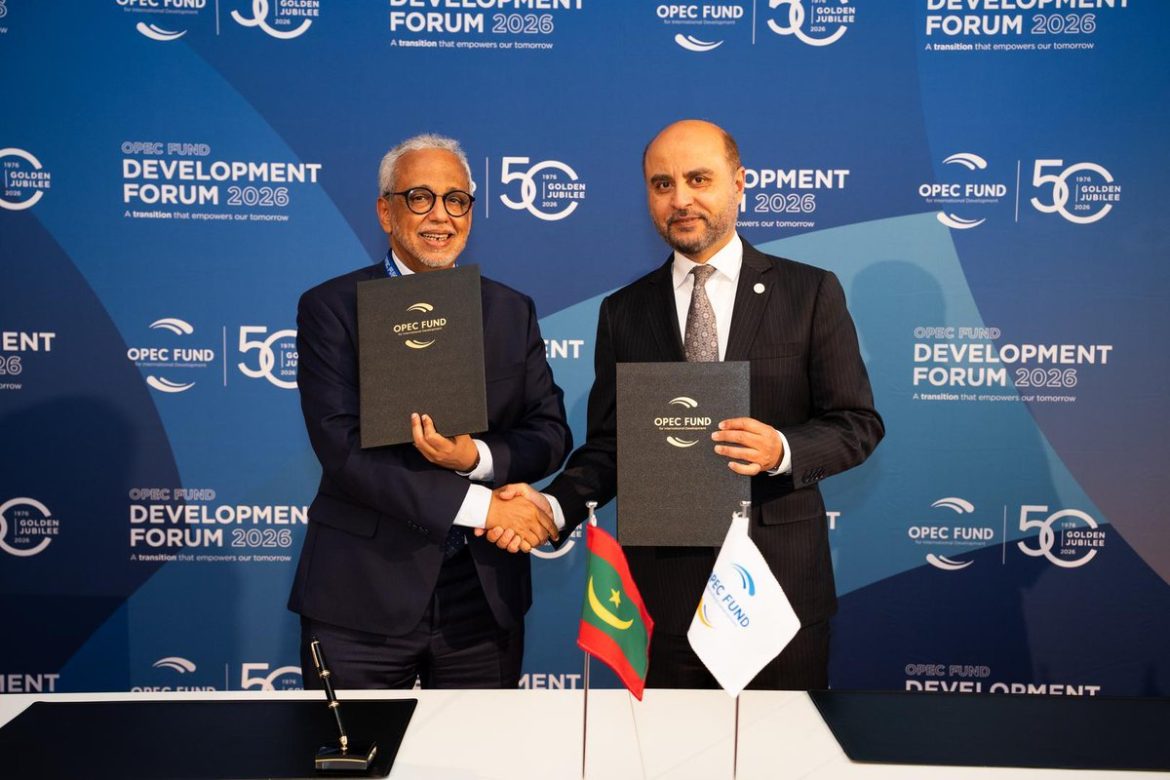
Mauritania has secured $195 million in financing from the OPEC Fund for International Development to support climate-resilient infrastructure, strengthen food security and expand social protection programs, as the West African nation seeks to address mounting economic and environmental pressures that threaten long-term development.
The financing package, signed in Vienna on June 23, consists of a $180 million Country Partnership Framework covering the 2026–2029 period and a separate $15 million loan dedicated to strengthening social protection systems. According to Mauritania’s Ministry of Economy and Finance, the agreement is designed to support structural economic transformation and enhance resilience rather than provide short-term fiscal assistance. The commitment comes at a critical moment for Mauritania, one of the Sahel region’s most climate-vulnerable economies. While the country has recorded periods of economic growth driven largely by mining and extractive industries, policymakers continue to face persistent challenges related to employment, poverty reduction, food security and climate adaptation.
Under the new partnership framework, funding will be directed toward strategic sectors considered essential to the country’s long-term development agenda. These include climate-resilient infrastructure, agricultural value chains, food security initiatives and rural economic development programs. Authorities say the investments are intended to reduce vulnerability to environmental shocks while creating new opportunities for economic diversification and job creation. The OPEC Fund, a multilateral development finance institution headquartered in Vienna, has increasingly expanded its engagement across Africa as governments seek financing for infrastructure, energy, agriculture and climate adaptation projects. The institution has financed projects in more than 125 countries and has become an important source of concessional and development-oriented capital for emerging economies.
For Mauritania, the emphasis on climate resilience reflects growing concern over the economic impacts of climate change across the Sahel, one of the world’s most environmentally stressed regions. According to the World Bank’s 2025 Country Climate and Development Report, Mauritania faces a dual challenge of accelerating economic transformation while adapting to increasingly severe climate risks. The report estimates that climate-related impacts could reduce the country’s gross domestic product by approximately 9.3% by 2050 if adaptation measures are not scaled up. The projected losses are linked to declining agricultural productivity, increased desertification, water scarcity, infrastructure degradation and reduced labour productivity caused by rising temperatures.
Agriculture and livestock remain particularly vulnerable. Although the sectors contribute a relatively modest share of national GDP compared with mining, they support the livelihoods of a significant portion of the population, particularly in rural communities. Variability in rainfall patterns, prolonged droughts and land degradation have increased pressure on farming and pastoral systems across much of the country.Food security has consequently become a growing policy concern.The United Nations Food and Agriculture Organization (FAO) has repeatedly identified the Sahel as one of the regions most exposed to climate-induced food insecurity, with erratic rainfall and declining land productivity affecting agricultural output. Mauritania’s reliance on food imports further increases exposure to global commodity price volatility and supply chain disruptions.
Against this backdrop, the new financing package seeks to strengthen agricultural value chains and support higher-value rural industries that can generate income while improving resilience to climate shocks. Development economists argue that expanding agro-processing, livestock value addition and rural enterprise development could help reduce dependence on low-productivity activities while creating employment opportunities outside the extractive sector. Job creation remains one of Mauritania’s most pressing economic challenges.
According to the World Bank, economic transformation has been slower than expected despite sustained macroeconomic reforms. Formal wage employment remains limited, while a large proportion of the labour force is concentrated in informal and low-productivity service activities. Self-employment dominates much of the labour market, reflecting the limited development of higher-value sectors such as manufacturing, logistics, financial services and digital industries. This structural challenge is particularly significant given Mauritania’s youthful population and the need to generate employment opportunities capable of supporting long-term economic inclusion. The financing agreement also includes a dedicated $15 million loan to strengthen social protection systems.
Governments across Africa have increasingly recognized social safety nets as a critical component of economic resilience, particularly in countries exposed to climate shocks and commodity price fluctuations. Effective social protection programs can help vulnerable households absorb economic shocks, maintain access to essential services and avoid falling deeper into poverty during periods of crisis. Mauritania has made progress in expanding targeted assistance programs in recent years, but coverage gaps remain, particularly in rural areas and among populations affected by climate-related disruptions. The new funding is expected to improve the effectiveness of existing safety net mechanisms while enhancing the government’s ability to provide targeted support to vulnerable groups.
The agreement also aligns with broader international efforts to increase climate adaptation financing for developing economies. While global climate finance has grown significantly over the past decade, adaptation funding continues to lag behind mitigation investments, despite growing recognition that vulnerable countries require substantial resources to manage the impacts of climate change. For Africa, the financing challenge is particularly acute. The African Development Bank estimates that the continent requires between $250 billion and $300 billion annually to address climate adaptation and mitigation needs, yet actual financing flows remain well below those levels. As a result, partnerships with multilateral lenders such as the OPEC Fund, the World Bank, the African Development Bank and other development finance institutions are becoming increasingly important in bridging investment gaps.
https://www.aecweek-registration.com/2026/
For Mauritania, the latest agreement represents more than a financing package. It reflects a broader effort to address interconnected challenges involving climate resilience, food security, employment and social inclusion. The effectiveness of the initiative will depend largely on implementation, institutional capacity and the ability to translate investment into measurable economic and social outcomes. As climate pressures intensify across the Sahel and development financing becomes increasingly linked to resilience-building objectives, Mauritania’s partnership with the OPEC Fund may offer insights into how vulnerable economies can combine climate adaptation and economic transformation strategies to support long-term development.


