


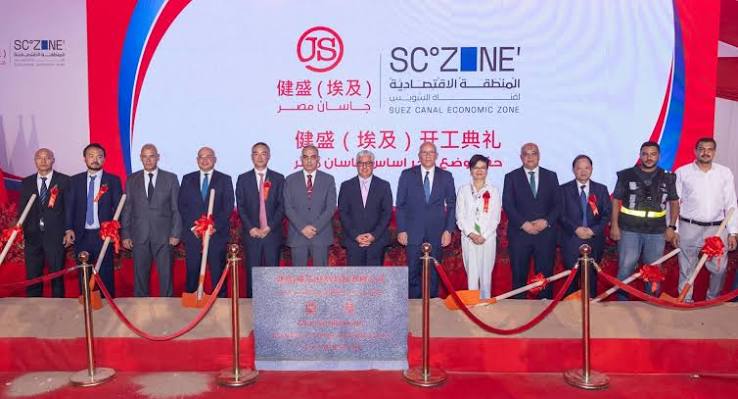
China’s Zhejiang Jiansheng Group, known as Jasan Group, has broken ground on a $117 million integrated textile and apparel complex in Egypt’s Suez Canal Economic Zone, adding export-oriented manufacturing capacity as Cairo seeks to expand the country’s garment industry and strengthen its position in global textile supply chains.
The project is being developed on a 300,000-square-metre site in the Qantara West Industrial Zone and will be implemented in three phases. According to the Suez Canal Economic Zone (SCZONE), the complex will include spinning and weaving facilities, ready-made and sportswear production, seamless garments, socks, accessories, elastic fabrics and dyeing operations. The project is expected to create about 6,000 direct jobs once fully operational, while 90% of its output will be directed to international markets.
The investment comes as Egypt seeks to move further up the textile value chain, from the production and processing of raw materials towards integrated manufacturing and export of finished garments. For an economy under pressure to generate foreign currency and expand non-oil exports, the development of export-oriented industrial capacity has implications beyond employment, particularly through its potential contribution to manufacturing output, trade earnings and industrial linkages.
Jasan’s investment also reinforces the growing presence of Chinese and Turkish manufacturers in Egypt’s textile sector. The Suez Canal Economic Zone has increasingly positioned Qantara West as a specialised manufacturing cluster for spinning, textiles and ready-made garments, with international investors attracted by the zone’s industrial infrastructure and access to export markets. SCZONE officials said the latest project reflects continued investor interest in the area and its development as a textile manufacturing hub.
The project is fully self-financed and will be developed in successive phases, reducing the need for direct public financing for the industrial facility. Its export orientation is also significant. With nine out of every ten units of production expected to be sold internationally, the complex is designed primarily around external markets rather than domestic consumption. That model could provide Egypt with an additional source of foreign-exchange earnings while integrating local production into international apparel supply chains.
Egypt’s apparel industry is already recording strong export growth. The Apparel Export Council of Egypt expects ready-made garment exports to reach about $4.4 billion in 2026, compared with $3.4 billion in 2025 and $2.8 billion in 2024. The council has outlined a longer-term ambition of raising annual textile and garment exports to around $11.5 billion by 2030, although achieving that level would require sustained investment, higher productivity and continued access to international markets.
The scale of the target illustrates the gap Egypt is attempting to close. Reaching $11.5 billion from $2.8 billion in 2024 would require exports to increase more than fourfold within six years. New factories alone will not determine whether that target is achieved. Competitiveness will also depend on energy costs, access to raw materials, logistics, labour productivity, trade agreements, compliance with international environmental and social standards and the ability of manufacturers to meet increasingly demanding delivery requirements.
The shift towards integrated textile complexes is particularly relevant to that challenge. Spinning, weaving, dyeing and garment manufacturing within connected industrial facilities can reduce reliance on imported intermediate products and allow manufacturers to respond more quickly to international orders. It can also create opportunities for local suppliers in packaging, logistics, maintenance, chemicals, machinery and other industrial services.
According to the U.S. Department of Agriculture’s 2026 assessment of Egypt’s cotton and textile sector, Chinese and Turkish investments have supported the expansion of integrated textile and apparel production, with Egyptian textile exports reaching $3.4 billion in 2025 and expectations for further growth in 2026.
Jasan’s project follows other foreign investments into the same industrial cluster. In April, SCZONE announced an agreement with Turkish companies Dinamik Raus Tekstil and YILTEM Apparel for an $8 million garment factory in Qantara West. The accumulation of investments suggests that the industrial zone is developing a concentration of textile manufacturers rather than relying on isolated production facilities.
For Egypt, that clustering could become important as global apparel companies reassess their sourcing networks. Manufacturers increasingly face pressure to demonstrate supply-chain traceability, environmental compliance and responsible production practices. Industrial zones that can provide integrated infrastructure and access to export markets may therefore have an advantage in attracting manufacturers seeking to diversify production locations.
The development also forms part of a wider effort by Egypt to increase the contribution of manufacturing to economic growth. Textile and apparel production remains one of the country’s established industrial sectors, with a large labour base and long-standing access to domestic cotton production. The challenge is to convert those existing advantages into higher-value exports while reducing production bottlenecks and improving the competitiveness of finished products.
SCZONE’s role is central to that strategy. The authority said it contracted 117 industrial projects during the 2025/26 financial year, representing investments of about $7.26 billion. The Jasan project therefore forms part of a broader effort to use the economic zone to attract foreign industrial capital and establish export-oriented production clusters.
The economic implications extend beyond the direct jobs expected from the Jasan complex. Large textile facilities can create demand for transport, warehousing, packaging, maintenance, logistics and other services, while local suppliers can benefit if procurement systems connect them to international manufacturers. The depth of those linkages will determine how much value remains within Egypt rather than being captured primarily through imported inputs.
Sustainability will also increasingly influence the competitiveness of the sector. Textile manufacturing is resource-intensive, particularly in areas such as energy, water, dyeing and waste management. As international buyers impose stricter environmental and supply-chain requirements, Egyptian manufacturers will face growing pressure to improve resource efficiency, wastewater treatment, traceability and labour standards. Investments in modern production infrastructure could therefore become important not only for capacity expansion but also for maintaining access to demanding export markets.
The regional significance is broader than Egypt’s own export ambitions. Africa remains heavily dependent on imported manufactured textiles and apparel despite having substantial cotton production and a large consumer market. Expanding integrated textile manufacturing in Egypt could demonstrate how African economies can capture more value by processing raw materials and producing finished goods rather than exporting commodities and importing higher-value products.
The Jasan investment consequently sits at the intersection of foreign direct investment, industrial policy and export diversification. If the three-phase complex reaches full production as planned, it will add significant manufacturing capacity to a sector that is already expanding rapidly. The more important test for Egypt, however, will be whether these investments translate into sustained export growth, stronger domestic industrial linkages and higher-value participation in global textile supply chains.
For Africa, the development highlights the importance of industrial ecosystems in attracting manufacturing investment. Egypt’s experience suggests that access to infrastructure, ports, industrial land and international markets can be decisive in converting foreign investment into export capacity. The longer-term development impact will depend on whether those investments generate durable skills, technology transfer, local supplier networks and competitive industries capable of operating beyond the initial investment cycle.


