


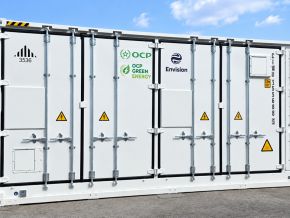
OCP Green Energy has energised a 25 MW/125 MWh battery energy storage system at Benguerir, marking Morocco’s first large-scale lithium iron phosphate battery storage installation and adding a new dimension to the country’s push to integrate renewable energy into energy-intensive industrial operations.
The system, which can store electricity for up to five hours, has been installed alongside OCP’s 67 MWp solar plant at Benguerir. Following the completion of battery, power-conversion and control-system installation, OCP Green Energy has begun performance testing ahead of progressive commissioning. Once operational, the system will store solar electricity generated during the day and release it during periods of higher demand.
The nearly 170 million-dirham investment, equivalent to about $18 million, represents more than an expansion of OCP’s renewable generation capacity. It demonstrates how large industrial electricity consumers are increasingly turning to storage to manage the intermittency of solar power and better align renewable generation with continuous industrial demand.

OCP Green Energy’s first phase of renewable investment already includes 202 MWp of solar capacity across Benguerir, Foum Tizi and Oulad Farès in Khouribga. The three plants are operational and supply renewable electricity to OCP’s mining and industrial sites. The Benguerir battery system adds flexibility to that generation portfolio by allowing electricity produced during periods of strong solar output to be shifted towards peak-demand periods.
Omar Kadir, managing director of OCP Green Energy, has described storage as a natural extension of the company’s renewable-energy strategy. The system is designed not only to improve the continuity of renewable electricity supplied to industrial facilities but also to support better demand management and greater flexibility in the power system.
That distinction is important for Morocco’s energy transition. Adding solar generation can increase the volume of renewable electricity available, but without sufficient flexibility, production can become misaligned with demand. Storage provides a mechanism for shifting electricity across time, potentially allowing more renewable generation to be consumed when it has the greatest operational and economic value.
The Benguerir system is expected to provide additional grid-support functions, including frequency regulation and reactive-power compensation. OCP says the system will operate on a daily charge-and-discharge cycle and has an estimated service life of 25 years, with lithium iron phosphate, or LFP, technology selected for its safety, thermal stability and longevity.
The economics of the project are also significant. OCP Green Energy says the battery system is expected to reduce the electricity bill at the industrial site by about 25% during peak hours once fully operational. The value of the installation therefore extends beyond its contribution to decarbonisation: it is also intended to improve the economics and reliability of electricity supply to a major industrial operation.
The project has also attracted concessional climate finance. It benefits from $20 million in financing from the Clean Technology Fund, a programme supported by the African Development Bank that provides financing for clean-energy technologies, including innovative electricity-storage solutions. The AfDB has previously identified battery storage as a component of OCP’s wider green-investment programme, including plans to pair additional solar capacity with hundreds of megawatt-hours of storage.
This financing structure highlights a wider challenge facing renewable-energy deployment across Africa. Solar and wind projects can increasingly be developed at competitive costs, but integrating variable generation into industrial and national electricity systems requires additional capital for batteries, transmission, grid management and other forms of flexibility.
Morocco is responding through several parallel investments. In July 2026, the World Bank approved $265 million for a 300 MW pumped-storage hydropower project in northern Morocco. The project is expected to enable the integration of at least 1 GW of additional solar and wind capacity into the national grid while replacing an estimated 3 TWh of fossil-fuel generation annually. It illustrates that Morocco’s storage strategy extends beyond batteries to large-scale grid infrastructure.
The policy direction is consistent with Morocco’s long-standing renewable-energy ambitions. The country has a target of increasing the share of renewable energy in installed electricity capacity to 52% by 2030, according to the Ministry of Energy Transition and Sustainable Development. For OCP, however, the rationale for storage is closely tied to industrial competitiveness. Phosphate mining and fertiliser production require large and continuous volumes of electricity. Ensuring that renewable electricity is available when industrial processes require it reduces the exposure of operations to fluctuations in renewable generation and creates a closer relationship between clean-energy investment and production economics.
OCP Green Energy is targeting more than 1.2 GW of renewable-energy capacity by 2027, with the longer-term objective of exceeding 2 GW and developing at least 2 GWh of energy storage. The company also aims for OCP Group to meet 100% of its industrial electricity requirements from renewable sources by 2027. The next stage of the programme is expected to add more than 400 MWp of solar generation and 600 MWh of storage. This would significantly change the scale of OCP’s storage portfolio compared with the initial 125 MWh system at Benguerir.
The trajectory is particularly relevant because OCP is one of Morocco’s largest industrial companies and a major global producer of phosphate-based fertiliser products. Its energy strategy therefore sits at the intersection of industrial policy, energy security and international competitiveness. The company has also been building a broader financing ecosystem around the transition. In 2023, the International Finance Corporation provided OCP with a €100 million green loan for the first phase of its solar programme, supporting the construction of four solar plants with a combined capacity of 202 MWp. IFC described the financing as part of OCP’s wider transition towards renewable energy in fertiliser production.
The significance of the Benguerir project also extends into industrial technology development. OCP’s wider ecosystem includes Mohammed VI Polytechnic University, which has been involved in research and innovation linked to materials, energy and industrial technologies. OCP Green Energy has indicated that research into LFP technologies derived from phosphoric acid is being developed with UM6P, with the longer-term objective of strengthening Morocco’s capabilities around battery materials and storage technologies.
That could become increasingly relevant as battery manufacturing expands across Africa. In July 2026, the African Development Bank approved a €100 million loan for Gotion Power Morocco to develop an integrated lithium-iron-phosphate battery gigafactory, with an initial 10 GWh annual production capacity and plans for substantial expansion. The project is intended to establish an integrated battery manufacturing base in Morocco and the wider Africa-MENA region.
Taken together, these developments suggest that Morocco’s energy transition is moving beyond the construction of individual renewable power plants towards an ecosystem combining generation, storage, industrial demand, finance, research and manufacturing. For African markets, the distinction matters. Renewable energy projects connected to industrial loads can provide an alternative route to scaling clean power because the electricity has a defined customer and can potentially be paired with long-term demand. Battery storage then becomes an economic tool for managing that electricity rather than simply an ancillary climate technology.
The Benguerir system also provides a practical example of how storage can address one of the central weaknesses of solar power: its production profile does not necessarily match the profile of industrial demand. A five-hour battery does not eliminate intermittency, but it can shift a portion of generation from periods of high solar availability to periods when electricity has greater operational value.
The challenge now is to demonstrate how the technology performs at scale. The system remains in the testing and progressive-commissioning stage, meaning its operational performance, degradation profile, cost savings and contribution to system flexibility will become important indicators for future deployments. For OCP, the test will be whether storage can simultaneously deliver three outcomes: reliable electricity for industrial operations, lower exposure to peak electricity costs and a greater share of renewable power in the company’s energy mix.
For Morocco, the stakes are broader. As solar and wind capacity expands, the ability to store, shift and manage electricity will increasingly determine how much renewable generation can be absorbed by the electricity system. The World Bank’s pumped-storage investment, OCP’s battery programme and the country’s emerging battery-manufacturing ecosystem point towards a strategy in which flexibility becomes as important as generation capacity.
The 25 MW/125 MWh Benguerir system is therefore more than a battery installation at a phosphate mine. It is an early demonstration of a broader industrial-energy model in which renewable generation, storage and large electricity demand are planned as a single system. If OCP’s wider programme reaches its 1.2 GW renewable-capacity target by 2027 and subsequently exceeds 2 GW with at least 2 GWh of storage, the company will have moved from using renewable electricity as an additional source of power towards building an integrated energy platform around its industrial operations.
For Morocco and other African economies seeking to decarbonise energy-intensive industries, that shift could be consequential. The next phase of Africa’s renewable-energy expansion will not only depend on how many megawatts can be built. It will increasingly depend on whether electricity can be stored, managed and delivered at the time industrial economies need it. Benguerir offers one early example of what that transition could look like.


