


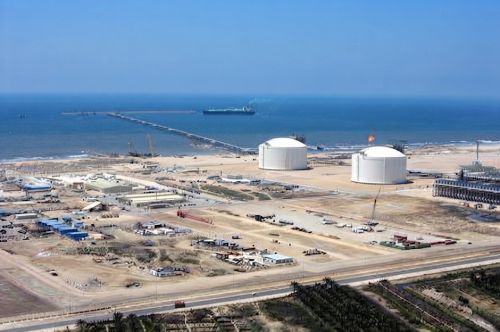
Mozambique’s Rovuma LNG project is moving closer to a final investment decision as ExxonMobil and its Area 4 partners accelerate engineering, procurement and logistics contracts worth more than $1.3 billion, signalling renewed momentum for one of Africa’s largest planned private-sector energy investments.
The latest awards include contracts to two Mozambican companies for shorebase and logistics services in Pemba, alongside an upstream engineering, procurement, construction and installation contract to a consortium led by Saipem and Jan De Nul. The awards follow approximately $1.1 billion in pre-investment contracts announced in August for long-lead equipment, including subsea production systems, large-bore valves and offshore line pipe.
The contracting activity comes as the Area 4 partners prepare for the project’s final investment decision, which ExxonMobil says is expected in 2026. Rovuma LNG is planned to include 12 electrically driven modular liquefaction units with combined capacity of 18.6 million tonnes of LNG a year, with start-up targeted for 2031.
The scale of the development makes the FID more than a corporate milestone. It would determine whether Mozambique moves from preparations for a second major LNG development in the Rovuma Basin into the construction phase of a project capable of reshaping the country’s export earnings, public revenues, infrastructure requirements and industrial supply chains.

The latest contracts also underline the role of local participation in the project. CFML Logistic, a subsidiary of state-owned railway company Caminhos de Ferro de Moçambique, has been selected to provide shorebase land and infrastructure services at the Pemba Bulk Terminal, while Alistair Group Mozambique will provide logistics services supporting Area 4 drilling and offshore operations. ExxonMobil said the awards demonstrate the partners’ commitment to local content and are intended to build domestic capabilities and support port infrastructure that could serve industries beyond oil and gas.
That objective is important because the economic impact of a capital-intensive LNG project is not determined solely by the value of gas exports. The depth of local procurement, workforce participation, supplier development and infrastructure sharing will influence how much of the investment remains within Mozambique.
The project is being developed in offshore Area 4 by Mozambique Rovuma Venture, with participation from Mozambique’s Empresa Nacional de Hidrocarbonetos (ENH), Eni, China National Petroleum Corporation (CNPC), Korea Gas Corporation (KOGAS) and XRG. ExxonMobil acts as the delegated operator for Rovuma LNG. Rovuma LNG was suspended in 2021 after an escalation of armed violence in Cabo Delgado forced the consortium to declare force majeure. ExxonMobil said in its 2025 annual filing that force majeure had subsequently been lifted and that the project had returned to front-end engineering and design work in support of an FID in 2026.
The restart places security and project execution alongside financing and market conditions as key considerations for the development. The project’s modular design is intended to provide greater flexibility in construction and reduce execution risk. ExxonMobil says the refreshed design uses 12 pre-assembled 1.55 million-tonne-per-year electric liquefaction modules and an 800 MW combined-cycle power plant to supply electricity to the LNG facility.
The project has also been designed with a lower-emissions profile than a conventional large-train LNG development. ExxonMobil says its electric LNG configuration could reduce greenhouse-gas emissions by up to 40% compared with traditional mega-train designs, although the project’s overall climate implications remain linked to the emissions associated with natural-gas production, liquefaction, shipping and end use. For Mozambique, the financial case is substantial. ExxonMobil cites a macroeconomic study by Standard Bank estimating that Rovuma LNG could contribute about $11 billion annually to the country’s gross domestic product and generate approximately $150 billion in government revenues over a 30-year operating life. The company also says the project could create opportunities for around 7,500 Mozambicans during the execution phase and about 700 jobs during operations.
Those figures illustrate both the opportunity and the policy challenge facing Mozambique. Large LNG projects can generate significant foreign-exchange earnings and government revenue, but converting those flows into broader economic development depends on fiscal management, domestic investment, infrastructure and diversification beyond hydrocarbons.
The local-content agenda is therefore becoming an important part of the project’s economic proposition. ExxonMobil and Area 4 partners are already supporting skills development through the Centro Tecnológico de Moçambique, a training facility backed by a reported $40 million investment from Rovuma LNG partners. The centre is intended to develop a local workforce capable of meeting the technical requirements of major oil and gas projects, particularly in Area 4.
Port infrastructure provides another potential spillover. Pemba is expected to play a growing role in supporting drilling, offshore operations and logistics. If investment in shorebase infrastructure, transport links and technical services is designed for broader commercial use, the benefits could extend into sectors including manufacturing, construction, logistics and other industrial activities. That possibility is particularly relevant because Mozambique is seeking to capture greater domestic value from its natural resources rather than relying primarily on the export of unprocessed commodities. The LNG sector can create demand for engineering, fabrication, transport, accommodation, financial services, professional services and specialised technical skills, provided domestic firms are able to meet the required standards and compete on cost and quality.
The project also sits alongside other developments in Mozambique’s gas industry. Eni and its Area 4 partners reached a final investment decision for the Coral North floating LNG project in October 2025, adding another development pathway for gas resources in the Rovuma Basin. The coexistence of multiple LNG developments increases the potential economic importance of the basin, but also raises questions about infrastructure coordination, skills availability, local procurement capacity and the country’s ability to manage a larger concentration of hydrocarbon revenues.
For investors, the immediate focus remains the FID. For Mozambique, however, the more consequential question will be what follows it. A positive investment decision would unlock one of the largest private investments in the country’s history, but the lasting economic impact will depend on how effectively the country links LNG investment to local enterprise development, skills, infrastructure, public finance and economic diversification.
The more than $1.3 billion in contracts awarded ahead of FID suggest that the project has moved considerably beyond an early-stage proposal. Yet the ultimate measure of Rovuma LNG will not be the size of its construction budget or LNG output alone. It will be whether Mozambique can use the investment to build productive capacity that remains valuable after the gas revenues begin to flow.


