


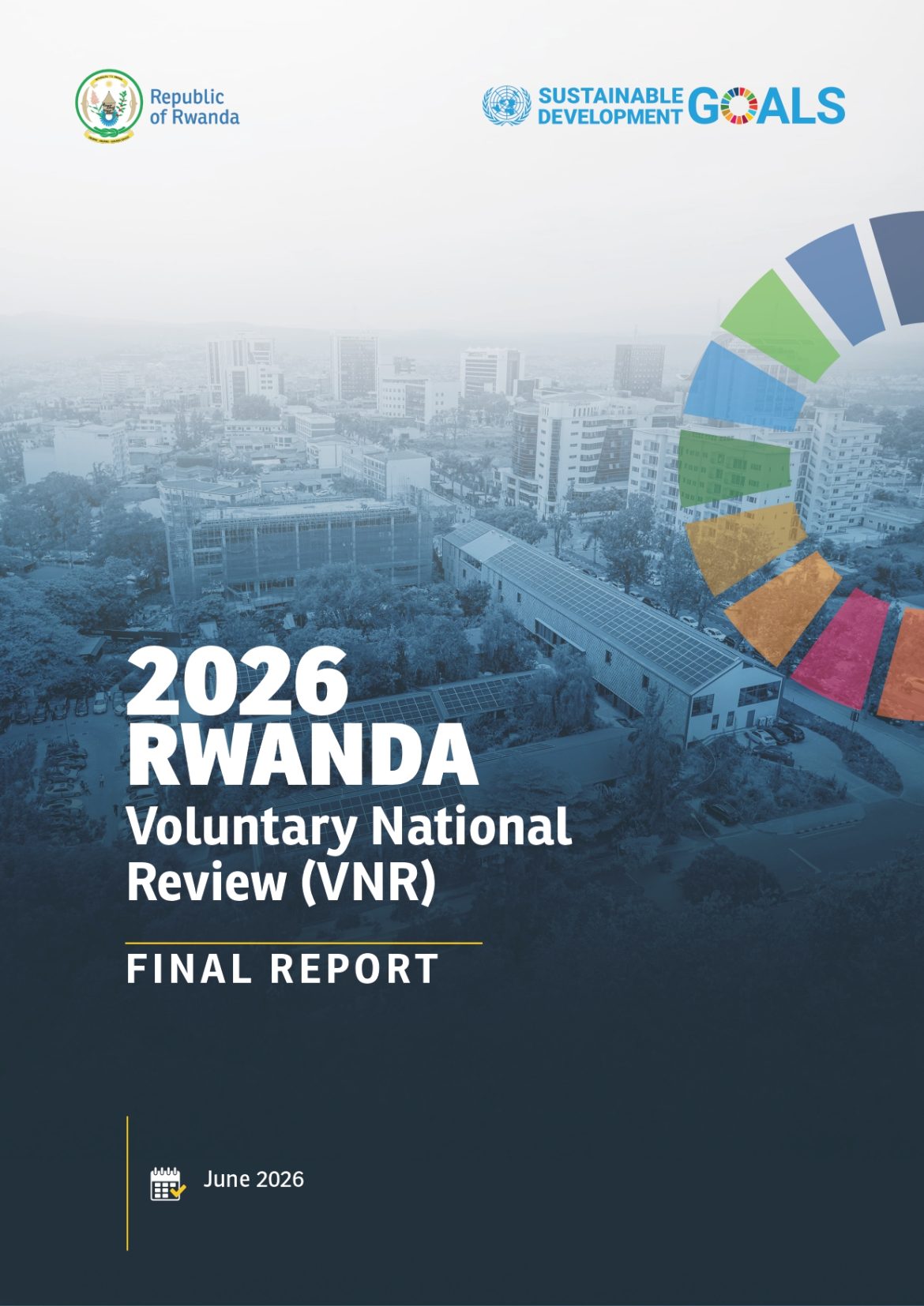
Rwanda has reaffirmed its commitment to achieving the United Nations Sustainable Development Goals (SDGs) by presenting its Third Voluntary National Review (VNR) at the 2026 High-Level Political Forum on Sustainable Development (HLPF) in New York, showcasing significant gains in economic growth, poverty reduction, digital transformation and access to essential public services while acknowledging that sustained financing and stronger international partnerships will be critical to achieving the 2030 Agenda. The review, presented on 15 July by Minister of Finance and Economic Planning Yusuf Murangwa, highlights Rwanda’s integrated approach to development planning, positioning sustainability, economic resilience and institutional governance as mutually reinforcing pillars of long-term national transformation.
Presented under the theme “Accelerating Progress Towards the 2030 Agenda,” the report builds on Rwanda’s previous Voluntary National Review submitted in 2023 and provides an updated assessment of the country’s progress in implementing the Sustainable Development Goals. More importantly, it illustrates how Rwanda has embedded the global development framework within its national Vision 2050 and the Second National Strategy for Transformation (NST2), ensuring that international commitments are translated into measurable domestic development outcomes.
The presentation comes at a time when many African countries are reassessing their progress towards the SDGs amid mounting fiscal pressures, climate change, geopolitical uncertainty and constrained development financing. According to the United Nations, less than one-fifth of the global Sustainable Development Goal targets are currently on track for achievement by 2030, with many developing economies facing widening financing gaps that threaten progress across poverty reduction, infrastructure, education, healthcare and climate resilience.
Against this backdrop, Rwanda’s latest review provides evidence of sustained economic and social progress. According to the report, the country’s economy expanded by 9.4% in 2025, making Rwanda one of Africa’s fastest-growing economies. The strong economic performance reflects continued investment in infrastructure, services, manufacturing, tourism and digital innovation, sectors that have become central to Rwanda’s long-term development strategy.
Economic growth has translated into measurable improvements in living standards. Poverty declined from 39.8% in 2017 to 27.4% in 2024, supported by expanded social protection programmes, livelihood initiatives and targeted poverty reduction interventions. At the same time, life expectancy increased to 70.2 years, reflecting continued improvements in healthcare delivery, nutrition, sanitation and public health systems.
Youth employment also showed encouraging progress. According to the review, youth unemployment fell from 22.7% in 2023 to 19.8% in 2025, driven by investments in entrepreneurship, vocational training, digital skills development and private sector job creation. For Rwanda, where a significant proportion of the population is under the age of 35, expanding employment opportunities remains essential for sustaining inclusive economic growth while strengthening long-term social stability.
The Voluntary National Review focused on five Sustainable Development Goals selected for the 2026 High-Level Political Forum: SDG 6 (Clean Water and Sanitation), SDG 7 (Affordable and Clean Energy), SDG 9 (Industry, Innovation and Infrastructure), SDG 11 (Sustainable Cities and Communities), and SDG 17 (Partnerships for the Goals). Rwanda also highlighted cross-cutting priorities including gender equality, social inclusion and the principle of ensuring that no one is left behind.
Access to basic services continues to improve across the country. By 2025, 89.5% of Rwandan households had access to improved water sources, while 84.6% relied on electricity as their primary source of lighting, demonstrating continued progress in expanding essential infrastructure. According to the World Bank, improved access to reliable water and electricity remains fundamental to economic productivity, public health, industrial competitiveness and human capital development.
Digital transformation has become another defining feature of Rwanda’s development model. The review indicates that fourth-generation (4G) mobile broadband coverage has reached 99% of the population, providing the digital backbone for expanded e-government services, financial inclusion and business innovation. More than 200 government services are now accessible online, reinforcing Rwanda’s position as one of Africa’s leading digital governance innovators.
According to the International Telecommunication Union (ITU), expanding digital infrastructure plays an increasingly important role in accelerating sustainable development by improving access to education, healthcare, financial services and public administration while reducing transaction costs for businesses and citizens alike. Rwanda’s investment in digital public infrastructure has therefore become both a governance reform and an economic competitiveness strategy.
Addressing delegates at the High-Level Political Forum, Minister Murangwa said Rwanda’s progress reflects the strength of its long-term national planning framework, institutional capacity and commitment to accountable governance. He noted that while substantial progress has been achieved, continued international cooperation remains essential for mobilising the financing, innovation and technical expertise required to accelerate implementation of the Sustainable Development Goals.
His remarks reflect a wider challenge confronting many African economies. According to the United Nations Conference on Trade and Development (UNCTAD), developing countries face an annual Sustainable Development Goal financing gap exceeding US$4 trillion, with African countries disproportionately affected by rising debt servicing costs, constrained fiscal space and limited access to affordable development finance.
The Organisation for Economic Co-operation and Development (OECD) similarly notes that achieving the SDGs will require significantly greater mobilisation of domestic resources, stronger public-private partnerships and more effective deployment of blended finance mechanisms capable of attracting long-term investment into sustainable infrastructure, renewable energy, healthcare and education.
Rwanda’s emphasis on partnerships therefore aligns directly with SDG 17, recognising that sustainable development increasingly depends on collaboration between governments, multilateral institutions, development finance institutions, the private sector and civil society. The country’s development model has long relied on coordinated planning supported by strategic international partnerships, enabling it to implement ambitious reforms despite relatively limited natural resource endowments.
The review also highlights the growing importance of climate resilience within Rwanda’s national development agenda. Investments in clean energy, water infrastructure, sustainable urban development and resilient public services are increasingly designed to support adaptation to climate change while reducing long-term environmental risks. According to the Intergovernmental Panel on Climate Change (IPCC), integrating climate resilience into national planning is essential for protecting development gains across Africa as temperatures rise and weather extremes become more frequent.
Rwanda’s integrated planning framework also complements the African Union’s Agenda 2063, which seeks to accelerate inclusive economic growth, industrialisation, regional integration and environmental sustainability across the continent. By aligning national priorities with both the SDGs and Agenda 2063, Rwanda demonstrates how African governments are increasingly harmonising global and continental development frameworks to improve policy coherence and implementation effectiveness.
The country’s experience also offers broader lessons for Africa’s development trajectory. Rather than treating sustainability as a standalone environmental agenda, Rwanda has embedded climate resilience, infrastructure development, digital transformation, human capital investment and institutional governance within a unified national development strategy. This integrated approach reflects a growing recognition that economic growth, environmental sustainability and social inclusion are interdependent objectives requiring coordinated implementation.
Nevertheless, the Voluntary National Review acknowledges that important challenges remain. Sustaining economic growth, reducing remaining poverty, expanding climate resilience and financing infrastructure development will require continued policy innovation, stronger institutions and expanded international support over the remainder of the decade.
As African governments prepare for the final five years leading to the 2030 deadline, Rwanda’s latest review illustrates both the opportunities and the complexities of implementing the Sustainable Development Goals under increasingly constrained global economic conditions. Its experience demonstrates that sustained political commitment, evidence-based policymaking, institutional accountability and strategic partnerships remain essential ingredients for delivering inclusive, resilient and sustainable development across the continent.


