


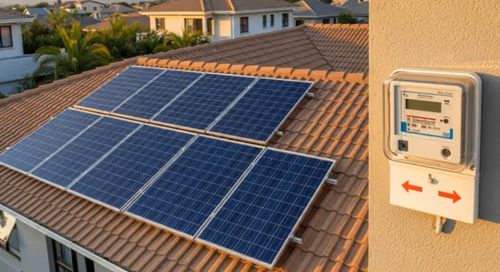
Rwanda is preparing to explore one of Africa’s most significant electricity market reforms by considering a net metering system that would allow households, businesses and institutions with rooftop solar installations to feed surplus electricity into the national grid in exchange for bill credits. The proposal, announced by Prime Minister Justin Nsengiyumva on 30 July, could transform thousands of electricity consumers into power producers while strengthening Rwanda’s efforts to meet rising electricity demand, diversify its energy mix and achieve universal electricity access by 2030.
The initiative was announced after members of Parliament raised concerns over the continued absence of electricity in 11 administrative cells, highlighting the need to accelerate electrification despite Rwanda’s impressive progress over the past decade. According to government officials, the proposed framework would enable consumers equipped with solar photovoltaic systems and smart meters to first meet their own electricity needs before automatically exporting excess generation to the national grid operated by the Rwanda Energy Group (REG).
If implemented, the policy would represent a major evolution in Rwanda’s electricity sector by shifting from a traditional centralized generation model towards a more distributed energy system where households, commercial buildings and institutions actively contribute to national electricity supply. Such systems, commonly known as net metering, have become increasingly important globally as governments seek to integrate distributed renewable energy while improving grid resilience and reducing pressure on large-scale generation infrastructure.
According to Prime Minister Nsengiyumva, the proposal forms part of broader government efforts to expand electricity generation capacity while improving energy access across the country. Rwanda is simultaneously advancing several major energy projects, including the 43.5-megawatt Nyabarongo II hydropower station, a planned 200-megawatt floating solar power project and expanded methane gas generation from Lake Kivu. Allowing distributed solar producers to contribute electricity to the grid would complement these investments by diversifying supply sources and making better use of existing renewable energy assets already installed across the country.
The proposal builds upon Rwanda’s strong foundation in off-grid solar deployment. According to the Rwanda Energy Group, national electricity access reached 84.6 percent by the end of July 2025, comprising 59.6 percent connected to the national grid and approximately 25 percent supplied through off-grid systems, the majority powered by solar energy. This widespread adoption of decentralized solar technologies provides Rwanda with a substantial base of potential participants should the government formally introduce net metering.
Many of these existing solar systems currently operate independently without any connection to the national grid, limiting their contribution to the wider electricity system. Under a net metering framework, some installations could potentially be upgraded with grid connections and smart metering technology, allowing unused daytime electricity generation to support neighbouring consumers instead of remaining underutilised.
According to Francine Munyaneza, founder of Rwanda-based solar company Munyax Eco, participating consumers could receive credits against future electricity bills based on the amount of electricity exported to the grid. Such financial incentives have proven effective in several international markets by shortening investment payback periods and encouraging greater private investment in rooftop solar systems.
However, implementing the proposal will require substantial regulatory reform. Rwanda currently has no legal framework permitting private consumers to sell electricity to the national grid. The Rwanda Utilities Regulatory Authority (RURA), which would oversee implementation, has yet to publish regulations governing grid connections, tariff structures, technical standards or compensation mechanisms for surplus electricity supplied by consumers.
Developing these regulations will be essential to ensure system reliability while balancing the interests of electricity consumers, utility operators and investors. Experience from other countries suggests that successful net metering programmes depend upon transparent pricing arrangements, modern grid management systems and clear technical requirements governing interconnection between distributed generators and national electricity networks.

The proposal arrives as Rwanda faces rapidly growing electricity demand driven by economic expansion, urbanisation, industrial development and rising household consumption. According to Energy Prof, national electricity demand is increasing by approximately 10 percent annually, placing growing pressure on existing generation capacity and transmission infrastructure.
Long-term projections illustrate the scale of the challenge ahead. Government estimates cited by KT Press indicate that electricity demand could increase to between 2.5 gigawatts and 4.5 gigawatts by 2050, compared with current installed generation capacity of approximately 1,000 megawatts. Meeting that demand will require significant investment across generation, transmission, distribution and energy storage while improving overall system efficiency.
Distributed solar generation could therefore become an increasingly valuable component of Rwanda’s future electricity system. Unlike conventional power plants, rooftop solar installations can be deployed incrementally, require limited land acquisition and reduce transmission losses by generating electricity close to where it is consumed. According to the International Energy Agency (IEA), distributed renewable energy systems are expected to play an increasingly important role in improving electricity security and accelerating clean energy transitions across emerging economies.
For Africa, Rwanda’s proposal reflects a broader shift towards modernising electricity markets through regulatory innovation rather than relying solely on expanding conventional infrastructure. Countries such as South Africa, Kenya and Morocco have already introduced forms of net metering that enable consumers to contribute surplus renewable electricity to national grids. If Rwanda proceeds with implementation, it would join a relatively small group of African countries adopting distributed electricity market models designed to increase renewable energy participation while strengthening grid flexibility.
The initiative also carries wider economic implications. Expanding distributed solar generation could stimulate private investment in renewable energy technologies, create employment opportunities across installation and maintenance services, reduce electricity costs for participating consumers and lower dependence on imported fossil fuels. For businesses, particularly small and medium-sized enterprises facing rising energy demand, generating part of their own electricity while offsetting grid costs could improve competitiveness and operational resilience.
From a sustainability perspective, encouraging greater integration of rooftop solar generation aligns closely with Rwanda’s long-term climate commitments and green growth strategy. The country has consistently positioned renewable energy expansion as a central component of its economic development agenda while seeking to reduce greenhouse gas emissions and strengthen resilience against climate-related energy disruptions.
The success of the proposed framework will ultimately depend on the government’s ability to establish a clear regulatory environment that encourages investment while maintaining grid stability and financial sustainability for the national utility. If implemented effectively, net metering could become an important policy instrument for accelerating universal electricity access, strengthening renewable energy deployment and supporting Rwanda’s transition towards a more resilient, decentralised and low-carbon electricity system.
As African countries continue to balance rapidly growing electricity demand with climate commitments and fiscal constraints, Rwanda’s proposed reform illustrates how policy innovation can complement infrastructure investment in expanding access to affordable, reliable and sustainable energy. The initiative demonstrates that future electricity systems may increasingly rely not only on utility-scale power plants but also on millions of consumers contributing directly to national energy security through distributed clean energy generation.


