


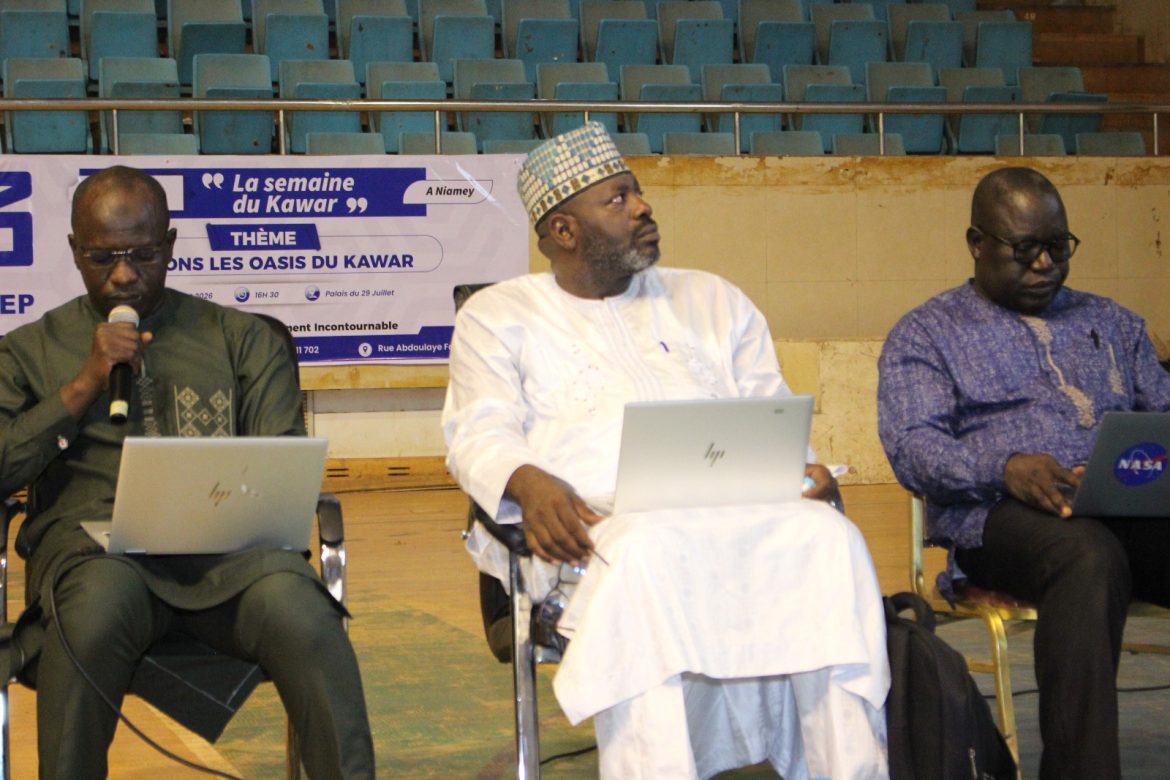
Niger has renewed its focus on the sustainable management of its fragile oasis ecosystems and the development of climate-resilient local value chains, placing the Kawar region at the centre of national discussions on environmental stewardship, rural economic transformation and sustainable development. The dialogue took place during Kawar Week in Niamey, where government representatives, development partners, local authorities, researchers and community leaders examined how better management of the country’s oasis landscapes can strengthen food security, improve livelihoods and enhance resilience against climate change in one of the Sahara’s most vulnerable regions.
The discussions come at a time when climate variability, desertification and water scarcity are placing growing pressure on Niger’s agricultural systems and rural economies. According to participants, protecting oasis ecosystems has become increasingly important not only from an environmental perspective but also as a strategic economic priority, given the role these ecosystems play in sustaining agricultural production, preserving biodiversity and supporting thousands of households across northern Niger.
The event, organised under the framework of Kawar Week by the Association for the Promotion of Intercommunality in Kawar (APIK-Baana), forms part of wider efforts to showcase the economic, cultural and environmental importance of the Kawar region while strengthening collaboration between public institutions, development partners and local communities. The initiative seeks to position sustainable natural resource management as a foundation for inclusive economic development rather than treating environmental conservation as a separate policy objective.
At the centre of the discussions were the unique oasis systems of Kawar, which provide critical water resources within one of the country’s driest regions. These oases support agricultural production, livestock activities and local industries built around dates, salt and natron, commodities that have sustained communities for generations and continue to contribute to local economies.
According to participants, safeguarding these ecosystems requires integrated management approaches capable of balancing conservation objectives with economic development. Maintaining groundwater resources, protecting fragile vegetation and improving water management systems were identified as essential measures for ensuring that these landscapes continue supporting livelihoods despite increasing climatic pressures.
The discussions also examined opportunities to strengthen the competitiveness of Kawar’s agricultural and mineral value chains. Government officials and regional stakeholders emphasised that improving production alone will not be sufficient unless accompanied by investments in processing, storage, logistics and market access.
According to participants, expanding transport infrastructure, improving storage facilities and encouraging investment in local processing industries could significantly increase incomes for producers while reducing post-harvest losses. Greater value addition within Niger would also enable rural communities to retain a larger share of economic benefits generated by agricultural and mineral products rather than exporting raw commodities with limited domestic processing.
For Africa, these discussions reflect a broader continental challenge facing many arid and semi-arid regions where climate adaptation increasingly depends on strengthening rural economies alongside environmental conservation. Across the Sahel, governments are seeking ways to combine ecosystem restoration with productive investments that generate employment, reduce poverty and strengthen food systems without accelerating environmental degradation.
According to the United Nations Convention to Combat Desertification (UNCCD), land degradation and desertification continue to threaten agricultural productivity across large parts of Africa, placing additional pressure on public finances through rising humanitarian costs, reduced agricultural output and increasing investment needs for climate adaptation. Integrated approaches such as those discussed during Kawar Week therefore have implications that extend beyond Niger by offering practical examples of how natural resource management can support long-term economic resilience.
Participants further highlighted the environmental challenges confronting the Kawar region, including declining water availability, advancing desertification and increasing climate variability. These pressures threaten agricultural productivity while increasing vulnerability among communities whose livelihoods depend directly on oasis ecosystems.
Strengthening irrigation systems, expanding access to sustainable water infrastructure and promoting climate-smart agricultural practices were identified as priority interventions capable of improving resilience while maintaining agricultural production under changing climatic conditions. According to participants, these investments could help reduce production risks while supporting more efficient use of increasingly scarce water resources.
The discussions also emphasised that sustainable development in geographically isolated regions such as Kawar requires stronger institutional coordination and long-term partnerships involving government agencies, development finance institutions, civil society organisations and local communities.
According to organisers, Kawar Week serves as a platform for encouraging intercommunal cooperation while promoting dialogue on investment opportunities, infrastructure development and local economic planning. Such collaborative approaches are increasingly recognised as necessary for addressing the complex interaction between environmental degradation, economic vulnerability and regional inequality.
The initiative aligns with broader African efforts to implement climate adaptation strategies that combine ecosystem restoration with inclusive economic development. Across the continent, governments are increasingly recognising that environmental protection must be integrated into broader development planning rather than treated as an isolated conservation objective.
For Niger, strengthening sustainable management of oasis ecosystems also supports national priorities relating to food security, rural employment and climate resilience. Agriculture remains a major contributor to livelihoods despite increasing exposure to droughts, land degradation and changing rainfall patterns. Improving the productivity and competitiveness of climate-sensitive value chains therefore has implications for household incomes, national food systems and long-term economic stability.
According to participants, preserving the ecological integrity of the Kawar oases while expanding economic opportunities represents a mutually reinforcing strategy. Healthy ecosystems provide the natural capital required for productive agriculture, while stronger value chains create economic incentives for communities to invest in sustainable resource management rather than unsustainable exploitation.
The outcomes of Kawar Week also reflect the growing importance of locally driven development models across Africa. Rather than relying solely on externally designed interventions, initiatives that build on local knowledge, strengthen community institutions and promote locally adapted solutions are increasingly being recognised as more effective in delivering durable climate adaptation and sustainable development outcomes.
As African countries continue mobilising climate finance and implementing national adaptation strategies, the experience emerging from Kawar illustrates how environmental conservation, rural enterprise development and institutional cooperation can be integrated into a single development framework. While significant investment will still be required to improve infrastructure, water management and market access, strengthening locally anchored value chains could help improve resilience, generate employment and preserve some of the continent’s most fragile ecosystems in the decades ahead.


