


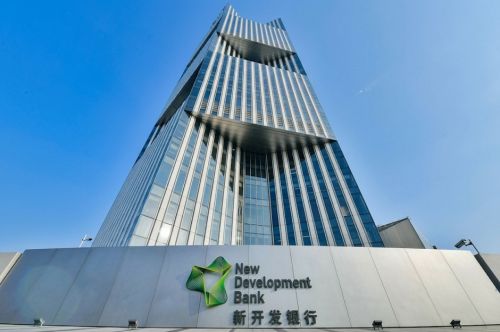
South Africa has signed $405 million in loan agreements with the New Development Bank to finance two major infrastructure projects in water and healthcare, directing $205 million towards the Magalies Bulk Water Supply Scheme and $200 million towards a new 488-bed tertiary hospital in Polokwane. The agreements, signed on August 28, come as the country faces deteriorating municipal water infrastructure, shortages in specialised healthcare capacity and growing pressure on government to direct limited public resources towards essential services.
The financing gives fresh momentum to two infrastructure projects that address constraints with direct implications for household welfare, public health and economic activity. The Magalies project will target six municipalities across Limpopo and North West where demand for water currently exceeds available supply, while the Limpopo Central Hospital project is intended to expand tertiary healthcare capacity in a province that has faced shortages of specialised hospital beds and increasing referrals to Gauteng.
The $205 million Magalies Bulk Water Supply Scheme is being implemented by Magalies Water and is designed to improve the reliability of drinking-water supplies in Bela-Bela, Modimolle-Mookgophong, Mogalakwena, Moretele, Moses Kotane and Rustenburg. According to the New Development Bank, water demand in the affected municipalities is currently more than 1.4 times available supply and is projected to rise to more than 1.6 times supply by 2035 without additional capacity. The project is expected to provide an additional 141 million litres of water a day, eliminating the current 117 million-litre daily deficit and partially accommodating future demand.

The scheme will involve extending and upgrading bulk water pipelines, expanding treatment capacity and developing water storage infrastructure. Its planned implementation period is five years, with financing also coming from commercial lenders and counterpart contributions from Magalies Water and the Department of Water and Sanitation. The NDB’s contribution therefore forms part of a wider capital structure rather than financing the entire project.
The urgency of the investment is underscored by South Africa’s broader water infrastructure performance. The 2025 Green Drop assessment found that 47% of the country’s 848 audited municipal wastewater treatment systems were in a critical state, up from 39% in 2022. Only 8% were classified as excellent or good performers, compared with 14% three years earlier. The deterioration has raised concerns about pollution, public health, environmental compliance and the reliability of municipal services.
South Africa’s water challenge is not limited to the availability of raw water. The Department of Water and Sanitation has identified weak municipal systems, inadequate maintenance, infrastructure deterioration and operational shortcomings as major constraints on reliable service delivery. Nationally, non-revenue water remains around 47.3%, meaning a substantial share of treated water does not generate revenue because of physical losses, theft, metering problems or other inefficiencies.
That makes bulk infrastructure investment important, but it also highlights a broader governance issue for South Africa. New pipelines and treatment facilities can increase capacity, but their development impact will depend on whether municipalities have the financial, technical and institutional capacity to operate and maintain the systems once they are commissioned. The sustainability of infrastructure spending therefore rests not only on construction but also on asset management, revenue collection, maintenance and effective municipal oversight.
The second NDB loan, worth $200 million, will finance the Limpopo Central Hospital project in Polokwane. The planned facility will have 488 beds and is intended to become the province’s principal referral hospital for specialised and advanced medical care. According to the NDB, Limpopo has a shortage of about 400 tertiary hospital beds, contributing to difficulties in accessing specialised treatment and a significant number of referrals to Gauteng. The hospital is designed to provide modern diagnostic, treatment and information-technology infrastructure while supporting medical education, clinical research and the training of healthcare professionals. The investment therefore extends beyond additional beds. It is intended to strengthen the institutional capacity required to deliver specialised healthcare within Limpopo rather than relying as heavily on facilities outside the province.
For a province with a large rural population and substantial distances between communities and specialised medical centres, the location of tertiary infrastructure has economic as well as health implications. Patients travelling outside the province for specialist care can face additional transport and accommodation costs, while referrals can place pressure on hospitals in neighbouring provinces. Expanding local capacity could help reduce some of these pressures if the facility is adequately staffed and integrated into the wider provincial health system.
The financing terms also illustrate the role of multilateral development banks in supporting public infrastructure at a time when governments face competing fiscal demands. Both loans have a 10-year maturity, including a four-year grace period, with interest charged at the daily Secured Overnight Financing Rate plus 0.93508 percentage points. According to National Treasury, the NDB financing, alongside resources secured from other multilateral development partners, has helped South Africa meet its $3.2 billion foreign-currency borrowing requirement for the 2026/27 financial year.
The use of development-bank financing is particularly relevant as South Africa seeks to maintain infrastructure investment while managing fiscal constraints. Concessional or development-oriented lending can provide longer repayment periods and grace periods that are better aligned with the economic lives of infrastructure assets than some forms of commercial borrowing. At the same time, the loans still add to public liabilities, making the effectiveness of project implementation and the long-term performance of the assets important considerations for public finances.
The two projects also demonstrate how infrastructure investment increasingly sits at the intersection of sustainability, economic development and public-sector resilience. Water security affects households, agriculture, manufacturing, mining and urban development, while healthcare infrastructure influences labour productivity, human capital and the ability of communities to withstand health shocks.
For Africa more broadly, South Africa’s experience reflects a wider infrastructure financing challenge. Governments across the continent face large gaps in water supply, sanitation, healthcare, transport and energy infrastructure, while domestic public revenues are often insufficient to fund the required investment alone. Multilateral development banks consequently remain important sources of long-term capital, particularly for projects where social and economic returns extend beyond the immediate financial revenue generated by the asset.
The New Development Bank, established by Brazil, Russia, India, China and South Africa in 2015, has increasingly positioned infrastructure and sustainable development as central areas of its lending. Its financing of the Magalies and Limpopo projects demonstrates how South Africa is using the institution not only as a source of capital but also as part of a broader strategy to mobilise external financing for essential infrastructure.
The immediate test will be implementation. The Magalies project must translate additional bulk-water capacity into reliable municipal services, while the Limpopo hospital will need sufficient clinical staff, equipment, maintenance budgets and operational funding to convert physical infrastructure into effective healthcare delivery. The experience of South Africa’s existing infrastructure systems suggests that these operational factors can be as important as the initial capital investment.

The $405 million package therefore represents more than two construction projects. It places water security and healthcare capacity within the wider question of how South Africa can rebuild essential public infrastructure while maintaining fiscal discipline and improving institutional performance. For communities in Limpopo and North West, the value of the investment will ultimately be measured not by the size of the loans but by whether water reaches households more reliably and whether patients can access specialised care closer to home.
For South Africa, the financing offers an opportunity to address infrastructure weaknesses that have accumulated over years. For the wider African development agenda, it also reinforces a practical lesson: sustainable infrastructure is not simply about building new assets. It requires long-term financing, effective institutions, reliable maintenance and the capacity to convert capital investment into services that improve economic resilience and human wellbeing.


