


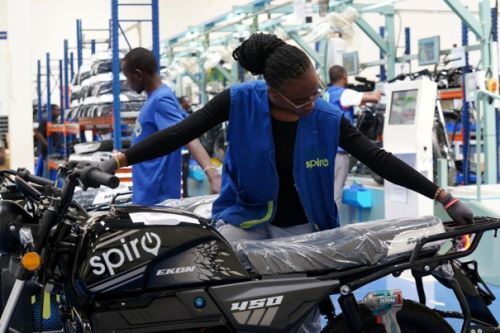
Electric mobility company Spiro has secured $420 million in financing since October 2025, including a newly announced $55 million equity investment from China’s NewTrails Capital, as the company accelerates expansion of its electric motorcycle and battery-swapping operations across Africa. The funding, announced on June 22, comes at a time when Africa’s electric two-wheeler market is experiencing rapid growth, driven by rising fuel costs, urban mobility demands, expanding battery-swapping networks and growing investor interest in clean transport infrastructure. The latest investment increases Spiro’s ongoing fundraising round to $270 million and brings its total capital raised over the past nine months to $420 million, making it one of the largest financing packages secured by an African electric mobility company.
The capital will be used to expand Spiro’s battery-swapping network, increase manufacturing capacity and strengthen operations across multiple African markets where demand for electric motorcycles continues to grow. The company currently operates in seven African countries and says it has deployed more than 100,000 electric vehicles and 2,500 battery-swapping stations. The latest investment highlights the increasing role of Chinese capital in Africa’s emerging clean mobility sector. While China has long dominated global electric vehicle supply chains, battery manufacturing and critical mineral processing, investors are increasingly looking beyond vehicle exports toward building local production ecosystems in developing markets.
Spiro said its partnership with NewTrails Capital is expected to support efforts to localize production and strengthen supply chains on the continent through closer cooperation with Chinese manufacturing partners. Such initiatives could have broader implications for African industrialization strategies, particularly as governments seek to develop local assembly and manufacturing capacity linked to the global energy transition.
“Having deployed 100,000 electric vehicles and 2,500 smart-swap stations across seven active markets, Spiro has firmly moved past the proof-of-concept phase. Partnering with NewTrail Capital’s deeply experienced team marks a powerful new chapter for Spiro as we prepare for the next steps of our pan-African and international expansion,”said Gagan Gupta, founder of Spiro.
The transaction follows a series of major financing agreements secured by the company in recent months. In February 2026, Spiro obtained $50 million in debt financing from the African Export-Import Bank (Afreximbank), Nithio and the Africa Go Green Fund. The financing package was designed to support fleet expansion and infrastructure deployment across key African markets. Earlier, in October 2025, the company raised an additional $100 million, including support from Afreximbank through the Fund for Export Development in Africa. The succession of funding rounds reflects growing confidence among development finance institutions, climate-focused investors and private capital providers in the commercial viability of Africa’s electric mobility sector.

According to the International Energy Agency’s Global EV Outlook 2026, electric motorcycle sales across Africa increased from fewer than 1,000 units in 2020 to approximately 70,000 units in 2025. While the continent remains a relatively small player in the global electric vehicle market, the pace of growth in the two-wheeler segment is attracting increasing attention from investors and policymakers. The expansion is particularly significant because motorcycles represent one of Africa’s most important transport modes. Across East and West Africa, millions of people rely on motorcycles for passenger transport, goods delivery and last-mile logistics. In countries such as Kenya and Uganda, motorcycle taxi operators play a critical role in urban and rural mobility systems, creating a natural market for lower-cost electric alternatives.
According to the IEA, Kenya recorded more than 25,000 electric motorcycle sales in 2025, accounting for roughly 15% of all new motorcycle registrations during the year. Uganda registered more than 30,000 electric motorcycle sales over the same period, making it one of Africa’s fastest-growing electric mobility markets. Industry analysts attribute the growth to a combination of factors including lower operating costs, expanding battery-swapping infrastructure and innovative financing models that reduce upfront purchase costs for riders. Battery-swapping systems are proving particularly attractive because they eliminate long charging times and allow operators to remain productive throughout the day.
The economics are becoming increasingly compelling for commercial riders. Fuel expenses represent one of the largest operating costs for motorcycle taxi operators, while maintenance costs for electric motorcycles are generally lower than those of conventional internal combustion engines. As fuel prices remain volatile across many African markets, electric alternatives are becoming more financially attractive for transport entrepreneurs. For African economies, the implications extend beyond transportation. The transport sector remains a major contributor to fossil fuel imports across many countries, placing pressure on foreign exchange reserves and public finances. Wider adoption of electric mobility could help reduce fuel import bills over time while supporting new industrial value chains linked to battery technology, vehicle assembly and renewable energy infrastructure.
https://www.aecweek-registration.com/2026/
The growth of battery-swapping networks also creates opportunities for investment in energy infrastructure, digital payment systems and local manufacturing ecosystems. However, challenges remain, including limited access to affordable financing, underdeveloped electricity infrastructure in some markets and the need for supportive regulatory frameworks that can accommodate rapid technological change. Nevertheless, the scale of investment flowing into companies such as Spiro suggests that electric motorcycles are increasingly moving from pilot projects to commercially viable transport solutions. As investors seek opportunities linked to Africa’s energy transition and urbanization trends, electric mobility is emerging as one of the continent’s fastest-growing clean technology sectors.
The latest financing round positions Spiro to expand its footprint during a period when African cities are confronting rising transport demand, fuel cost pressures and growing interest in lower-emission mobility solutions. Whether that growth can be sustained at scale will depend not only on continued investor confidence but also on the ability of governments, infrastructure providers and private operators to build the broader ecosystem required to support an electric transport future.


