


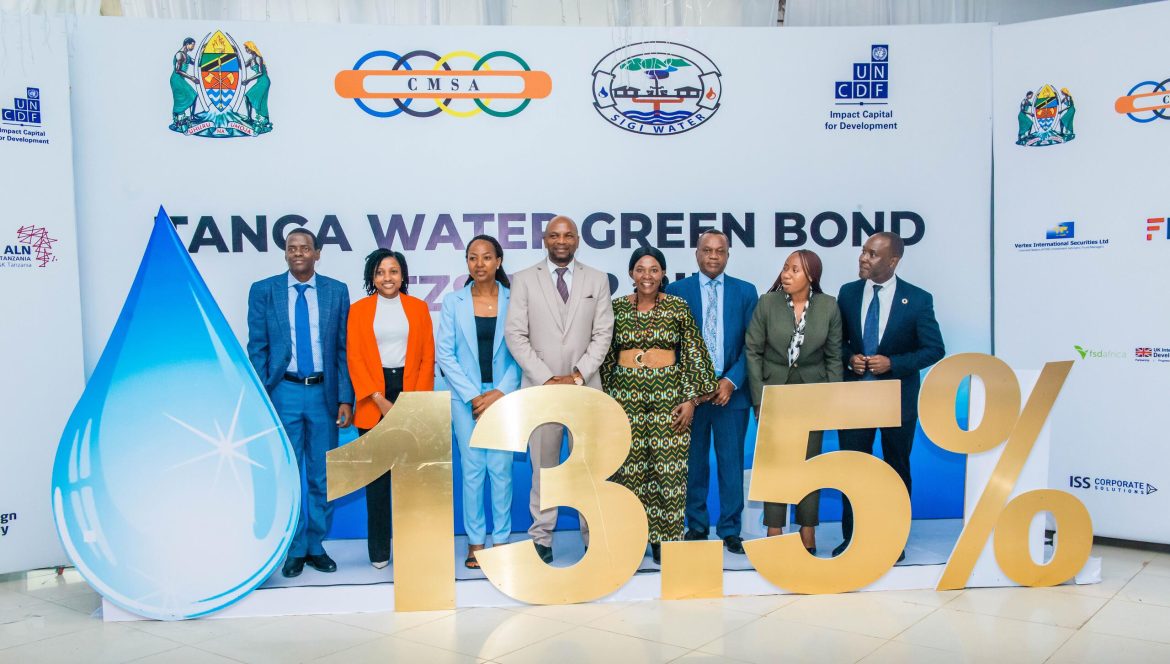
Tanzania’s Tanga Urban Water Supply and Sanitation Authority (Tanga UWASA) has demonstrated how a subnational green bond can connect capital-market finance with water infrastructure and watershed conservation, but the experience also shows that successful climate finance depends on institutions, community networks and local capacity built long before a financial instrument is issued.
The TZS 53.1 billion green bond issued by Tanga UWASA is East Africa’s first subnational green bond and was designed to finance improvements to the water system serving Tanga and surrounding areas. According to the University of Oxford’s Smith School of Enterprise and the Environment, part of the proceeds is being directed towards conservation in the Zigi River catchment, the upstream source underpinning the region’s water supply. A recent field study published by the Smith School argues that the significance of the transaction lies not only in the capital it raised, but in the institutional relationships that existed before the bond was issued.
That distinction is important for African markets where the need for climate and infrastructure finance is rising while public budgets remain under pressure. The Tanga case suggests that the effectiveness of green finance can depend as much on the institutional architecture surrounding a project as on the financial instrument itself. In the Zigi catchment, relationships between upstream farming communities, downstream water users and public agencies had been developing for more than a decade before the green bond entered the picture.
At the centre of that history is UWAMAKIZI, a community-based organisation that emerged from an Equitable Payment for Watershed Services programme launched in 2010 by WWF Tanzania and CARE International. Formally registered in 2013 with 473 members across five villages, the organisation now represents almost 3,000 members across 35 villages, according to the Oxford field research. Its role illustrates how locally governed institutions can become an intermediary between environmental objectives and the economic activities of communities whose livelihoods depend on the same natural resources that downstream infrastructure relies upon.
The economic connection is straightforward. Tanga UWASA depends on the Zigi River for water, while land-use practices upstream affect erosion, sedimentation and water quality. Investment in catchment management can therefore have implications for the cost and reliability of downstream water services. The green bond allocates about TZS 525 million, or roughly 1% of its proceeds, to activities including marking and protecting the boundaries around the Mabayani Dam and expanding conservation work in the UWAMAKIZI project area.
The wider bond is intended to address infrastructure constraints alongside environmental risks. According to the United Nations Capital Development Fund, the financing supports an expansion of water production and supply capacity from 45,000 to 60,000 cubic metres a day, an additional 60 kilometres of distribution network, rehabilitation of 110 kilometres of existing pipes and the installation of 12,000 smart prepaid meters. The programme is expected to extend services to about 6,000 additional households while reducing water losses from the existing system.
The structure also provides an example of how domestic capital can participate in climate adaptation finance. The bond was 103% oversubscribed, with 65% of the investment coming from Tanzanian institutional investors, including pension funds, insurers, fund managers and financial institutions. The remaining investment came from members of the public, including diaspora investors and small-business owners. UNCDF said its $1 million catalytic grant helped absorb early risks and crowd in investment, producing a leverage ratio of 1 to 20.
For Tanzania, this matters beyond the individual water utility. Local authorities and public utilities across Africa face growing infrastructure needs at a time when sovereign balance sheets are constrained and commercial borrowing can be expensive. The Tanga transaction provides a case study in whether subnational entities with predictable revenue streams can use domestic capital markets to finance infrastructure in local currency rather than relying exclusively on national government allocations or foreign-currency borrowing. UNCDF has described the bond as a potentially replicable model for municipalities and subnational public entities seeking to finance local development projects.
The Zigi catchment also demonstrates why environmental protection cannot always be separated from economic planning. The Pangani Basin Water Board identifies the Zigi and Ruvu catchments as important water-producing landscapes within Tanzania’s Eastern Arc, while land degradation, deforestation, population growth and inadequate infrastructure have placed pressure on their ability to provide reliable water services. Declining water quantity and quality can ultimately increase costs for downstream users and intensify pressure on already constrained public infrastructure.
The conservation programme has attempted to address those pressures through activities that also affect household livelihoods. According to UWAMAKIZI, more than 1,000 farmers have received training, community nurseries have been established, more than 75,000 seedlings planted and nearly 18,000 trees restored along riverbanks. Farmers have also adopted perennial crops including cocoa, cloves, cinnamon, avocado and citrus, although earlier assessments identified limited market access as a constraint to sustaining participation. More recent efforts to connect producers with buyers, including through digital auction channels, point to the importance of linking conservation finance with viable local economic opportunities.
That experience exposes a broader challenge for sustainable finance in Africa. Financial markets can mobilise capital for infrastructure and environmental projects, but they cannot by themselves create the governance systems needed to manage those investments. Where community organisations, public agencies, utilities and local governments lack clear roles, additional financing can struggle to translate into durable outcomes. Conversely, where those relationships already exist, a financial instrument can reinforce and expand an institutional system that is capable of delivering services over time.
This has implications for the rapidly expanding conversation around green bonds, carbon markets, biodiversity finance and other climate-finance instruments across Africa. The focus is often placed on the volume of capital raised, the size of an issuance or the number of projects financed. The Tanga experience suggests that investors and policymakers also need to examine what sits underneath those transactions: who owns the assets, who manages them, how revenues are collected, how environmental outcomes are measured, and whether communities and public institutions have the capacity to maintain the systems being financed.
The approach may become increasingly relevant as African cities face simultaneous pressures from population growth, climate variability, ageing infrastructure and limited fiscal space. Water utilities are particularly exposed because their financial performance is closely linked to the condition of natural water systems. Protecting a catchment can therefore function not simply as an environmental intervention, but as part of the risk-management strategy for essential infrastructure.
 Tanga’s experience does not remove the challenges associated with scaling green finance. The conservation allocation within the bond remains relatively small compared with the overall infrastructure investment, and the long-term effectiveness of catchment protection will depend on continued institutional coordination, monitoring and sustainable financing. The Oxford research also highlights the need to understand whether the organisations and relationships required to implement new financing are already established or must first be developed.
For African governments, utilities and investors, that may be one of the most practical lessons from the Zigi River. The question is not simply how to raise more green capital, but whether financial resources are being directed through institutions capable of converting investment into reliable services, stronger local economies and measurable environmental outcomes. In Tanzania, the history behind the bond suggests that the foundations for that conversion were laid years before the transaction reached the capital market.


