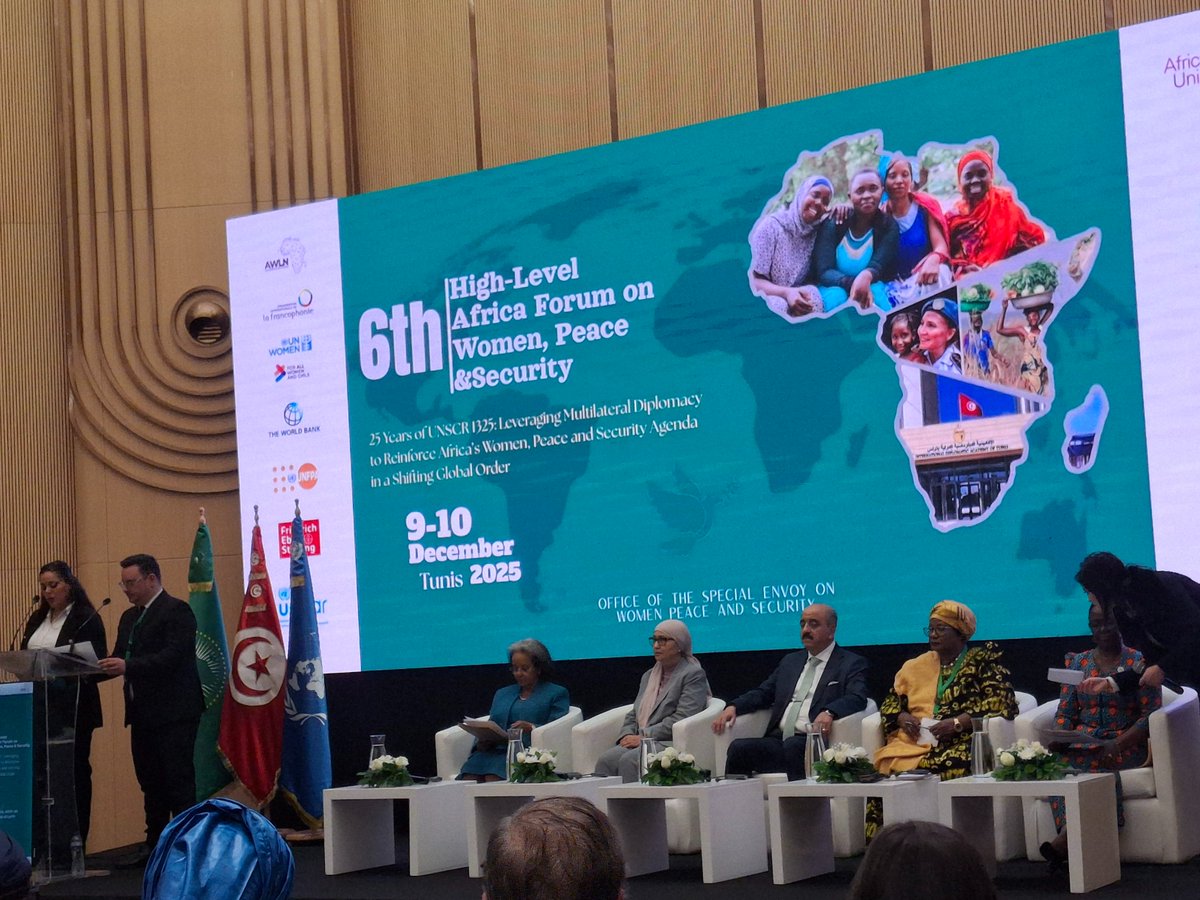

The African Union on Monday opened the 6th High-Level Africa Forum on Women, Peace and Security (WPS) in Tunis, bringing together senior officials, former heads of state, diplomats and civil society leaders to examine the continent’s progress and setbacks 25 years after the adoption of UN Security Council Resolution 1325.
The gathering, held under the theme “Leveraging Multilateral Diplomacy to Reinforce Africa’s Women, Peace and Security Agenda in a Shifting Global Order,” sought to chart a clearer path for women’s leadership in peacebuilding at a moment when conflict, political instability and shrinking civic space continue to disrupt African societies.
From the outset, the tone of the Forum was shaped by the African Union Commission Chairperson, H.E. Mahmoud Ali Youssouf, whose video address paid tribute to women who are holding fractured communities together across the continent.
Read also: East Africa risks €2.75B in farm exports as EU traceability rules expose major compliance gaps
He singled out the women of Sudan, who continue to organize humanitarian support amid one of the world’s most devastating conflicts; women in the Great Lakes region, who navigate cycles of displacement and uncertainty; and women in the Sahel, whose daily resilience sustains entire communities despite persistent insecurity.
His message underscored a largely unspoken truth: that the continent’s most vulnerable populations often remain standing because women refuse to let society collapse around them.
Youssouf reiterated that the AU intends to elevate implementation over rhetoric. He argued that the next decade of the WPS agenda must centre accountability, stronger financing and deliberate efforts to place women in leadership roles across national and regional institutions.

He referenced the convergence of three developments, the global momentum around the 16 Days of Activism campaign, a renewed G20 commitment to women’s rights, and the AU’s new Convention on Ending Violence Against Women and Girls (CEVAWG), as a foundation for more decisive action. However, he stressed that the presence of political commitments means little unless they translate into improved protection mechanisms and stronger participation by women in peace and security processes.
His message aligned closely with that of the AU Chairperson’s Special Envoy on Women, Peace and Security, H.E. Ambassador Liberata Mulamula, who reminded delegates that Africa’s progress in the WPS arena has always depended on cooperation rather than fragmentation.
Mulamula cautioned governments against slipping behind earlier gains, noting that the complex security environment, shaped by armed conflict, terrorism, resource pressures and democratic backsliding, requires sustained attention to the obligations all Member States have already agreed to uphold.
Read also: Kenyan Activist Truphena Muthoni breaks 72+ hour tree-hugging Guinness World Record
Mulamula emphasised the slow pace of ratifying CEVAWG, which only seven countries have endorsed to date. The Convention, designed to create legally binding commitments to end violence against women and girls, remains one of the continent’s most ambitious tools. She argued that without broad ratification, African governments will continue to rely on fragmented national laws that leave millions without adequate protection.
The expectation, she noted, is that the Tunis Forum should provide a blueprint for the next ten years of the WPS agenda, ensuring it moves beyond advocacy into measurable change.
Tunisia, hosting the Forum, used the moment to highlight its longstanding record of advancing women’s rights. H.E. Mohamed Ali Nafti, Minister of Foreign Affairs and Immigration of Tunisians Abroad, reminded delegates that the country’s reforms began soon after independence with the 1956 Personal Status Code, a piece of legislation that distinguished Tunisia in the region for expanding women’s legal and social freedoms.
The country’s 2022 Constitution further consolidated this trajectory by embedding equality and paving the way for the appointment of the region’s first female Head of Government. Nafti stressed that these developments are not symbolic; they reflect a national belief that women must participate fully in shaping peace processes, not simply respond to their consequences.
Read also: Gender Based Violence in Kenya: How a national crisis is undermining Social Sustainability
Two former presidents, H.E. Sahle-Work Zewde of Ethiopia and H.E. Joyce Banda of Malawi, anchored the conversation in the realities facing women in conflict-affected areas. Sahle-Work described how displacement, loss of livelihoods and insecurity place disproportionate strain on women, whose labour often becomes the invisible safety net that communities rely on during instability.
She urged governments and partners to confront the political and economic interests that fuel conflict, arguing that peace must be treated as a strategic investment rather than an aspiration.
Banda echoed this and reminded participants that UNSCR 1325 represented a turning point globally, recognising women as agents whose leadership is integral to resolving conflict. She noted that African women have been at the forefront of peace mediation, community reconciliation and humanitarian coordination long before international frameworks acknowledged their role.
Additional perspectives came from Hon. Justice Emeritus Effie Owuor, who outlined how conflict dynamics are being reshaped by digital platforms used to spread misinformation, harassment and incitement. Owuor warned that peacebuilding approaches must evolve to reflect these shifts.
She urged leaders to strengthen early warning systems, reinforce mediation mechanisms, and end the pattern of excluding women from decisions that directly affect them. Policies, she argued, must be connected to lived realities if they are to produce lasting security.
The Forum also heard from H.E. Ms. Nyaradzayi, who called for increased investment in women peacebuilders and stronger support for young women preparing to enter leadership roles. UN Women affirmed its full backing for AU Member States as they work to meet their WPS commitments, emphasising the need for consistent monitoring and resourcing.

Ms. Grace Kabayo, drawing on decades of experience within the Pan-African Women’s Organization (PAWO), encouraged a revival of continent-wide organising. She expressed solidarity with countries facing ongoing instability, including South Sudan, Burundi and the Democratic Republic of Congo, and argued that early action is essential to prevent crises from widening. Kabayo urged African women to build collective influence, defend democratic governance and protect those who step into public leadership roles.
The Forum was officially opened by Tunisia’s Minister of Family, Women, Childhood and Seniors, H.E. Asma Jebri, who formally welcomed participants and affirmed Tunisia’s responsibility as host to set the pace for the next phase of the WPS agenda. Her message was clear: women’s leadership is not a peripheral concern but a continental priority that shapes peace, stability and development.
Engage with us on LinkedIn: Africa Sustainability Matters
Engage with us on LinkedIn: Africa Sustainability Matters