


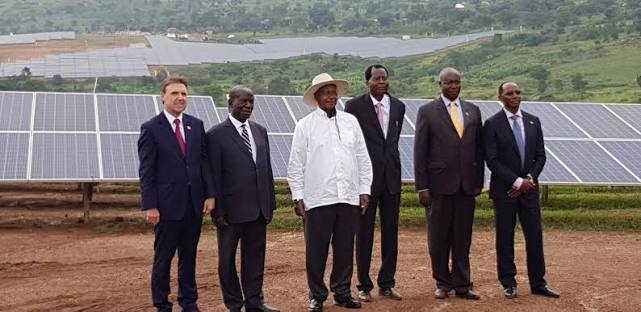
Uganda has energised AMEA Power’s 24 MWp Ituka Solar Photovoltaic plant in the West Nile region, bringing a utility-scale renewable energy project into operation in one of the country’s historically underserved electricity markets and adding new generation capacity to the national grid. The project, located in Ombachi village in Madi Okollo District, is expected to generate about 53,940 MWh of electricity annually and demonstrates how investment in generation and transmission infrastructure can work together to expand Uganda’s clean-energy capacity and support regional economic development. AMEA Power says the plant is its first operational asset in Uganda.
The project is being implemented through Ituka West Nile Uganda Limited, a wholly owned subsidiary of AMEA Power, on a 52-hectare site approximately 450 kilometres from Kampala. Electricity generated by the facility is evacuated through a 33/132 kV transformer substation and connected to the Lira-Gulu-Nebbi-Arua 132 kV transmission line operated by the Uganda Electricity Transmission Company Limited (UETCL). This connection is significant because it integrates generation from West Nile into the wider national electricity system rather than limiting the plant to a local or isolated supply network.
The energisation follows a project development process that began several years ago. AMEA Power and UETCL signed a Power Purchase Agreement in September 2023, alongside an Implementation Agreement with Uganda’s Ministry of Energy and Mineral Development. Construction formally began in August 2024, when the project was described as the first utility-scale grid-connected solar PV facility in the West Nile region.

The original financing structure illustrates the importance of development finance and risk mitigation in attracting private capital to African power projects. The project secured $19 million in financing from the Emerging Africa Infrastructure Fund, while the African Trade and Investment Development Insurance supported the development through its Regional Liquidity Support Facility. Such arrangements can improve the bankability of projects by addressing some of the financial and payment risks associated with long-term electricity contracts in emerging markets.
AMEA Power estimates that the plant can provide electricity equivalent to the needs of more than 192,000 households and avoid approximately 26,600 tonnes of carbon emissions annually. These figures are based on the project’s expected generation and represent potential benefits once the facility operates at its anticipated performance levels.
For West Nile, the project has significance beyond its contribution to Uganda’s overall generation capacity. The region has faced longstanding challenges associated with electricity access, network development and reliability. Uganda’s Ministry of Energy and Mineral Development has previously identified the expansion of electricity connections and transmission infrastructure in West Nile as priorities, including through rural electrification programmes and the Electricity Access Scale-Up Project.
The availability of generation capacity alone does not automatically translate into universal electricity access. Connections, distribution networks, transmission capacity and affordability remain essential components of electricity development. Nevertheless, adding generation capacity close to an expanding transmission network can strengthen the foundation upon which further connections and productive uses of electricity can be developed.
The Ituka project also demonstrates the increasingly important relationship between renewable-energy generation and grid infrastructure in Africa. Solar projects can be developed relatively quickly compared with some conventional generation technologies, but their economic value depends on the ability of transmission and distribution systems to absorb and deliver their output. In West Nile, the Lira-Gulu-Nebbi-Arua transmission corridor provides the infrastructure through which Ituka can contribute to the national power system.
Uganda already has a relatively renewable electricity system, with hydropower historically accounting for a large share of generation. Adding utility-scale solar provides another source of renewable electricity and can diversify the generation portfolio. The value of that diversification is particularly relevant as African power systems contend with changing rainfall patterns, rising electricity demand and the need to expand generation without locking economies into higher-emission technologies.
The financing model is also relevant to Uganda’s broader energy investment strategy. The Ituka project combines an independent power producer, a government ministry, a public transmission utility, a development-finance institution and a specialised infrastructure insurer. This illustrates the layered structure increasingly required to bring renewable-energy projects from development to financial close and eventually operation.
For investors, the project highlights the importance of bankable power-purchase agreements and mechanisms that address the financial risks of electricity offtake. For governments, it underscores the need to coordinate generation investment with transmission expansion and electricity-access policies. For communities, the ultimate measure will be whether improved electricity infrastructure translates into more reliable services, business activity, employment and economic opportunities.
AMEA Power has also said its community investment programmes associated with the project include initiatives covering gender equality, education and training. These programmes are intended to complement the infrastructure investment by supporting socioeconomic development around the project area. The project’s environmental and social dimensions are also part of the wider development framework. Documentation associated with the project includes environmental and social assessments and community engagement mechanisms, while the World Bank Group’s Multilateral Investment Guarantee Agency has published project-related environmental and social documentation for Ituka.
The plant’s expected annual output of nearly 54 GWh is modest compared with Uganda’s national electricity system, but its regional importance is greater. The project represents the type of distributed utility-scale investment that can help extend renewable generation beyond established power-generation centres and bring private capital into areas where infrastructure constraints have historically limited investment. That pattern matters across Africa. The continent’s electricity-access challenge is not simply a question of generating more power; it also involves building transmission and distribution networks, strengthening utilities, improving project bankability and ensuring that electricity reaches households and productive sectors. Projects such as Ituka show how these components can be combined within a single investment structure.
The next challenge for Uganda will be translating additional generation into broader economic value. Reliable electricity can support agricultural processing, small and medium-sized enterprises, health facilities, schools, telecommunications and other productive activities, but those benefits depend on affordable connections and functioning distribution infrastructure.
The energisation of Ituka therefore represents a wider development milestone for Uganda’s energy transition. By combining utility-scale solar generation with transmission infrastructure and development-finance support, the project provides a practical example of how renewable energy can be deployed outside traditional generation centres while contributing to national electricity objectives.
For West Nile, the significance lies in bringing new generation into a region where improved electricity infrastructure is closely linked to economic inclusion. For Uganda, the project adds renewable capacity and diversification to the national power system. And for Africa more broadly, it reinforces the importance of mobilising private investment alongside public infrastructure and development finance if the continent is to expand electricity access while managing the economic and climate pressures associated with rising energy demand.


