


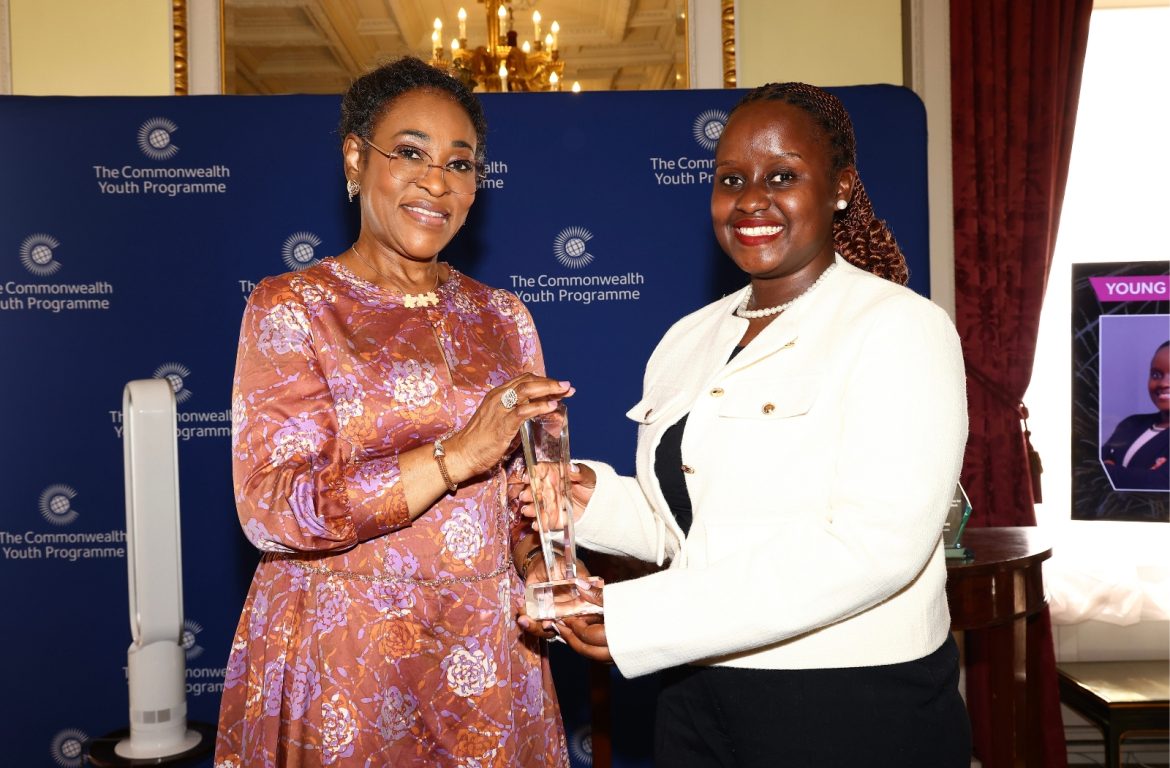
Ugandan technology entrepreneur Shifra Ainomugisha has been named the 2026 Commonwealth Young Person of the Year after developing artificial intelligence and solar-powered agricultural technologies designed to reduce post-harvest losses, improve food security and strengthen the resilience of Africa’s smallholder farmers. The recognition highlights the growing role of youth-led innovation in addressing one of the continent’s most persistent development challenges: producing sufficient food while preventing millions of tonnes from being lost before reaching consumers.
The award, presented during the 2026 Commonwealth Youth Awards in London, recognised Ainomugisha’s work through Solafam Uganda Ltd, a social enterprise that integrates solar-powered cold storage, renewable energy irrigation systems and artificial intelligence to help farmers preserve harvests, improve productivity and increase rural incomes. Selected from nearly 1,000 applicants across the Commonwealth’s 56 member countries, she was also recognised as the regional winner for Africa under Sustainable Development Goal (SDG) 2 on Zero Hunger.
 Her achievement reflects a broader shift taking place across Africa, where digital technologies, renewable energy and climate-smart agriculture are increasingly being viewed not simply as innovation sectors but as essential components of food system resilience. According to the Commonwealth Secretariat, the Youth Awards recognise young leaders developing practical solutions that advance sustainable development while creating measurable social and economic impact.
Ainomugisha’s journey began not in a research laboratory but on her family’s tomato farm in Western Uganda, where nearly half of each harvest was routinely lost before reaching the market because of inadequate storage and weak agricultural infrastructure. Despite producing food, the family struggled to generate sufficient income to meet basic needs, including school fees. Those experiences shaped a determination to develop technologies capable of addressing both food waste and rural poverty simultaneously.
Today, Solafam Uganda operates an integrated agricultural model centred on three complementary technologies. Solar-powered cold storage facilities extend the shelf life of fresh produce, allowing farmers to avoid distress sales immediately after harvest. Solar irrigation systems reduce dependence on costly diesel pumps while enabling year-round cultivation. Complementing both is Lean AI, a WhatsApp-based artificial intelligence platform that provides farmers with real-time advice on planting, irrigation scheduling, pest management, post-harvest handling and market access.
The approach addresses structural weaknesses that continue to undermine African agriculture. According to regional agricultural assessments, post-harvest losses remain among the largest constraints to food security across Sub-Saharan Africa, with inadequate storage, unreliable energy access, limited extension services and fragmented market systems significantly reducing the value of agricultural production. Smallholder farmers, who produce most of the food consumed across much of the continent, remain disproportionately exposed to these inefficiencies.
Solafam reports that its technologies have reduced post-harvest losses among participating farmers by approximately 30 percent while increasing household incomes by nearly 28 percent. Although the enterprise remains concentrated in Uganda, its business model demonstrates how decentralised renewable energy and digital technologies can complement one another to improve agricultural productivity without increasing environmental pressures.
The significance of the innovation extends beyond farm-level productivity. Agriculture contributes between 20 and 30 percent of gross domestic product in many African economies while employing most rural populations. Reducing food losses could strengthen national food security, increase export competitiveness, improve household incomes and reduce pressure to expand agricultural production into environmentally sensitive ecosystems.
Artificial intelligence is also emerging as a potentially transformative tool for agricultural extension services across Africa. Many governments face persistent shortages of extension officers capable of reaching remote farming communities. AI-enabled advisory platforms provide an opportunity to supplement traditional extension systems by delivering timely, location-specific guidance through widely available mobile technologies. Solafam is now adapting its advisory platform to function through USSD technology, allowing farmers without smartphones to access agronomic information using basic mobile devices.
Renewable energy remains equally central to the enterprise’s approach. Solar-powered irrigation and cold storage reduce reliance on fossil fuels while addressing one of the principal barriers to agricultural commercialisation: unreliable electricity access. Across rural Africa, inadequate energy infrastructure continues to constrain value addition, food preservation and agro-processing, contributing to significant economic losses throughout agricultural supply chains.
The recognition of Ainomugisha’s work also reflects increasing international attention on the role of young entrepreneurs in delivering climate adaptation solutions. Africa possesses the world’s youngest population, with millions of young people entering labour markets annually. Expanding access to green technologies, digital innovation and climate-smart enterprises could generate employment opportunities while strengthening economic resilience against climate-related shocks.
Women remain central to this transformation. Across much of Sub-Saharan Africa, women constitute a significant proportion of the agricultural workforce yet frequently face unequal access to land, finance, technology and extension services. Solafam’s programmes deliberately prioritise women farmers, reflecting evidence that improving women’s access to productive resources contributes directly to higher agricultural output, improved household welfare and stronger community resilience.
 The award also reinforces growing recognition that addressing food insecurity requires more than increasing agricultural production alone. Investments in storage infrastructure, renewable energy, digital advisory services and market access increasingly form part of comprehensive strategies aimed at strengthening food systems under changing climatic conditions.
As governments, development finance institutions and private investors expand support for agricultural transformation across Africa, innovations such as those pioneered by Ainomugisha demonstrate how locally developed technologies can address structural development challenges while advancing climate resilience, rural industrialisation and inclusive economic growth. Her recognition illustrates that Africa’s food security agenda is increasingly being shaped not only through national policy but also through youth-led enterprises capable of translating lived experience into scalable development solutions.


