
The United Nations and its partners on Monday, December 8, 2025, unveiled a $33 billion global humanitarian appeal aimed at saving millions of lives across countries battered by war, climate shocks, crop failures, epidemics, and natural disasters. The immediate phase of the appeal seeks $23 billion to support 87 million people in urgent need, while the full plan for 2026 targets 135 million people across 23 country operations and six regional programs for refugees and migrants.
The announcement, made in a hybrid press event coordinated by the UN Office for the Coordination of Humanitarian Affairs (OCHA), underscores the scale of the challenges confronting Africa and the broader Global South.

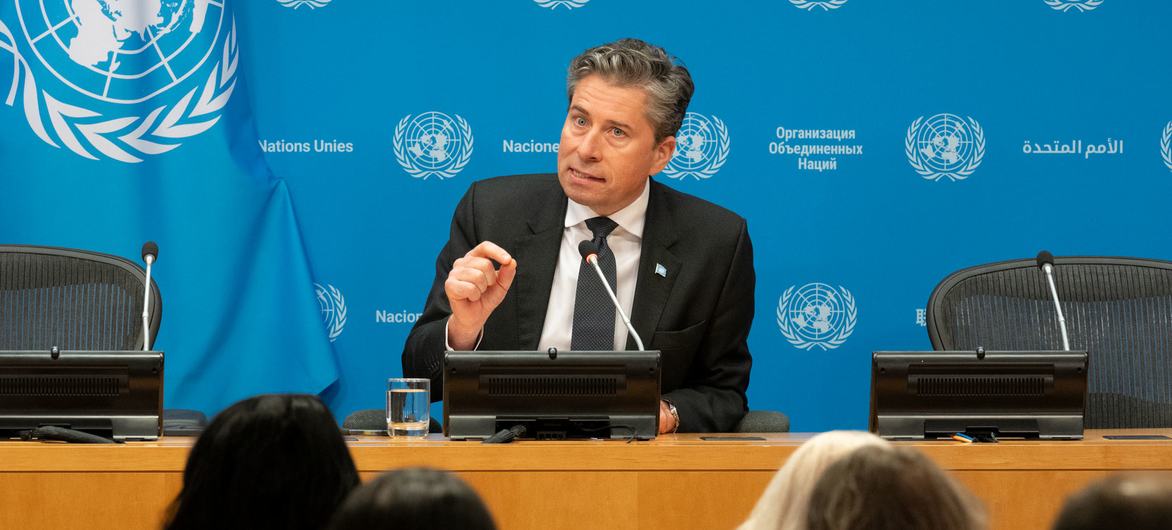
Tom Fletcher, Under-Secretary-General for Humanitarian Affairs and Emergency Relief Coordinator (UNOCHA), briefs journalists at UN Headquarters. Image source: UN News Image source: UN News
Tom Fletcher, UN Under-Secretary-General for Humanitarian Affairs and Emergency Relief Coordinator, emphasized the human focus of the appeal. “This appeal sets out where we need to focus our collective energy first: life by life,” he said.
Fletcher described the Global Humanitarian Overview 2026 as a blueprint grounded in evidence, reform, and efficiency, with a shift toward empowering local organizations and directing resources to those most affected.
The appeal comes after a year of record strain on humanitarian operations. In 2025, funding dropped to $12 billion, the lowest in a decade, resulting in aid organizations reaching 25 million fewer people than the previous year. The consequences were immediate and severe. Communities across East and West Africa faced surging hunger, crumbling healthcare systems, stalled education, and interrupted mine-clearance operations. Families were left without shelter, cash assistance, or protection services, while more than 320 aid workers were killed, the majority of them local staff.
Read also: How EU’s softer pollution rules could hurt Africa’s green exports
Africa remains at the epicenter of many of these crises. Sudan, hosting the world’s largest displacement crisis, requires $2.9 billion to reach 20 million people, while Ethiopia, the Sahel region, and parts of the Horn of Africa continue to face compounded climate-driven shocks, including prolonged droughts, floods, and locust infestations. In the Occupied Palestinian Territory, $4.1 billion is needed to reach three million people impacted by ongoing conflict, illustrating the global reach of urgent humanitarian need. Syria, similarly, will require $2.8 billion to reach 8.6 million people.
The UN’s strategy focuses not only on emergency response but also on operational efficiency and market support. Aid agencies are cutting duplication, purchasing locally, and ensuring that resources directly benefit the communities in need. In West Africa, for instance, local procurement of food and medicine strengthens markets and reduces dependency on distant supply chains, while in East Africa, investments in local infrastructure such as water storage and cold chains enhance both humanitarian reach and long-term resilience.

The success of the appeal depends heavily on the response from UN Member States. Fletcher stressed the political dimension: “I will then share the amounts committed and answer a simple question: did governments show up? The answer will define who lives and who falls through the cracks.” Countries are also urged to strengthen protection for civilians and humanitarian workers, particularly in regions experiencing armed conflict, where violations of international law exacerbate human suffering.
Beyond immediate relief, the appeal highlights systemic gaps in Africa’s resilience. In many countries, fragile health systems, limited social protection networks, and weak early-warning mechanisms amplify the effects of droughts, floods, and conflict. In Ethiopia and Somalia, for example, successive failed rainy seasons have left millions dependent on food assistance. Similarly, in the Lake Chad Basin, displacement and food insecurity intersect with insecurity, complicating delivery of aid and increasing operational risks.
The appeal also shines a light on the critical role of local actors. By channeling funding through national and community organizations, the UN aims to build capacity on the ground while creating more sustainable delivery models. Local NGOs, farmer cooperatives, and municipal authorities in countries such as Kenya, Nigeria, and Mozambique are increasingly tasked with managing logistics, distributing food and medical supplies, and monitoring vulnerable populations, marking a shift from traditional centralized humanitarian models.
The 2026 appeal underscores the widening gap between humanitarian need and global funding availability. With climate change accelerating and conflicts persisting, Africa and other vulnerable regions are expected to remain on the frontline of crises. Experts argue that sustained investment, strategic partnerships, and political will are necessary not only to save lives today but to stabilize communities, support development, and prevent recurring emergencies.

For African governments, civil society, and private sector partners, the appeal represents both a lifeline and a call to action. Beyond financing, it demands coordinated planning, better data systems, and integration of humanitarian interventions with longer-term resilience strategies. The coming months will test whether the global community can match urgent rhetoric with sufficient resources, ensuring that millions of people facing hunger, displacement, and disaster do not slip further into crisis.
The UN’s $33 billion appeal is a stark reminder that in a rapidly changing world, humanitarian needs are intensifying faster than funding mechanisms, and that global solidarity is crucial if Africa and other regions are to withstand shocks while advancing sustainable recovery.
Engage with us on LinkedIn: Africa Sustainability Matters
Engage with us on LinkedIn: Africa Sustainability Matters