


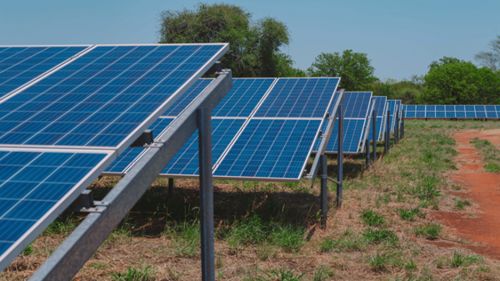
Mozambique’s state-owned utility Electricidade de Moçambique (EDM) and Mozambican conglomerate VBC Corporation are planning a $69 million, 45-megawatt solar photovoltaic plant in Lamego, central Mozambique, as the country expands renewable generation and grid infrastructure to support its target of universal electricity access by 2030.
The proposed Nhamatanda Solar Power Station, to be located in Lamego in Nhamatanda district, Sofala province, has entered the environmental licensing process, with public consultations forming part of the environmental impact assessment. According to documentation reviewed by Lusa and reported by Club of Mozambique, the project would occupy about 160 hectares and connect to the Lamego substation through two 110-kilovolt transmission lines extending about 11.9 kilometres.
The project comes as Mozambique attempts to expand electricity supply while bringing more of its population and productive economy into the formal power system. The government’s National Energy Plan targets electricity access for all Mozambicans by 2030, up from 60.1% in 2024 according to the International Energy Agency. The plan also envisages adding 3.1 gigawatts of new generation capacity and increasing the share of renewable energy in the country’s generation mix.

The latest project therefore sits at the intersection of three infrastructure requirements: new generation, transmission capacity and last-mile connections. A solar plant alone does not translate automatically into electricity access. The power must be evacuated through adequate transmission infrastructure and distributed through a network capable of connecting households, businesses and public institutions. The Lamego project’s proposed grid connection is consequently an important component of the investment. The two 110-kV lines would transport electricity from the solar plant to the Lamego substation before feeding it into Mozambique’s national electricity grid. This infrastructure is designed to allow the generation asset to contribute directly to the wider public power system rather than operate as an isolated electricity source.
The environmental assessment is also significant because the project is planned across approximately 160 hectares. Documentation submitted for public consultation identifies potential effects on agricultural land, livelihoods and sites of cultural importance. The assessment includes measures relating to resettlement and livelihood restoration for families that could be affected by the development. For Mozambique, these issues are increasingly relevant as energy infrastructure moves beyond large generation projects into areas where electricity access, agriculture and local economic activity overlap. Environmental licensing is therefore not simply a procedural stage. The quality of land-use assessments, consultation and compensation arrangements can influence both project implementation and the long-term relationship between infrastructure developers and host communities.
The project is being developed as part of Mozambique’s broader Energia para Todos, or Energy for All, programme, which was launched to accelerate electricity access across the country. The World Bank says the programme has already delivered substantial gains through the ProEnergia project, which connected more than 514,000 households between 2020 and 2024 and provided electricity to public facilities including schools and health posts. The project also helped EDM expand its distribution network by about 30%, from 3,800 kilometres to 4,889 kilometres.
Mozambique’s current connection drive is continuing at pace. According to government data reported by Lusa, 75,411 new electricity connections were recorded in the first quarter of 2026. Of these, 44,743 were connected to the national grid, while 30,668 were supplied through independent systems using solar and small hydropower plants.
EDM has set a much larger target for the full year. The utility plans to deliver 420,000 new connections in 2026 and has an investment budget of about $82 million, with approximately $70 million coming from the World Bank-financed ProEnergia programme and $12 million from EDM’s own resources. According to EDM chairman Joaquim Ou-Chim, the investment programme is intended to support the acceleration of electricity access across the country.
That financing structure illustrates the role international development finance continues to play in Mozambique’s electricity expansion. Public utilities in many African countries face a difficult combination of high infrastructure costs, low average consumer purchasing power and the need to extend networks into sparsely populated areas. Development finance can help reduce the initial capital burden, while private-sector participation can provide additional sources of investment and project-development capacity.
The African Development Bank is also supporting Mozambique’s access agenda. In April 2026, the bank approved the second phase of its Mozambique Energy for All Programme, a results-based financing operation designed to expand electricity access in underserved provinces while strengthening power-sector governance and private-sector participation. The programme supports both on-grid last-mile electrification and off-grid solar mini-grids.
The World Bank’s wider programme is similarly moving beyond conventional grid expansion. Its ProEnergia Plus initiative has supported hundreds of thousands of additional connections, while the Accelerating Sustainable and Clean Energy Access Transformation in Mozambique project, known as ASCENT, is designed to support both on-grid and off-grid electrification. The World Bank says ASCENT’s first phase has an allocation of $131 million.
For VBC Corporation, the Lamego development represents another step into Mozambique’s energy infrastructure market. The company is already working with EDM on a separate 60 MW solar project near the Corumana dam in Maputo province, an investment estimated at about $110.6 million that is also undergoing environmental assessment. The involvement of a Mozambican-owned private company is relevant to the government’s wider effort to increase domestic participation in infrastructure development. Local companies can potentially bring knowledge of regulatory processes, land issues, labour markets and commercial conditions that international developers may need to build through partnerships.
The projects also illustrate the growing importance of solar power within Mozambique’s electricity strategy. The country has significant hydropower resources and remains an important regional electricity producer, but its generation and transmission system faces the challenge of serving a geographically dispersed population while supporting economic growth. The U.S. Department of Commerce estimates Mozambique has potential across hydro, gas, coal, wind and solar, and notes the government’s objective of universal electrification by 2030.
Solar generation offers an opportunity to diversify the supply mix, particularly as photovoltaic costs have fallen and project development has expanded across African markets. But Mozambique’s experience also shows that generation capacity needs to be planned alongside transmission and distribution investment. The Lamego project’s proposed 11.9-kilometre transmission connection is an example of how grid infrastructure becomes an integral part of the economics of a new renewable-energy project.
The scale of Mozambique’s access challenge remains substantial. Although official estimates cited in recent reporting put national electrification at around 66.4%, the government’s 2030 objective requires millions of additional connections. The country’s off-grid electrification framework also recognises that universal access will require a combination of national-grid connections, mini-grids and solar home systems rather than a single technology pathway. The International Energy Agency’s summary of Mozambique’s off-grid plan targets 6.9 million families through the national grid, 1.3 million through mini-grids and 2 million through solar home systems by 2030.
This makes projects such as Lamego relevant beyond their installed capacity. The 45 MW plant will not by itself close Mozambique’s access gap, but its value lies in adding generation to a system undergoing simultaneous expansion of transmission networks and consumer connections. The project’s next major test will be the completion of environmental licensing and the resolution of issues identified through public consultation. Financial close, construction, grid integration and eventual commercial operation will determine when the planned capacity becomes available to the national system. No construction timetable has been publicly established in the information currently available.
For Mozambique, the broader economic question is whether the country can maintain the pace of electricity expansion without creating new financial and operational pressures on its utility. For communities in central Mozambique, the practical measure will be whether new generation and grid investment ultimately produce reliable electricity for households, businesses, schools and health facilities while managing land and livelihood impacts associated with infrastructure development.
The Lamego project consequently reflects the wider direction of Mozambique’s energy transition: greater use of solar generation, stronger participation by domestic private capital and continued reliance on development-finance institutions to expand the electricity system. Its significance will ultimately be measured not only by the 45 MW of generation planned, but by how effectively that power is integrated into the national grid and translated into broader economic participation as Mozambique moves towards its 2030 universal-access target.


