


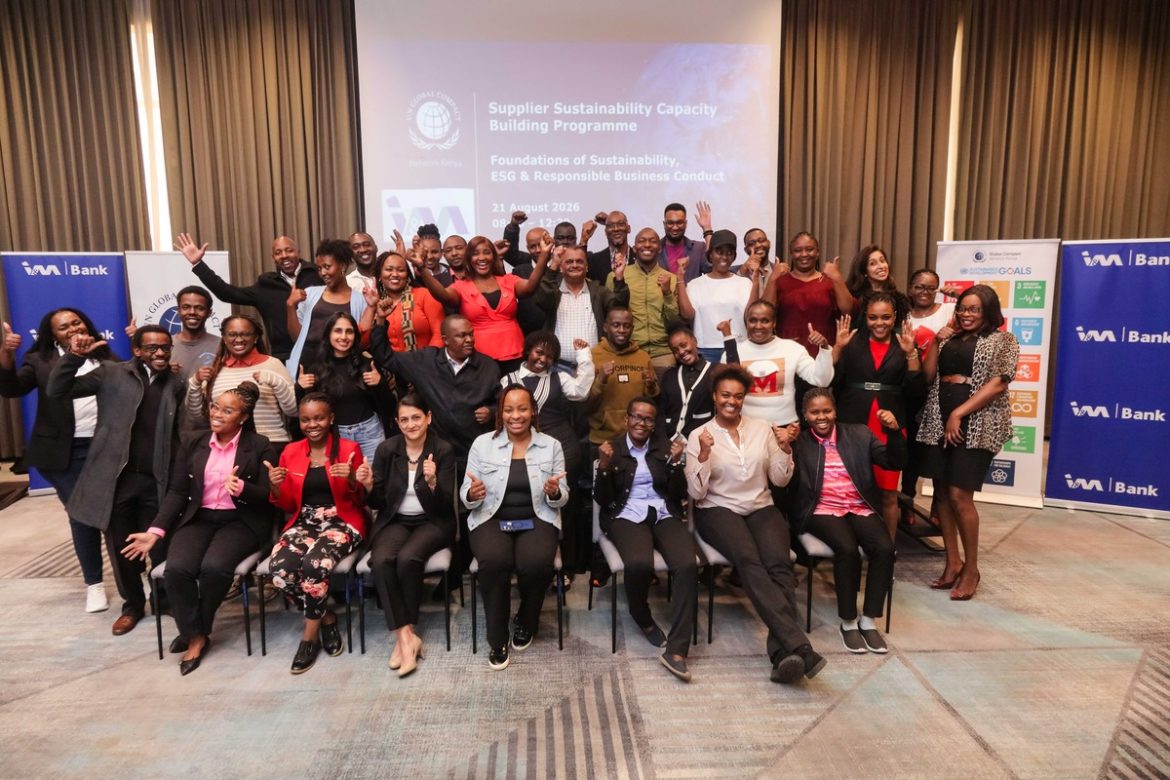
I&M Bank has partnered with the United Nations Global Compact Network Kenya to launch a supplier sustainability programme aimed at helping small and medium-sized enterprises strengthen environmental, social and governance practices, as financial institutions increasingly extend sustainability expectations beyond their own operations and into the wider business ecosystems on which they depend.
The Supplier Sustainability Capacity Building Programme was launched in Nairobi on Aug. 21, 2026, with a half-day workshop focused on responsible business practices. The fully sponsored initiative will provide participating I&M Bank SME suppliers with practical tools, training and improvement roadmaps intended to help them identify sustainability gaps, manage environmental and social risks and progressively align their operations with the bank’s procurement standards.
The programme is significant because supplier sustainability is becoming an increasingly practical issue for African businesses rather than a requirement confined to large corporations. Banks, multinational companies and major buyers are facing growing pressure to understand the environmental and social risks embedded in their value chains, while smaller suppliers are increasingly expected to demonstrate responsible business practices to remain competitive.
Global Compact Network Kenya said the programme will run for six to eight weeks in a hybrid format. Participating suppliers will receive training covering environmental sustainability, climate action, social responsibility and governance, alongside ESG self-assessment tools that can help businesses establish where their current practices fall short and develop progressive improvement plans.
The approach reflects a shift from treating ESG primarily as a reporting exercise towards embedding sustainability considerations into everyday business decisions. For SMEs, this can include how workers are treated, how suppliers are selected, how waste and energy are managed, how risks are identified and how businesses maintain transparent governance structures. That transition matters in Kenya because SMEs occupy a central position in the country’s economy and employment landscape. They operate across manufacturing, agriculture, trade, professional services, logistics and other sectors that feed into larger corporate supply chains. Their ability to meet emerging sustainability requirements can therefore influence the resilience of entire value chains rather than individual companies alone.
For financial institutions, the issue has an additional risk dimension. A bank may have strong internal environmental and social policies, but weaknesses among its suppliers can still expose the institution to operational, reputational and compliance risks. Supplier disruptions, poor labour practices, weak governance or environmental incidents can affect business continuity and ultimately increase costs.
I&M Bank Group Chief Financial Officer David Ngata said the programme was intended to strengthen the wider ecosystem around the bank. The initiative, according to the bank, is designed to help SME suppliers strengthen governance, manage environmental and social risks and improve their prospects for long-term growth. The partnership also builds on I&M Group’s existing sustainability strategy. Its 2024 sustainability reporting identifies ESG risk and compliance oversight as part of the group’s sustainability governance structure and highlights sustainable procurement among the areas being integrated into its operations.
I&M’s sustainability reporting has previously identified sustainable operations, resource management and supplier-related practices as areas of focus. The group’s 2023 sustainability report also documented efforts to improve waste management and reduce greenhouse-gas emissions associated with waste streams, including e-waste, paper, plastics, metals and organic waste. Extending those principles to suppliers represents a more demanding stage of implementation. Internal sustainability policies are largely within a company’s direct control, while supply-chain practices depend on the capacity and resources of third-party businesses. The gap can be particularly significant for SMEs that may lack dedicated sustainability teams, formal ESG reporting systems or the financial resources to undertake large-scale operational changes.
This is where the partnership with Global Compact Network Kenya becomes relevant. The UN Global Compact’s Kenya network has been working with businesses on responsible business practices, sustainability and the integration of the UN Global Compact principles into corporate decision-making. Its executive director, Judy Njino, has emphasised the importance of building sustainability capacity among smaller businesses rather than simply transferring compliance requirements to them.
The supplier programme therefore places capacity building alongside procurement expectations. Instead of requiring suppliers to immediately meet a fixed set of sophisticated ESG reporting standards, the initiative is structured around assessment, training and progressive improvement. Participants will use ESG self-assessment tools and improvement roadmaps to identify areas where changes are required.
For Kenyan SMEs, that could become increasingly important as sustainability requirements become embedded in procurement decisions. Larger companies operating in export markets are already dealing with requirements relating to traceability, emissions, labour standards, human rights, waste management and responsible sourcing. Similar expectations can increasingly flow down to local suppliers that want to retain or gain access to corporate and international markets.
The development also coincides with broader changes in Kenya’s sustainable-finance environment. The Central Bank of Kenya has incorporated climate-related risk considerations into its supervisory framework for banks, while the Kenya Green Finance Taxonomy provides a framework for identifying economic activities that contribute to environmental objectives. These developments are gradually pushing sustainability considerations further into financial and corporate decision-making.
For banks, the implications extend beyond their own carbon footprint. Financial institutions sit at the centre of business ecosystems through lending, procurement, payments and supplier relationships. Strengthening sustainability among vendors can therefore create a wider network of businesses with stronger governance systems and greater awareness of environmental and social risks.
The programme also highlights an important distinction between ESG compliance and business resilience. For a small manufacturer, for example, identifying excessive energy use can become both an environmental and cost-management exercise. Better waste management can reduce disposal costs, while stronger labour and occupational-safety practices can reduce disruptions and improve employee retention. Stronger governance can also improve the ability of a business to satisfy due-diligence requirements from larger customers.
That does not mean every ESG intervention will generate immediate financial returns. SMEs face competing pressures around working capital, taxation, energy costs, market access and access to affordable finance. Sustainability requirements that are introduced without practical support can become another administrative burden for smaller businesses.
The fully funded structure of I&M Bank’s programme addresses part of that challenge by reducing the immediate cost of capacity building for participating suppliers. The bank has also indicated that it will issue a Call for Expressions of Interest for eligible vendors interested in joining the programme, potentially widening access to the initiative beyond the suppliers involved in the initial launch.
The economic significance of such programmes will ultimately depend on whether the training produces measurable changes in business practices. The key indicators will include whether suppliers establish ESG policies, improve environmental management, strengthen governance controls, address labour and human-rights risks and use the assessment tools to monitor progress over time.
The programme also offers a model for how large African companies can approach supply-chain sustainability. Rather than viewing ESG requirements solely as a screening mechanism for suppliers, businesses can combine procurement standards with technical assistance and capacity building. Such an approach can potentially improve compliance while preserving the participation of smaller enterprises in formal value chains.
For Kenya, this matters because sustainability standards are increasingly becoming linked to competitiveness. SMEs that can demonstrate responsible business practices may be better positioned to participate in supply chains where buyers require environmental and social information. Conversely, businesses unable to meet emerging expectations could face higher barriers to accessing major corporate customers, export markets or certain forms of finance.
The initiative also has implications for the financial sector’s broader role in Kenya’s transition towards a more sustainable economy. Banks are not only lenders; they are major purchasers of goods and services and important gatekeepers to corporate markets. Their procurement decisions can influence how thousands of businesses manage environmental and social risks.
I&M Bank’s partnership with Global Compact Network Kenya therefore represents an attempt to move ESG considerations from corporate policy into the supplier relationships that underpin day-to-day banking operations. Its longer-term relevance will depend on whether participating SMEs can convert training into operational improvements and whether those improvements become embedded in procurement decisions and business performance.
For Africa more broadly, the development reflects a growing recognition that sustainable value chains cannot be built exclusively through the policies of large corporations. Smaller enterprises form much of the connective tissue between producers, consumers, institutions and major companies. Building their capacity to manage environmental, social and governance risks is consequently becoming an economic and competitiveness issue as much as a sustainability one.
As Kenyan companies face increasingly complex market requirements, the challenge will be to ensure that ESG standards raise the quality and resilience of value chains without creating compliance costs that smaller businesses cannot absorb. I&M Bank’s supplier programme provides one example of how financial institutions and sustainability organisations are beginning to address that balance through training, practical tools and progressive improvement rather than relying solely on supplier compliance checks.


