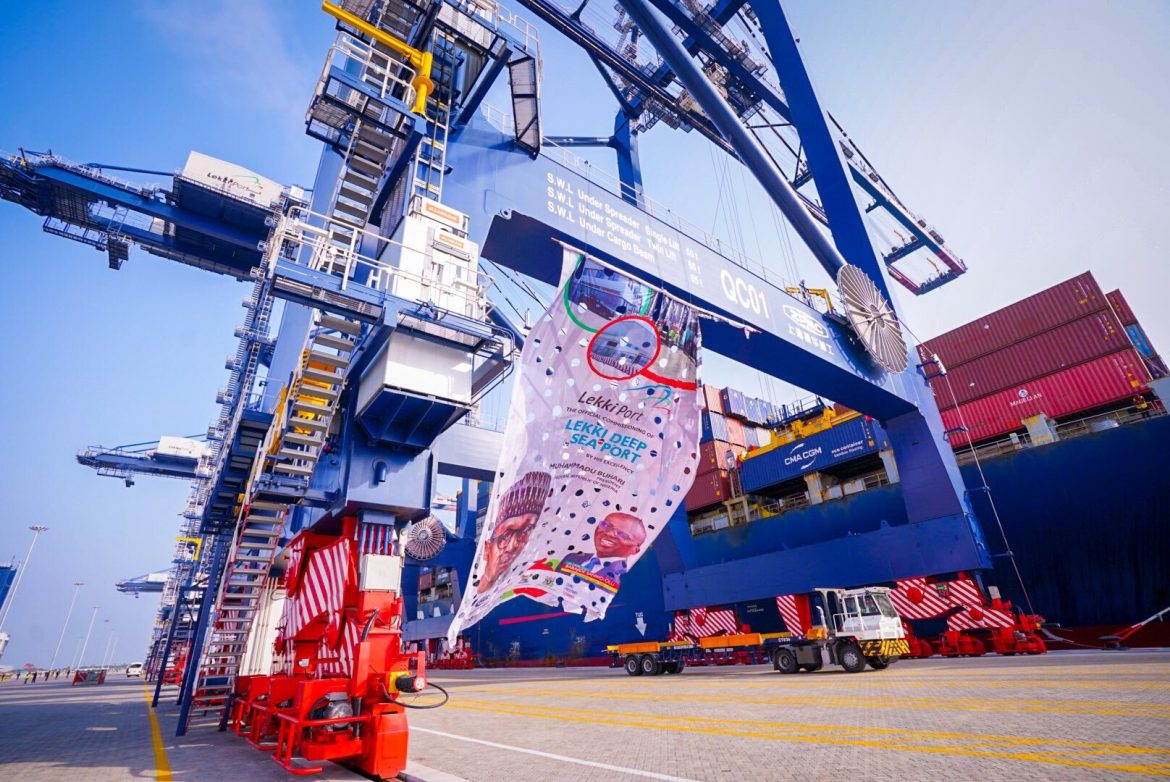
Nigeria’s Lekki Deep Sea Port has processed goods worth nearly $9.3 billion in imports and exports within the first nine months of 2025, a performance that has rapidly altered the country’s maritime trade hierarchy and signaled a structural shift in how Africa’s largest economy moves cargo. The figures, drawn from official trade data covering January to September, show the port handled about 13.46 trillion naira in combined trade value, lifting it to Nigeria’s second-largest port by trade value just two years after commencing commercial operations.
Read also: Africa’s Cocoa, Coffee and Timber exports face new EU timeline under EU Deforestation Rules
The scale of the rise is striking in a system long dominated by legacy ports. Over the same period, Tin Can Island Port recorded trade valued at about 9.31 trillion naira, while Onne Port handled 6.76 trillion naira. Only Apapa Port remains ahead of Lekki, maintaining its long-standing position as the country’s primary maritime gateway. For a facility that began operating in 2023, Lekki’s performance has exceeded early projections and reshaped cargo routing decisions by shipping lines and importers.
Executives at the port attribute the growth to a combination of physical design and operational efficiency. Lekki’s deeper draught allows it to accommodate larger vessels that cannot berth at older Nigerian ports, many of which face depth constraints and congestion. Automation across container handling, cargo tracking and gate operations has reduced turnaround times, a persistent challenge in Lagos where delays have historically added significant costs to trade.

Since September, container volumes have risen sharply, pushing the port to around half of its designed capacity earlier than analysts expected. This growth reflects changing preferences among global shipping lines, many of which are consolidating calls at fewer, more efficient ports to manage costs and emissions. Larger vessels, fuller loads and shorter port stays translate into lower per-unit shipping costs, a factor that increasingly shapes trade competitiveness.
The implications extend beyond port rankings. Nigeria’s economy depends heavily on imports of machinery, fuel and intermediate goods, while exports remain concentrated in oil and gas. Improving port efficiency affects inflation, manufacturing input costs and the viability of non-oil exports. In West Africa, where port congestion has long undermined regional trade, Lekki’s rise introduces a new benchmark for scale and performance.
Sustainability considerations also sit beneath the numbers. Congestion at older Lagos ports has contributed to chronic traffic, air pollution and fuel waste as trucks queue for days to access terminals. Lekki’s design incorporates barge operations that move cargo via inland waterways, reducing reliance on road haulage. Currently, about ten percent of cargo is transported by barge, easing pressure on Lagos roads and cutting emissions associated with idling trucks. Executives say this share is expected to grow as operators adapt logistics chains.
Yet the port’s success has also exposed bottlenecks beyond its perimeter. Road and rail connections remain the weakest links. Without reliable hinterland connectivity, cargo evacuation risks becoming the next constraint, particularly as industrial activity expands along the Lekki corridor. Projects such as the Lagos–Calabar Coastal Road and proposed rail extensions are now central to sustaining growth. Without them, efficiency gains inside the port could be offset by delays outside it.

Digital coordination across government agencies is another unresolved challenge. While Lekki operates on automated systems, cargo clearance still depends on multiple agencies with uneven levels of digital integration. Delays at this stage add time and cost, blunting the advantages of modern port infrastructure. Executives have called for unified digital platforms linking customs, regulators and terminal operators to fully unlock efficiency.
Policy choices will also matter. Port operators have urged reforms to Nigeria’s tax and payment systems to align with international practices. Models that allow deferred tax payments after cargo clearance, common in Europe, are seen as ways to improve cash flow for traders and attract higher-value cargo.
Read also: Egypt secures polish Agro-processing investment to boost fruit exports
Lekki Deep Sea Port’s ascent reflects more than a single infrastructure project succeeding. It illustrates how modern ports can reorder trade flows, reduce environmental pressure and reposition African economies within global supply chains. Whether Nigeria can convert this early momentum into long-term gains will depend on how quickly surrounding infrastructure, policy frameworks and digital systems catch up with the port’s capacity.
Engage with us on LinkedIn: Africa Sustainability Matters