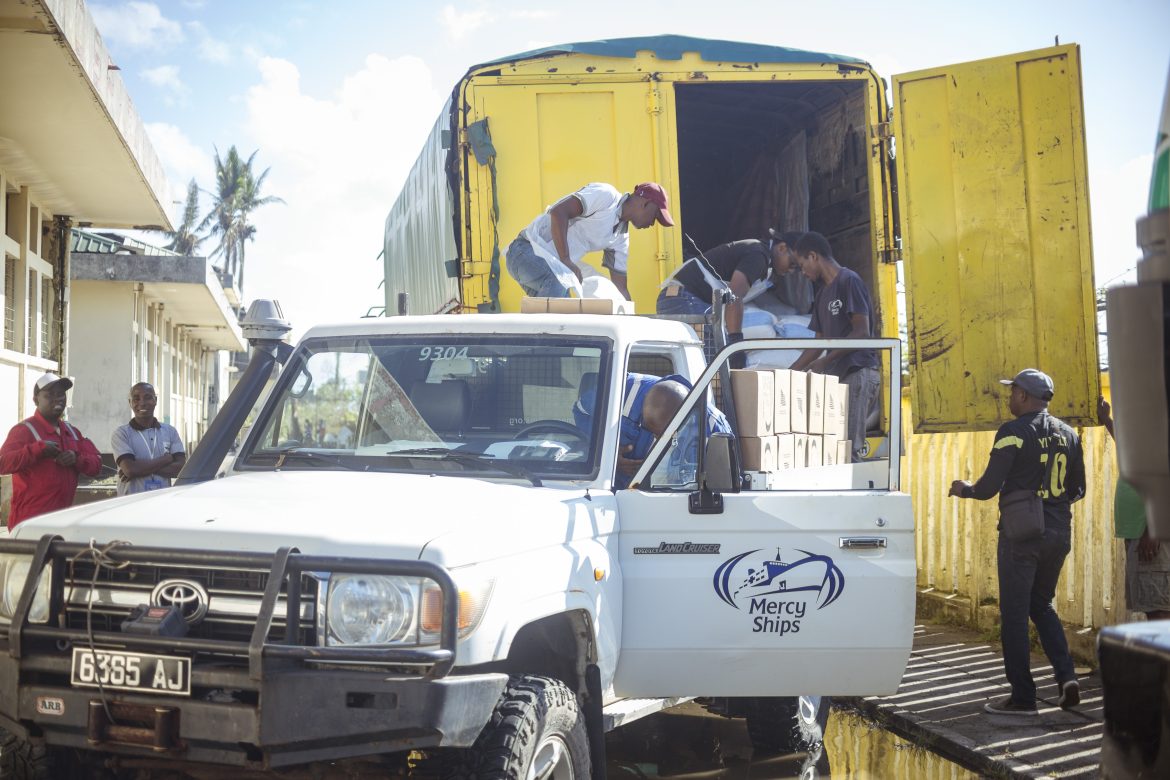
Mercy Ships, the international maritime healthcare organization, has integrated its operations into Madagascar’s national disaster response following the landfall of Cyclone Gezani, which caused extensive damage to the country’s eastern coastal infrastructure. In a statement released on March 3 from Toamasina, the organization confirmed the delivery of 537 bags of rice, 1,000 roofing sheets, and 1,000 ready-to-eat meals to the government’s designated disaster coordination body.
The intervention comes at a critical juncture for the Malagasy government as it navigates the fiscal and logistical pressures of a dual crisis: immediate humanitarian displacement and the long-term degradation of a healthcare system already strained by limited specialist coverage and geographic isolation.
The economic impact of tropical cyclones in the Indian Ocean has become a recurring stressor for Madagascar’s public finances, frequently necessitating the reallocation of development budgets toward emergency reconstruction. According to the World Bank, climate-related disasters can cost the island nation upwards of 1% of its GDP annually, a figure that complicates debt sustainability and slows the pace of structural reforms.
The provision of roofing materials and food supplies by Mercy Ships is intended to stabilize community health facilities and schools in the Toamasina region, preventing a complete collapse of local services while the central government coordinates broader recovery efforts. This localized support is a practical necessity in a country where the “last mile” delivery of aid is often inhibited by a road network that remains highly vulnerable to flooding and washouts.
While the organization’s hospital vessel, the Africa Mercy, is currently undergoing scheduled maintenance in South Africa, its country director, Nicholas Ahadjie, noted that the disaster response represents an extension of a long-term partnership with the Ministry of Health. The ship is expected to return to Malagasy waters in May to resume specialized surgical services and professional medical training.
For Madagascar, these services function as a vital supplement to the national health budget, addressing a significant backlog of elective surgeries that the state-funded system cannot currently accommodate. The training of local healthcare professionals during these missions is particularly relevant for Africa’s broader development goals, as it focuses on building indigenous surgical capacity and anesthetic safety, benchmarks of a resilient national health architecture.
The broader implications of such interventions highlight the growing role of non-state actors in bolstering African climate resilience. As extreme weather events increase in frequency across the Mozambique Channel, the coordination between international NGOs and national disaster management authorities serves as a blueprint for “Global Africa” to manage transition risks.
By grounding sustainability in the reality of infrastructure repair and food security, the response to Cyclone Gezani underscores that healthcare and climate adaptation are inseparable from the continent’s economic stability. As Madagascar prepares for the return of the Africa Mercy, the focus remains on ensuring that the immediate relief efforts translate into a strengthened institutional capacity to withstand future environmental shocks.