


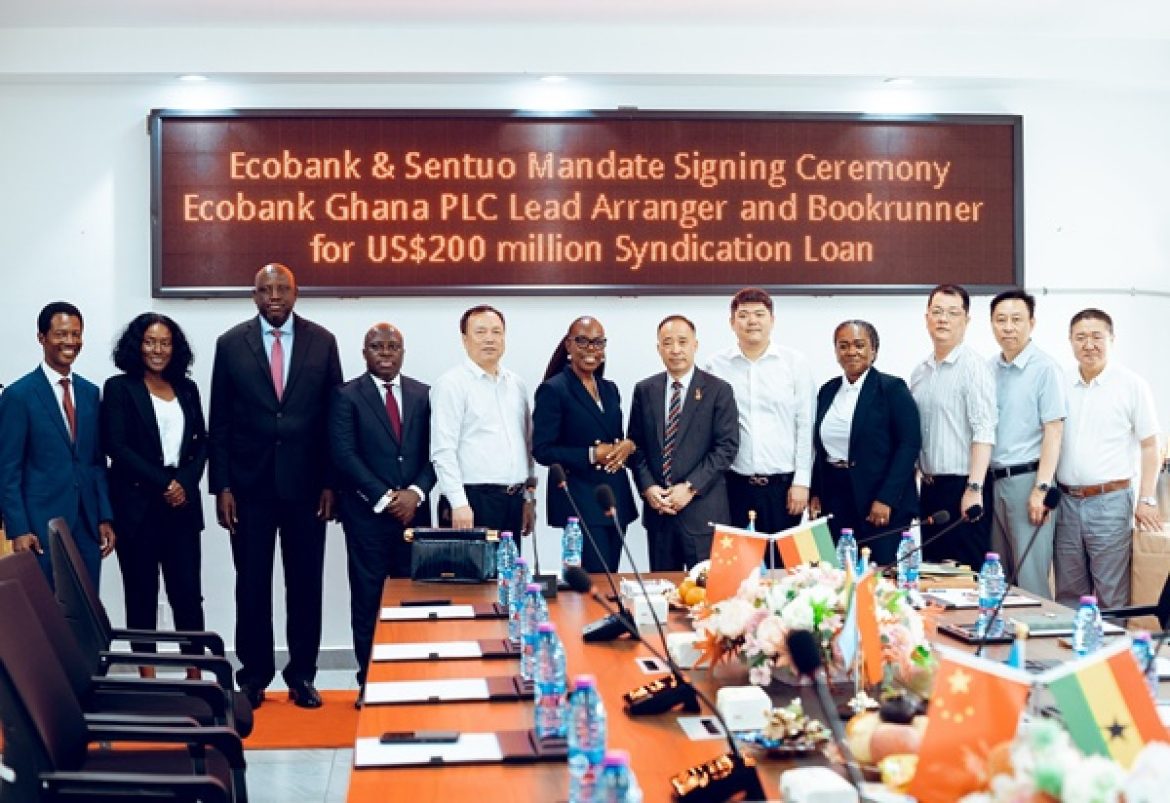
Ecobank Ghana has been appointed to coordinate a $200 million financing package for the second phase expansion of Sentuo Oil, Ghana’s first privately developed refinery, in a move that underscores West Africa’s growing push to expand domestic refining capacity and reduce reliance on imported petroleum products. The arrangement, formalised through a memorandum of understanding signed in Accra, brings together plans to scale up refining infrastructure at a time when Ghana continues to import the bulk of its fuel needs despite being a significant crude oil producer.
The financing mandate places Ecobank Ghana in charge of assembling a syndicate of local, regional and international lenders to mobilise capital for the project, which is expected to more than double Sentuo Oil’s refining capacity from 40,000 barrels per day to 100,000 barrels per day. The expansion will also introduce petrochemical production capabilities, marking a shift from a single-stream refinery model toward a more integrated industrial facility capable of supplying both fuel and chemical inputs for manufacturing sectors.
According to Ecobank Ghana Managing Director Abena Osei-Poku, the bank’s involvement reflects a broader financing strategy focused on supporting industrial projects with multiplier effects on employment and economic output. Speaking at the signing ceremony in Accra, she said the institution remained committed to financing initiatives that unlock growth, expand industrial capacity and strengthen domestic value chains, particularly in strategic sectors such as energy.
Read also:Ecobank and AGRA Sign Major Agriculture Finance Deal to Boost African Farmers and Agribusinesses
The Sentuo Oil refinery, developed by China’s Sentuo Group, was inaugurated in January 2024 following an investment of approximately $1.98 billion by former President Nana Akufo-Addo. Designed with the capacity to process locally produced crude oil, including output from Ghana’s offshore fields, the facility represents one of the country’s most significant private investments in downstream energy infrastructure. In its current configuration, it processes up to 40,000 barrels per day, according to company data.

The expansion builds on earlier commitments by Sentuo Group, which in July 2024 announced an additional $980 million investment after securing full operational licensing. At the time, Sentuo Group Chairman Xu Ningquan argued that Africa should retain and refine more of its crude oil domestically rather than exporting it for processing abroad, a position that aligns with wider continental discussions on value addition and resource sovereignty.
Ghana’s refining sector has long struggled to keep pace with domestic demand. During the refinery’s inauguration in 2024, then-President Nana Akufo-Addo noted that the country imported about 97 percent of its fuel consumption, despite being an oil-producing nation. This structural imbalance has placed sustained pressure on foreign exchange reserves, increased exposure to global price volatility and contributed to fiscal stress in managing energy subsidies and fuel import bills.
The Sentuo expansion, alongside parallel developments at state-owned infrastructure such as the Tema Oil Refinery, reflects a broader policy shift toward strengthening domestic refining capacity. Only recently, President John Dramani Mahama announced that Tema Oil Refinery was preparing to process its first cargo of crude sourced from Ghana’s offshore fields, signalling incremental progress in reducing dependence on imported refined products.
Energy consultancy Petro-Logistics has noted that Sentuo’s operational model, which incorporates agreements to source crude domestically, could help stabilise supply chains and improve the economics of local refining if supported by consistent regulatory and logistical frameworks. However, industry analysts caution that the success of such projects will depend on the reliability of crude feedstock, the efficiency of port and pipeline infrastructure, and the ability of financial markets to sustain long-term capital flows into downstream energy assets.
https://www.aecweek-registration.com/2026/?repid=
For Ghana and the wider West African region, the Ecobank-led financing initiative highlights the evolving role of African financial institutions in underwriting large-scale industrial infrastructure. It also raises broader questions about how energy transition strategies intersect with continued investment in fossil fuel refining capacity at a time when global markets are increasingly shifting toward decarbonisation.
The development is likely to have implications beyond Ghana, particularly for countries seeking to balance energy security with foreign exchange stability and industrial diversification. If successfully executed, the Sentuo expansion could serve as a model for integrating refining and petrochemical production into broader industrial policy frameworks across resource-rich African economies.


