


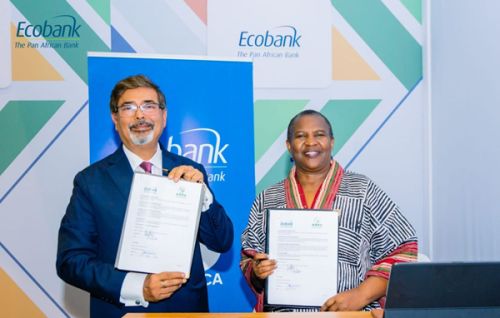
Ecobank and Alliance for a Green Revolution in Africa have signed a memorandum of understanding aimed at strengthening agricultural value chains across Africa, as financial institutions and development agencies increase efforts to address chronic financing gaps in the continent’s food systems.
The agreement, signed on May 11 on the sidelines of the Africa Forward summit in Nairobi, focuses on improving access to finance for smallholder farmers, cooperatives and small and medium-sized agribusinesses operating across agricultural supply chains.
Under the partnership, Ecobank and AGRA will develop financing instruments tailored to agricultural businesses, including working capital loans, equipment financing and trade finance solutions. The agreement also includes risk-sharing mechanisms, guarantees and blended finance structures designed to reduce the perceived risks associated with agricultural lending in African markets.
The partnership comes amid renewed efforts by African and international financial institutions to reposition agriculture as a commercially viable sector capable of driving industrial growth, trade expansion and economic resilience across the continent.
“We must treat agriculture as a high-growth commercial sector rather than a subsistence activity,”said Anup Suri, Ecobank Group’s executive director for commercial and consumer banking.
The agreement is also expected to support women-led and youth-led agribusinesses through the integration of Ecobank’s Ellever programme with AGRA’s Value4HER and YEFFA initiatives, reflecting growing recognition that access to finance remains disproportionately constrained for women and younger entrepreneurs in African agricultural markets.
The memorandum follows another major financing announcement made during the Nairobi summit: a three-year, 300 million euro agreement between Proparco and Ecobank to support African agricultural value chains. The AGRA partnership is expected to help channel part of those resources to producer organisations and agribusinesses across the continent.
The announcements come as African governments and development finance institutions face mounting pressure to strengthen domestic food systems against rising climate shocks, import dependence and volatile global commodity markets. Agriculture employs more than half of Africa’s workforce, according to the African Development Bank, yet the sector continues to face significant financing constraints, particularly for smallholder producers and agro-processing businesses.
Trade finance has emerged as a central concern within those discussions. During the summit, Proparco also launched the Africa AgriTrade Coalition, a platform bringing together 16 financial institutions with nearly 400 billion euros in combined assets. The coalition aims to help narrow what industry estimates place at a $50 billion gap in African agricultural trade financing.
Proparco Chief Executive Françoise Lombard said 500 million euros had been committed within a single day of discussions, highlighting the scale of financing institutions are attempting to mobilise for African agriculture amid growing concerns over food security and climate vulnerability.
For African economies, improving agricultural financing carries broader implications beyond food production. Limited access to affordable credit has historically constrained investment in irrigation systems, storage infrastructure, logistics networks and agro-processing capacity, contributing to persistent post-harvest losses and limiting regional trade competitiveness.
According to regional trade analysts, improving access to trade finance could also help accelerate intra-African agricultural commerce under the African Continental Free Trade Area by supporting cross-border supply chains and reducing dependence on imported food products.

The Ecobank-AGRA agreement also places significant emphasis on climate-resilient agriculture and green financing instruments, reflecting the increasing exposure of African food systems to droughts, floods and shifting weather patterns. Climate-related disruptions have intensified pressure on public finances across several African countries as governments face rising food import bills and emergency response costs linked to failed harvests.
“African food systems are one of the most compelling opportunities of our time,”said Alice Ruhweza, referring to the partnership’s broader ambition to support sustainable agricultural transformation across the continent.
While financing commitments toward African agriculture have increased in recent years, implementation challenges remain significant. Financial institutions continue to cite fragmented value chains, inadequate collateral systems and limited rural financial infrastructure as key barriers to scaling agricultural lending.
The latest agreements nonetheless signal a growing shift among lenders and development institutions toward treating African agriculture not solely as a development sector, but increasingly as a strategic economic and trade priority tied to industrialisation, climate resilience and long-term fiscal stability.


