


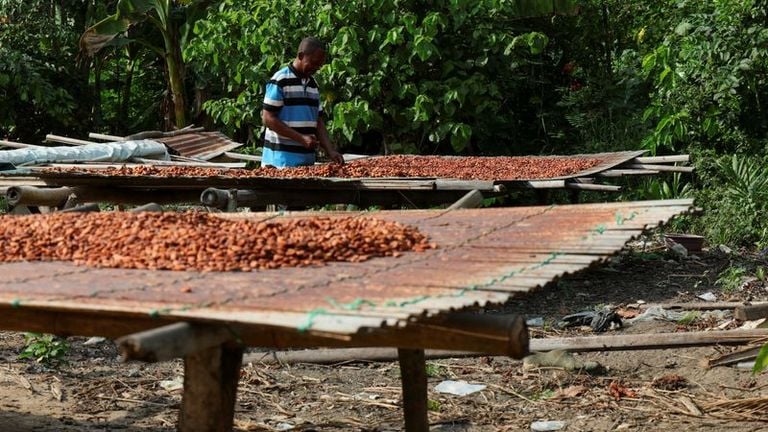
Ghana’s cocoa sector is facing renewed pressure as farmers report payment delays of up to six months for delivered cocoa beans, raising concerns that liquidity constraints could undermine production during the 2025/2026 season despite favourable weather conditions and improved crop yields. The delays, reported across several cocoa-growing regions, are affecting farmers’ ability to harvest, transport and maintain cocoa farms at a critical point in the production cycle, prompting warnings of broader implications for one of Africa’s most important agricultural export industries.
The concerns emerged as cocoa farmers and cooperative leaders accused parts of the cocoa purchasing system of failing to settle payments in a timely manner, leaving producers without the working capital required to sustain operations. According to farmer representatives, some growers are now considering withholding harvested beans until immediate payment can be guaranteed, creating the potential for supply disruptions within the country’s cocoa value chain.
 Ghana occupies a pivotal position in global cocoa markets as the world’s second-largest cocoa producer after Côte d’Ivoire. The sector remains one of the country’s most important sources of foreign exchange earnings and supports the livelihoods of hundreds of thousands of rural households. Any disruption to production or marketing systems therefore carries implications that extend beyond farming communities to national export revenues, fiscal stability and broader economic performance.
According to Theophilus Tamakloe, Vice President of the Ghana Cocoa Co-operatives Association, many farmers lack the cash resources necessary to hire labour or transport harvested cocoa to purchasing centres. The situation is particularly significant because harvesting and post-harvest handling activities require immediate expenditures that most smallholder farmers finance through anticipated cocoa payments.
The payment bottlenecks have emerged despite assurances from the Ghana Cocoa Board (COCOBOD) that funds have been released to Licensed Buying Companies to settle outstanding obligations. However, some buyers maintain that disbursements have not reached all actors within the supply chain, highlighting continuing challenges in the flow of funds between regulators, purchasing agents and producers.
The dispute points to deeper structural issues within Ghana’s cocoa economy. Financing gaps, delayed settlement mechanisms and liquidity pressures have become recurring concerns in commodity-dependent sectors where producers often operate with limited access to affordable credit. In such systems, payment delays can quickly translate into operational constraints that affect productivity, crop quality and overall market efficiency.
For Ghana, the timing is particularly important. Global cocoa markets have experienced significant volatility in recent years due to production shortfalls, climate-related disruptions and supply chain uncertainties affecting major producing countries. Higher international prices have improved revenue prospects for exporting nations, yet farmers can only benefit from favourable market conditions if domestic purchasing and payment systems function effectively.
The situation also highlights the broader challenge of ensuring that value generated within agricultural commodity chains reaches primary producers in a timely and equitable manner. While cocoa remains a major export earner, smallholder farmers often face financial vulnerability due to fluctuating prices, rising input costs and dependence on intermediated marketing systems. Delayed payments can intensify these pressures, reducing farmers’ ability to reinvest in production and maintain household welfare.
From a development perspective, the implications extend well beyond the cocoa sector. In many cocoa-growing communities, farm income supports education, healthcare, food security and local economic activity. Prolonged disruptions in payment systems therefore affect rural consumption patterns and can weaken economic resilience in regions heavily dependent on agricultural production.
The issue also raises questions about the long-term sustainability of commodity-based development models. According to agricultural economists, reliance on a narrow range of export commodities exposes countries to both external market volatility and internal operational risks. Strengthening agricultural value chains requires not only increased production but also efficient financial systems, reliable market infrastructure and transparent payment mechanisms that support producers throughout the production cycle.
 Across Africa, policymakers are increasingly focused on improving agricultural value addition, enhancing farmer incomes and building more resilient food and commodity systems. These priorities align with the African Union’s Agenda 2063, which emphasises inclusive agricultural transformation, rural development and stronger participation by African producers in global value chains.
The payment delays confronting Ghana’s cocoa farmers serve as a reminder that agricultural performance depends as much on institutional efficiency as on favourable weather or improved yields. While current production conditions suggest the potential for a strong harvest, the ability of farmers to realise those gains will depend largely on whether financial bottlenecks within the cocoa marketing system can be resolved before they begin to affect output, market confidence and the broader economic contribution of one of Africa’s most strategically important export sectors.


