


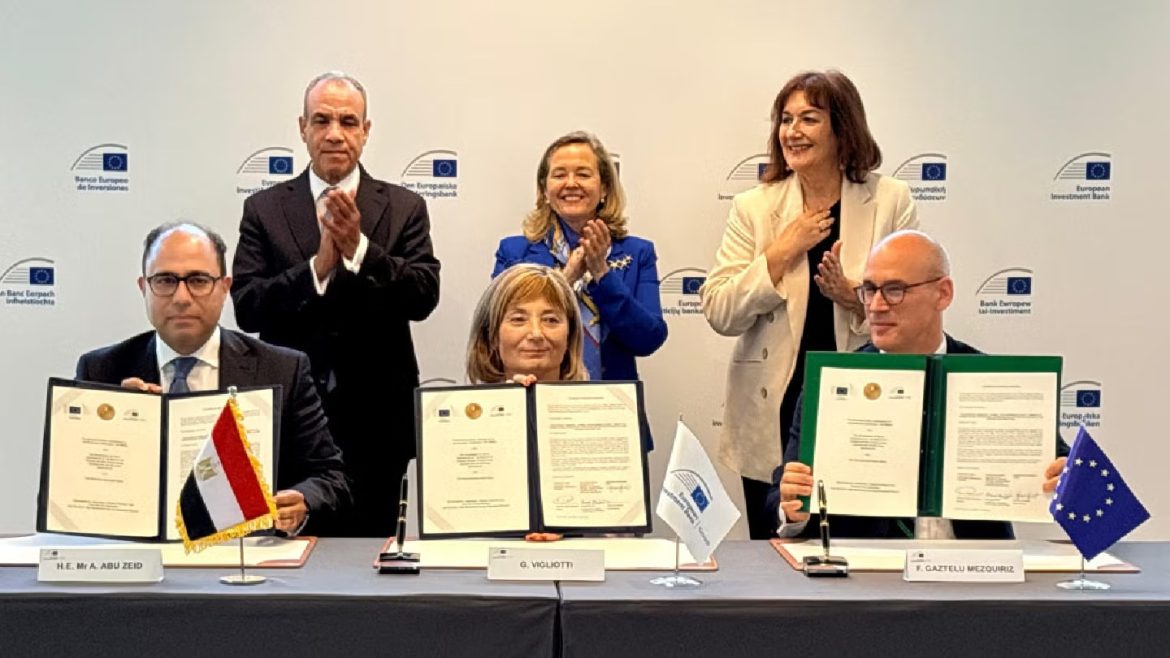
Egypt has secured €690 million ($800 million) in financing from the European Investment Bank (EIB) to modernize and expand its electricity transmission network, a move expected to strengthen the country’s renewable energy ambitions, improve grid reliability and reinforce its position as a strategic energy hub linking Africa, the Middle East and Europe.
The financing, announced by the EIB on June 15, will support a national electricity transmission programme implemented by the Egyptian Electricity Transmission Company (EETC). The investment is designed to enable the integration of up to 22 gigawatts (GW) of renewable energy capacity into Egypt’s national grid by 2030, helping the country address one of the most significant challenges facing energy transitions worldwide: ensuring that transmission infrastructure expands at the same pace as renewable power generation.
According to the European Investment Bank, the project forms part of the broader Trans-Mediterranean Renewable Energy and Clean Technology Cooperation Initiative (T-MED), a regional programme aiming to mobilize up to €25 billion in investments by 2035 across renewable energy, green hydrogen and clean technology value chains. The initiative seeks to strengthen energy cooperation between Europe, North Africa and the wider Mediterranean region while supporting energy security and decarbonization objectives. The planned grid expansion is expected to provide sufficient transmission capacity to connect renewable energy projects capable of supplying electricity to nearly 10 million households. The EIB said the investment would reduce transmission losses, improve electricity reliability, enhance energy security and support future electricity trade across the Mediterranean.
The financing arrives at a critical stage in Egypt’s energy transition strategy. The country has accelerated efforts to diversify its energy mix as electricity demand continues to rise alongside population growth, industrial development and urban expansion. While Egypt remains one of Africa’s largest energy producers, the country is increasingly positioning renewable energy as a central pillar of its long-term economic and energy security planning. Last month, President Abdel Fattah el-Sisi announced a new national objective to increase renewable energy’s share of electricity generation to 45% by 2028, significantly advancing previous targets. Achieving that goal will require substantial investments not only in solar and wind generation but also in transmission networks, storage systems and grid management technologies capable of handling variable renewable power.
According to the International Renewable Energy Agency (IRENA), Egypt’s installed renewable energy capacity reached approximately 9,258 megawatts by the end of 2025. Much of that growth has been driven by large-scale solar and wind developments, including the internationally recognized Benban Solar Park in Aswan Governorate and wind projects located along the Gulf of Suez, one of the continent’s most productive wind corridors. Despite these advances, fossil fuels continue to dominate Egypt’s electricity sector. Natural gas and other conventional fuels account for roughly 87% of electricity generation, while solar and wind energy contribute approximately 7% of total output. This imbalance highlights both the scale of the transition challenge and the importance of investments that strengthen the country’s ability to absorb increasing volumes of renewable power.
Grid infrastructure has emerged as a critical constraint across many African energy markets. While renewable generation investments have expanded rapidly in countries such as Egypt, Morocco, South Africa and Kenya, transmission networks have often struggled to keep pace. Limited grid capacity can delay project commissioning, increase curtailment risks and reduce investor confidence. For Egypt, strengthening transmission infrastructure carries implications that extend beyond domestic electricity supply. The country has increasingly sought to position itself as a regional energy trading hub, leveraging its strategic geographic location and growing interconnection network. Egypt already maintains electricity links with neighboring countries and has explored additional interconnection projects that could facilitate cross-border power exchanges between Africa, the Middle East and Europe.
The modernization programme could therefore support future regional electricity trade while creating conditions for greater renewable energy exports and green industrial development. Enhanced transmission infrastructure is also expected to complement Egypt’s growing interest in green hydrogen production, a sector that depends heavily on reliable access to large-scale renewable electricity. The project also reflects a broader shift in climate and infrastructure finance across Africa, where development finance institutions are increasingly focusing on enabling infrastructure rather than generation assets alone. While renewable energy projects often attract significant attention, experts note that transmission systems, storage facilities and grid modernization programmes are equally important if countries are to meet clean energy targets and improve electricity access.
https://www.aecweek-registration.com/2026/
For African economies pursuing industrialization while responding to climate-related pressures, investments in grid infrastructure have become increasingly important from both an economic and fiscal perspective. Modern transmission networks can improve system efficiency, reduce energy losses, lower operational costs and create more resilient electricity systems capable of supporting manufacturing, digital infrastructure and urban development. As Egypt advances toward its renewable energy targets, the success of its energy transition will depend not only on the volume of new solar and wind projects entering the market but also on the ability of the national grid to absorb, distribute and manage those resources efficiently. The EIB-backed investment represents a significant step in addressing that challenge while strengthening Egypt’s broader ambitions to become a leading clean energy and electricity trading hub in Africa and the Mediterranean region.


