


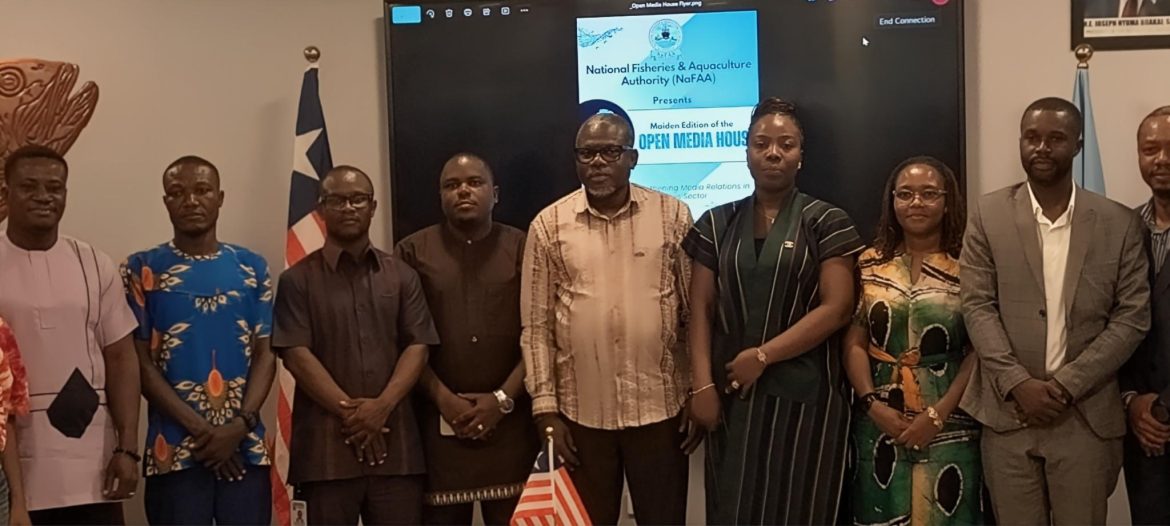
Liberia has launched a new communication framework aimed at improving transparency, public engagement and accountability in the management of its fisheries sector, as the country seeks to strengthen the economic value of its marine resources and advance its blue economy agenda. The National Fisheries and Aquaculture Authority (NaFAA) introduced its inaugural One Media House platform and a five-year Communication Strategy and Action Plan on July 8, 2026, bringing together government officials, journalists, development partners and fisheries stakeholders in Monrovia.
The initiative establishes a structured quarterly engagement platform between NaFAA, media organisations and the public, while the broader communication strategy is expected to guide how the authority shares information, reports progress and engages stakeholders across Liberia’s fisheries value chain. The launch comes at a time when African coastal economies are increasingly recognising the importance of effective ocean governance as a foundation for economic growth, food security and climate resilience. For countries such as Liberia, where fisheries provide livelihoods for coastal communities and contribute to national economic activity, improving institutional transparency has become closely linked to protecting marine resources and attracting sustainable investment.
According to Liberia’s Ministry of Information, the initiative reflects a broader government effort to strengthen communication as a component of institutional performance and public accountability. Minister of Information Jerolinmek Matthew Piah, who attended the launch, highlighted the importance of communication in ensuring citizens understand the role of fisheries in national development and the need for sustainable resource management. Minister Piah pointed to previous experience with the Smallholder Transformation and Agro-Business Revitalization Project (STAR-P) at the Ministry of Agriculture, where he said communication was incorporated as a development component during the project design phase. He noted that effective communication helped create stronger links between institutions, communities and development partners.
The fisheries sector has significant strategic importance for Liberia’s economy. With a coastline extending along the Atlantic Ocean and rich marine ecosystems, the country’s fisheries resources provide employment opportunities, support local food systems and contribute to trade. However, like many African coastal nations, Liberia faces challenges associated with illegal, unreported and unregulated (IUU) fishing, pressure on marine ecosystems and the need for stronger enforcement capacity. Illegal fishing remains one of the major concerns affecting African coastal economies. The practice reduces government revenues, undermines legitimate fishing businesses and threatens long-term marine resource sustainability. Improved information-sharing between government institutions, communities and the media is increasingly viewed as a critical tool for strengthening oversight and public awareness.
“Supporting sustainable fishery management and ensuring accurate media reporting helps highlight issues such as overfishing, illegal fishing, marine pollution, and habitat destruction,” Minister Piah said during the launch.
The role of journalism in monitoring natural resource governance has gained greater attention across Africa as governments seek to improve accountability in sectors ranging from mining and energy to agriculture and fisheries. Investigative reporting can help identify governance gaps, while consistent public communication can support better understanding of policies affecting communities and businesses. NaFAA’s Director of Communication and Media Services, Lewis E.B. Konoe, said the One Media House initiative was created to address information gaps between the authority and the public. He said the platform would provide journalists with greater access to fisheries-related information while improving the accuracy and quality of sector reporting.
The five-year communication strategy is expected to support more coordinated engagement between NaFAA and stakeholders, including fishing communities, development organisations, government agencies and private-sector actors. The authority said the approach is designed to promote transparency, accountability and stronger collaboration around fisheries development. For Liberia, strengthening communication around fisheries management has implications beyond public relations. Effective information systems can support investor confidence, improve stakeholder coordination and contribute to better implementation of fisheries policies. As African countries seek to develop sustainable blue economy industries, institutional capacity and governance frameworks remain central to ensuring that marine resources generate long-term economic benefits.
The African Union has identified the blue economy as a key development opportunity for the continent, particularly through sustainable fisheries, marine transport, coastal tourism and ocean-based industries. However, achieving these objectives requires strong institutions, reliable data, effective regulation and meaningful participation from communities that depend on marine ecosystems. Liberia’s approach reflects a wider shift among African governments and development partners towards integrating communication, accountability and stakeholder engagement into sector reforms. Development programmes increasingly recognise that technical investments alone are insufficient without mechanisms that allow citizens and stakeholders to understand, monitor and participate in implementation.
 https://www.aecweek-registration.com/2026/
Development partners and the Press Union of Liberia welcomed NaFAA’s initiative, emphasising that transparency and access to information are important elements of sustainable fisheries governance. Their support highlights the growing recognition that public communication is part of broader institutional strengthening efforts.
As Liberia continues to develop its fisheries sector, the effectiveness of the new communication framework will depend on consistent implementation, quality information-sharing and the ability to translate engagement into improved decision-making. For African coastal economies facing growing pressures from climate change, resource depletion and economic uncertainty, stronger governance systems will remain essential to ensuring that natural resources support inclusive and sustainable development.


