


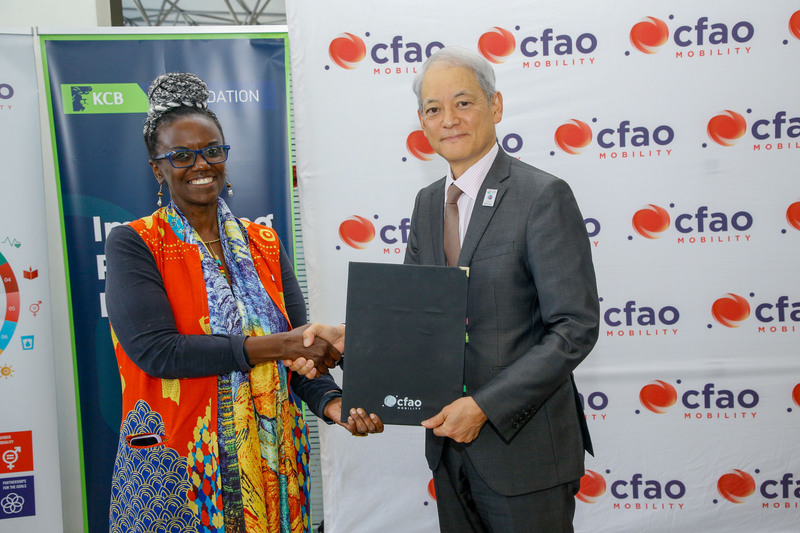
Kenya has taken another step towards strengthening the skills needed for its emerging electric mobility industry after KCB Foundation partnered with CFAO Mobility Kenya to train 200 young people in automotive engineering and electric mobility technologies. The initiative, announced this week, will provide industry-based technical training at the Toyota Kenya Academy, alongside entrepreneurship, financial literacy and business development support, as the country seeks to develop a workforce capable of supporting its rapidly expanding sustainable transport sector.
The programme comes as Kenya accelerates investments in electric vehicles (EVs), charging infrastructure and clean transport solutions in line with its climate commitments and broader efforts to reduce dependence on imported fossil fuels. While electric mobility investment across Africa has grown significantly over the past five years, industry leaders increasingly identify workforce development as one of the sector’s most pressing challenges. The collaboration between KCB Foundation and CFAO Mobility Kenya seeks to address that skills gap by preparing young technicians and entrepreneurs for employment and business opportunities emerging within Kenya’s green transport economy.
Participants will receive practical training at the Toyota Kenya Academy, where they will gain hands-on experience in vehicle diagnostics, automotive engineering, electric vehicle systems and modern mobility technologies. The curriculum extends beyond technical instruction to include entrepreneurship, financial literacy, business management, access to finance and market linkages, reflecting growing recognition that technical expertise alone is insufficient to support sustainable employment and enterprise development.
Speaking during the launch, KCB Foundation Managing Director Mendi Njonjo said the partnership responds directly to changing labour market demands by equipping young people with practical skills aligned to industry needs. She noted that combining technical competence with entrepreneurial capabilities would enable young people, particularly women, to participate more effectively in Kenya’s evolving mobility ecosystem while supporting inclusive economic growth. The partnership agreement was signed in the presence of Peter Ng’eno, Director of Corporate Banking at KCB Bank Kenya, underscoring the financial institution’s continued investment in youth empowerment, workforce development and sectors expected to contribute to Kenya’s long-term economic transformation.
For Kenya, the initiative reflects a broader shift towards developing human capital alongside investments in sustainable infrastructure. The country’s electric mobility sector has expanded rapidly in recent years, driven by rising fuel costs, supportive government policies, technological advances and increasing private sector investment. Companies including BasiGo, Roam, Spiro, ARC Ride, Ampersand, Opibus (now Roam) and several motorcycle battery-swapping operators have accelerated deployment of electric buses, motorcycles and commercial vehicles across Kenya.
According to the International Energy Agency (IEA), transport accounts for approximately one-quarter of global energy-related carbon dioxide emissions, making electrification one of the most important pathways for reducing emissions while improving urban air quality. Across Africa, electric mobility is increasingly being viewed not only as a climate solution but also as an industrial opportunity capable of stimulating manufacturing, innovation and skilled employment.
Kenya has emerged as one of the continent’s leading electric mobility markets due to its relatively clean electricity mix. According to the Energy and Petroleum Regulatory Authority (EPRA), more than 90% of Kenya’s electricity generation comes from renewable sources, primarily geothermal, hydro, wind and solar power. This gives electric vehicles operating in Kenya one of the lowest lifecycle carbon footprints globally, strengthening the country’s position as a regional hub for sustainable transport technologies.
The government has also introduced policy measures supporting EV adoption. Kenya reduced the excise duty on fully electric vehicles from 20% to 10% in 2023 while continuing to explore additional fiscal incentives aimed at expanding electric mobility. The country’s National Energy Efficiency and Conservation Strategy and broader climate commitments further encourage investment in clean transport as part of efforts to reduce greenhouse gas emissions under its updated Nationally Determined Contributions (NDCs).
However, industry expansion depends not only on technology and infrastructure but also on the availability of skilled technicians capable of maintaining increasingly sophisticated vehicle systems. According to the International Labour Organization (ILO), the transition to green economies will require significant investment in workforce development, with millions of new jobs expected globally in renewable energy, sustainable transport and environmental technologies. Many of these positions demand technical competencies that traditional automotive training programmes have not historically provided.
The KCB Foundation-CFAO Mobility Kenya initiative addresses that emerging gap by introducing specialised training focused on electric mobility technologies while strengthening participants’ entrepreneurial capacity. This dual approach reflects changing employment patterns within Africa’s transport sector, where many graduates may establish independent service businesses, operate maintenance workshops or participate in emerging electric mobility supply chains rather than seeking conventional salaried employment.
Entrepreneurship training therefore becomes equally important as technical instruction. According to the African Development Bank (AfDB), Africa’s rapidly growing youth population represents one of the continent’s greatest economic opportunities provided sufficient investment is made in education, skills development and enterprise support. By 2030, Africa is expected to account for a substantial share of the global working-age population, increasing the urgency of preparing young people for future industries.
Kenya’s automotive sector itself is undergoing gradual transformation. Beyond vehicle assembly, opportunities are emerging in battery maintenance, charging infrastructure, fleet management, digital mobility platforms, software development and renewable energy integration. The rise of electric motorcycles, particularly within Kenya’s boda boda sector, is also generating demand for technicians skilled in battery diagnostics, power electronics and electric drivetrains.
According to the United Nations Environment Programme (UNEP), clean mobility represents one of the most promising sectors for simultaneously advancing climate action, economic development and improved urban air quality across developing economies. Investments in workforce readiness therefore complement investments in infrastructure by ensuring industries have access to qualified personnel capable of supporting long-term growth.
The partnership also reinforces the growing role of the private sector in advancing Kenya’s green transition. Rather than relying solely on government-led training programmes, financial institutions, manufacturers and automotive companies are increasingly collaborating to develop industry-specific skills aligned with evolving labour market needs. Such partnerships help reduce skills mismatches while improving employment outcomes for graduates entering rapidly changing industries.
For KCB Foundation, the programme aligns with its broader mission of supporting youth employment, entrepreneurship and economic inclusion through practical skills development. For CFAO Mobility Kenya, the initiative contributes to building the technical workforce necessary to support expanding automotive and electric mobility operations across East Africa.
As Kenya positions itself as a regional leader in sustainable transport, investments in human capital are becoming as important as investments in charging infrastructure and vehicle deployment.
Developing technicians capable of servicing electric vehicles, entrepreneurs able to build businesses around emerging technologies and financial literacy among young innovators will help ensure that the country’s transition to cleaner mobility delivers not only environmental benefits but also inclusive economic opportunities.
For Africa more broadly, the programme illustrates how workforce development is becoming an increasingly important pillar of the continent’s energy transition. As electric mobility expands across African cities, success will depend not only on importing new technologies but also on cultivating local talent capable of maintaining, innovating and scaling sustainable transport systems for decades to come.


