


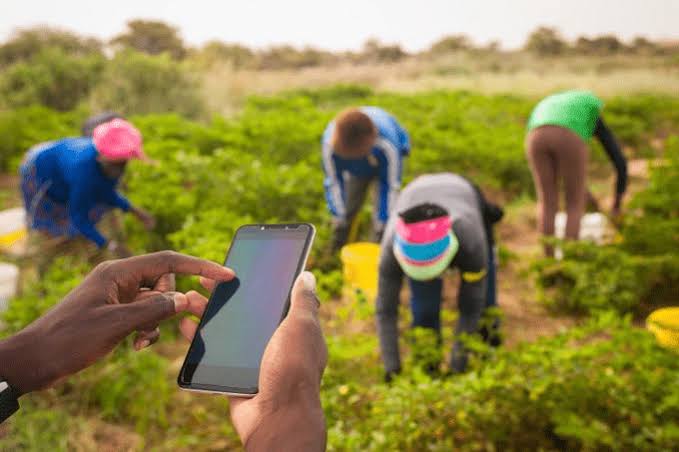
Nigeria is accelerating efforts to modernise one of the weakest links in its agricultural value chain by embracing digital advisory services to complement an overstretched public extension system. As more than 80% of the country’s farmers continue to rely on smallholder agriculture for their livelihoods, the Alliance for a Green Revolution in Africa (AGRA) is championing a hybrid model that combines digital technologies with community-based agricultural advisers to improve farmers’ access to timely, localised and practical guidance.
The initiative comes at a critical time for Africa’s largest economy, where agricultural productivity remains constrained by limited extension services despite increasing climate risks, rising food demand and growing pressure to improve food security. According to data from the National Agricultural Extension and Research Liaison Services (NAERLS), Nigeria had one agricultural extension officer for every 6,446 farming households in 2024—far above the internationally recommended ratio of one officer for every 800 to 1,000 households. The shortage has significantly reduced the frequency and quality of interactions between farmers and agricultural professionals, slowing the adoption of improved farming practices, climate-smart technologies and market-oriented production.
The challenge is particularly acute given agriculture’s importance to Nigeria’s economy. According to the World Bank, agriculture contributes approximately one-quarter of Nigeria’s gross domestic product and employs more than one-third of the country’s labour force. Smallholder farmers dominate production of cereals, legumes, vegetables and other staple crops that underpin national food security. Yet many continue to face declining soil fertility, erratic rainfall, pest outbreaks, limited access to quality inputs and volatile market conditions without adequate technical support.
Regional disparities further expose the weaknesses within the extension system. NAERLS data show that Akwa Ibom State has one extension officer serving approximately 24,468 farming households, while Kwara State performs considerably better, approaching the recommended benchmark with nearly one officer for every 1,000 households. Such disparities leave millions of farmers without regular access to agronomic advice, particularly during critical planting and harvesting seasons.
According to Odusan Olaoluwa, Digital Solutions Specialist at AGRA, the scale of the staffing deficit means many farmers receive little or no personalised technical guidance throughout an entire growing season.
“In some states, a single public extension officer is theoretically responsible for between 10,000 and 20,000 farming households. That means fewer than one in ten farmers can expect personalised and timely advice during a growing season,” Olaoluwa explained.
The growing complexity of farming has amplified the consequences of these shortages. Climate change is increasing rainfall variability across many parts of Nigeria, while new crop diseases, invasive pests and evolving market quality standards require farmers to make increasingly sophisticated production decisions. Conventional extension systems have struggled to keep pace with these changing realities.
Against this backdrop, digital technologies are emerging as an important component of agricultural transformation. Rising mobile phone ownership and expanding rural connectivity have created opportunities to deliver advisory information more efficiently while maintaining local engagement through trained community advisers.
Rather than replacing traditional extension officers, AGRA’s model seeks to strengthen them through digital tools capable of extending their reach and improving service quality. The organisation works with Nigerian institutions, including NAERLS, Extension Africa (EXAF) and private-sector partners, to digitise advisory content and make it accessible through SMS, voice messaging systems and mobile applications delivered in local languages.
“Our role is to ensure that when a farmer in Kaduna, Niger or Nasarawa asks a question about maize diseases, fertiliser schedules or market prices, a nearby human adviser can use a mobile tool to provide the right answer in real time, in a format the farmer understands and trusts,” Olaoluwa said.
The approach reflects a growing recognition across Africa that digital agriculture is most effective when combined with trusted local intermediaries rather than relying solely on technology platforms. Community-Based Advisers (CBAs), modelled on Nigeria’s earlier Village-Based Adviser system, act as the bridge between digital information systems and farmers, translating technical recommendations into practical field-level guidance.
The hybrid advisory model has already demonstrated measurable results in pilot programmes. Since 2018, AGRA’s Village-Based Adviser initiative in Kaduna and Niger states has increased the proportion of women serving as community advisers from 18% to 40%, expanding female participation in agricultural knowledge systems. Approximately 81% of participating advisers now generate income through commissions earned from advisory services, creating a more sustainable extension model while improving livelihoods.
Young people have also emerged as important beneficiaries. Representing roughly one-third of the Community-Based Adviser workforce, they have adapted particularly well to mobile-based advisory systems, demonstrating how digital agriculture can create new employment opportunities alongside improved farming outcomes.
The initiative also introduces greater financial sustainability into agricultural extension. Experiences with fee-based advisory services covering crop disease diagnosis, climate-smart agriculture, input recommendations and market access indicate that farmers are willing to pay for services when they perceive measurable improvements in productivity and income. Such market-based mechanisms could reduce dependence on public funding while expanding access to high-quality advisory support.

Nigeria’s digital agriculture strategy also aligns with broader national policy objectives. The country has adopted frameworks promoting digital transformation, climate-smart agriculture and food system resilience. Integrating successful pilot projects into national agricultural policy could enable government institutions to institutionalise digital extension rather than allowing fragmented initiatives to develop independently.
According to the Food and Agriculture Organization (FAO), strengthening agricultural extension remains one of the most cost-effective investments for improving food security across developing economies. Access to reliable advisory services supports higher productivity, improved resource management, greater resilience to climate shocks and stronger market participation, particularly among smallholder producers.
Across Africa, governments are increasingly recognising that modern agricultural transformation depends not only on improved seeds, fertilisers and mechanisation but also on effective knowledge systems capable of delivering practical information directly to farmers. Countries including Kenya, Rwanda, Ethiopia and Ghana have expanded digital advisory platforms in recent years, reflecting a broader continental shift towards technology-enabled agricultural services.
For Nigeria, where population growth continues to increase pressure on domestic food production, improving agricultural extension carries broader economic implications beyond individual farm productivity. Higher yields can reduce food imports, improve rural incomes, strengthen agro-industrial value chains and contribute to national economic resilience.
The success of AGRA’s hybrid advisory model will ultimately depend on its ability to scale nationally while maintaining the trust and local engagement that underpin effective agricultural extension. If successfully integrated into Nigeria’s broader agricultural development strategy, digital-human advisory systems could transform an overstretched public service into a more responsive, inclusive and sustainable knowledge network capable of supporting millions of smallholder farmers navigating increasingly complex production environments.
As African agriculture adapts to climate change, market integration and technological innovation, Nigeria’s experience illustrates that digital transformation is not simply about introducing new technologies. Rather, it is about strengthening institutions, empowering local communities and ensuring that practical knowledge reaches farmers when and where it is needed most.


