


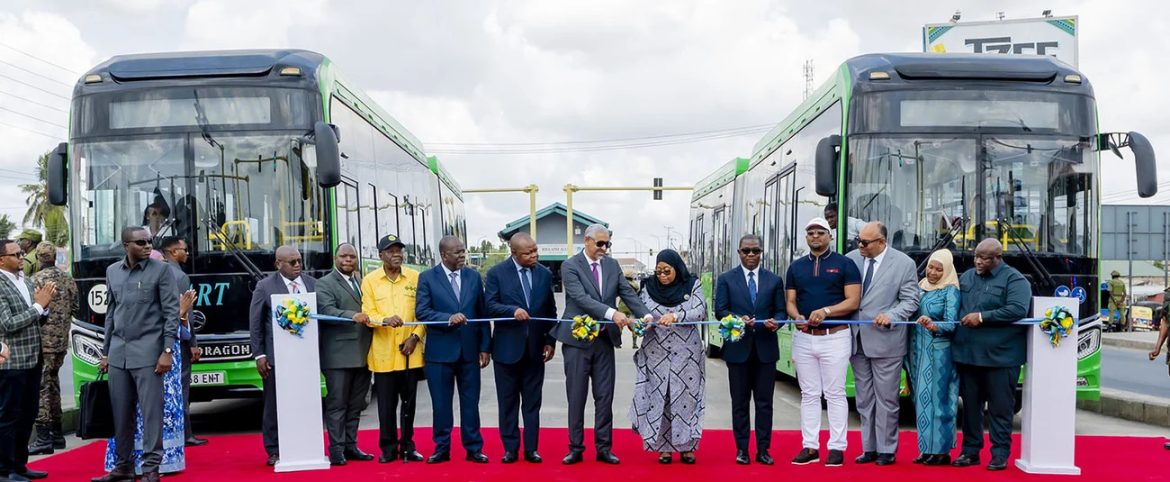
Dar es Salaam has formally launched the second phase of its Bus Rapid Transit (BRT) network, opening a 20.3-kilometre dedicated transport corridor connecting Mbagala with the city centre and strengthening one of Tanzania’s largest investments in mass urban mobility. President Samia Suluhu Hassan and African Development Bank Group President Dr Sidi Ould Tah launched the project on August 7, with the $155 million investment expected to reduce travel times, improve access to economic opportunities and services, and support a lower-emission transport system in one of East Africa’s fastest-growing cities.
The project, financed by the African Development Bank Group and the Africa Growing Together Fund and implemented by the Tanzania National Roads Agency, extends the BRT network along Kilwa and Kawawa roads. The infrastructure includes 20.3 kilometres of dedicated BRT lanes, 26 passenger stations, two flyovers, a major bus depot, two off-road terminals, four feeder stations, a pedestrian bridge and improved facilities for pedestrians and other road users. The AfDB’s project database confirms that the corridor runs from the Mbagala area in Temeke District to Dar es Salaam’s central business district, where it connects with the first phase of the BRT system at the Kariakoo hub.
For Dar es Salaam, the investment addresses a problem with direct economic consequences. Congestion has long imposed costs on workers, businesses and households through longer commuting times, unpredictable journeys and higher transport expenses. By separating high-capacity buses from general traffic, the BRT model is designed to improve the reliability of public transport while allowing more people to move through the city using existing road space more efficiently.
The early operational results suggest a significant change for passengers along the corridor. Passenger services began in October 2025, and travel times on one of the city’s busiest routes have reportedly fallen from around 90 minutes to approximately 30 minutes. Daily passenger numbers have increased to about 90,000, roughly three times the volumes recorded when services began.
The significance of those gains extends beyond transport. Shorter and more predictable journeys can influence how people access jobs, schools, healthcare facilities and markets. For businesses, improved mobility can widen the pool of workers able to reach employment centres and reduce the time and uncertainty associated with moving people and goods across the metropolitan area.
This is particularly relevant as Tanzania continues to invest in infrastructure to support economic transformation. The African Development Bank said in March that its active Tanzania portfolio was approximately $4 billion across 30 operations, covering sectors including transport, energy, agriculture, water and sanitation, with infrastructure accounting for about 81% of commitments. The Bank has linked its infrastructure investments in Tanzania to improved regional connectivity, competitiveness, incomes and employment.
The BRT project also demonstrates the economic value of investing in mass transit rather than relying exclusively on road expansion. Dar es Salaam’s population and economic activity continue to place pressure on the city’s road network. Adding more conventional road capacity can be costly and may not keep pace with demand, while dedicated public transport can increase passenger-carrying capacity within existing urban corridors.
The environmental implications are also material. Once fully operational, the project is expected to use a fleet of 250 clean-energy buses and reduce greenhouse-gas emissions along the corridor by an estimated 76% annually, from approximately 250 tonnes to 60 tonnes. The transition is significant because transport remains a major source of urban air pollution and emissions, while rapid motorisation is increasing pressure on African cities to develop cleaner mobility systems.
For Dar es Salaam, the environmental benefits will depend partly on how effectively public transport attracts passengers away from higher-emission private and informal modes. A reliable BRT system can support that shift by offering predictable travel times and relatively efficient movement of large numbers of passengers. The challenge is ensuring that services remain affordable, safe and sufficiently frequent as the city expands.
The social dimension is equally important. The project includes dedicated bus services for students, addressing a longstanding challenge in which young passengers faced crowded morning transport and delays in reaching schools. Improved pedestrian infrastructure and formalised stations can also reduce some of the risks associated with informal boarding and roadside travel.
The human impact of the investment was illustrated by Works Minister Abdallah Hamis Ulega, a former Mbagala resident, who described the transition from passengers boarding buses through windows to orderly boarding at designated stations. The change points to a broader issue in urban infrastructure: the quality of public transport is not measured only by speed, but also by safety, predictability and dignity.
The project has also created employment during construction, with women accounting for 13% of the workforce, while strengthening technical capacity, road-safety initiatives and institutional systems. These secondary benefits are important because large infrastructure projects can generate economic value beyond the physical assets themselves when they contribute to skills development and institutional capability.
The BRT system is also part of a wider effort to create a more integrated urban transport network. Phase II connects with the existing BRT system, allowing passengers to move between the southern parts of the city and the central business district through a more structured public transport network. The African Development Bank describes the project as part of Dar es Salaam’s broader mobility master plan.
The next challenge will be maintaining that integration as the network expands. President Samia Suluhu Hassan has indicated plans to extend BRT services further, including towards the neighbouring Coast Region. Such expansion could strengthen connections between Dar es Salaam and surrounding economic areas, but it will require sustained investment in transport infrastructure, fleet capacity, maintenance, land-use planning and traffic management.
The financing model also highlights the continuing role of development finance institutions in Africa’s urban transformation. Large metropolitan transport systems require substantial upfront capital, while their economic returns are distributed across commuters, businesses, municipalities and the wider economy. Development banks can therefore play an important role in financing infrastructure where benefits extend beyond the immediate financial revenues generated by the transport operator.
The wider lesson for African cities is increasingly clear. Urban mobility is not simply a transport-sector issue. It affects productivity, household income, access to employment, public health, environmental performance and the competitiveness of cities. As African urban populations grow, inadequate mobility can become a constraint on economic growth just as significant as shortages of electricity, water or industrial infrastructure.
Dar es Salaam’s experience also demonstrates the importance of measuring infrastructure through outcomes rather than construction milestones. The 20.3 kilometres of dedicated lanes, stations, flyovers and terminals represent the physical investment, but the more important indicators will be whether commuters consistently save time, whether public transport remains accessible to lower-income households, whether emissions decline and whether businesses gain more reliable access to labour and markets.
For Tanzania, the Phase II launch therefore represents more than the completion of another transport project. It provides a foundation for a more integrated urban economy in which mobility can support productivity while reducing some of the environmental and social costs associated with congestion.
The African Development Bank’s current Tanzania portfolio demonstrates the scale of infrastructure financing required to address the country’s transport, energy, water and connectivity needs. The BRT investment adds an urban dimension to that agenda, showing how transport infrastructure can simultaneously contribute to economic competitiveness, social inclusion and climate objectives.
The test now is whether Dar es Salaam can sustain the operational performance achieved since services began, expand the network without compromising reliability, and integrate BRT with other forms of public and non-motorised transport. If those conditions are met, Phase II could provide a practical model for other African cities seeking to manage congestion while building more productive, accessible and lower-emission urban economies.


