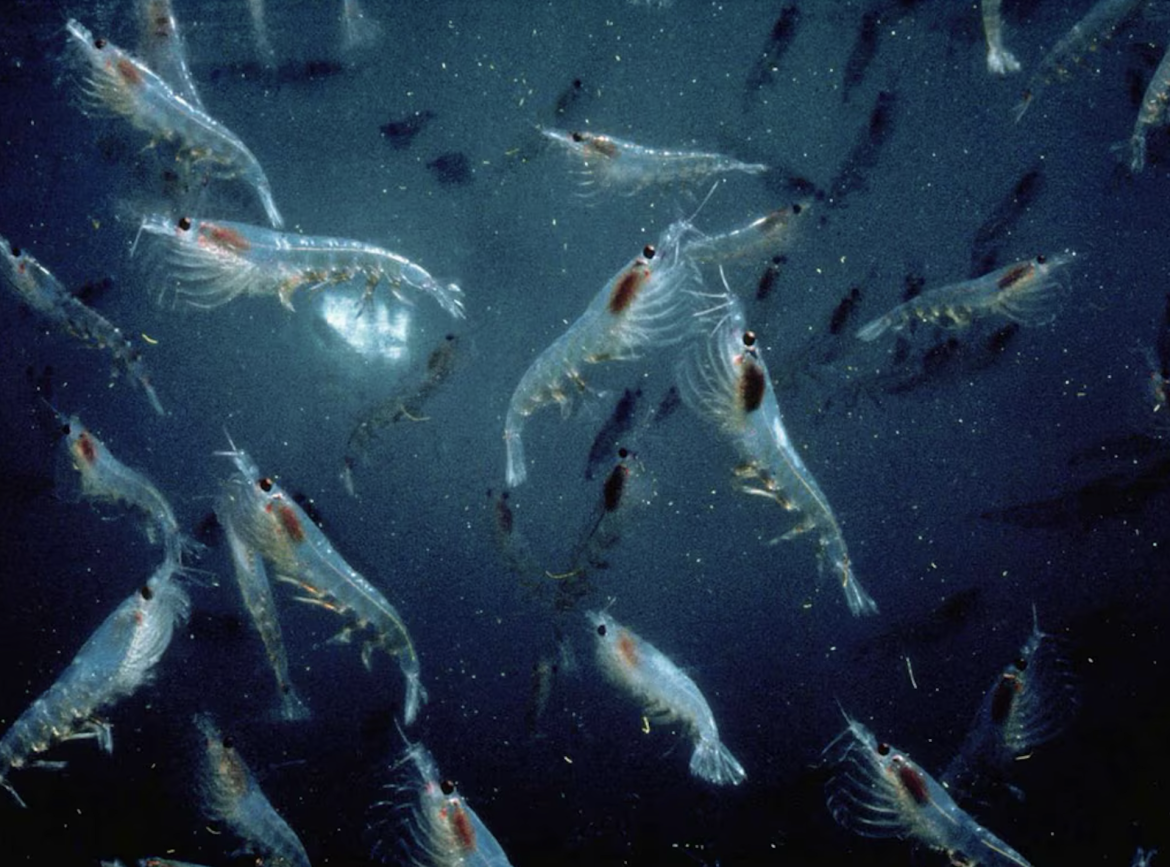
The Antarctic krill fishery is approaching its seasonal catch limit for a second consecutive year, raising renewed questions over whether the current management framework can adequately protect one of the Southern Ocean’s most important food resources as climate change alters the ecosystem. The expected early closure follows last year’s unprecedented shutdown, when the fishery reached its 620,000-tonne trigger level four months before the scheduled end of the season.
The issue extends beyond the volume of krill being removed from Antarctic waters. Scientists and conservation organisations have increasingly focused on where fishing takes place, particularly around the Antarctic Peninsula, where industrial activity overlaps with areas used by penguins, whales, seals and other wildlife that depend on dense concentrations of krill. Krill are a central component of the Southern Ocean food web and support a wide range of marine species. They are also increasingly valuable commercially, supplying raw material for omega-3 nutritional supplements, aquaculture feed and pet-food products. This creates a direct economic link between a growing global market and a resource that also performs a critical ecological function.
The approaching closure is therefore becoming a test of whether a catch limit based largely on overall biomass can adequately account for the localised effects of fishing. Although the current catch remains substantially below estimates of total krill biomass, the distribution of the fishery has become increasingly concentrated in the Antarctic Peninsula and Scotia Sea region. WWF has argued that this concentration can create localised depletion in areas where predators depend on krill, while ASOC has raised similar concerns in its objection to the fishery’s recertification.
The regulatory challenge became more pronounced after the expiry of CCAMLR Conservation Measure 51-07 at the end of 2024. The measure had helped distribute fishing effort across management areas. After it lapsed, the Commission for the Conservation of Antarctic Marine Living Resources’ Scientific Committee concluded that the resulting concentration of fishing was not precautionary and called for changes to the management system. No replacement system was agreed at CCAMLR’s 2025 annual meeting, leaving the fishery operating while negotiations over a revised approach continue. That gap is significant because the Southern Ocean is undergoing rapid environmental change, complicating the assumptions on which historical management decisions were based.
The scientific uncertainty is particularly important. Existing assessments of krill biomass rely heavily on surveys conducted before the scale of recent Antarctic sea-ice losses and other climate impacts became fully apparent. Changes in sea-ice conditions can affect krill distribution and their life cycle, while shifts in ocean conditions may alter where and when large aggregations occur. This means that a fishery can remain below a broad biomass threshold while still creating pressure in specific areas where predators require krill at particular stages of their reproductive and feeding cycles. The management question is consequently becoming less about whether there are enough krill somewhere in the Southern Ocean and more about whether fishing is occurring in the right places and at the right intensity.
The ecological stakes have also become more visible through recent assessments of Antarctic wildlife. The International Union for Conservation of Nature added both the emperor penguin and Antarctic fur seal to its Endangered category in April 2026, identifying climate change and declining krill availability among the threats affecting Antarctic ecosystems. For Antarctic wildlife, changes in krill availability can have consequences that extend through the food chain. Penguins, seals and whales depend on krill directly or indirectly, meaning that localised reductions in access to the resource can affect the ability of species to feed, reproduce and respond to other environmental pressures.
For the fishing industry, however, the issue is more complex than simply measuring annual catch against total biomass. Industry representatives have pointed out that the 620,000-tonne trigger level represents only a fraction of the larger precautionary catch limit for the broader management area and a small share of estimated biomass. Aker QRILL, one of the principal companies involved in the fishery, has argued that an early seasonal closure should not automatically be interpreted as evidence that the fishery is biologically unsustainable.
That distinction is central to the debate. A fishery can operate below a precautionary overall catch threshold while still generating concerns about spatial concentration and ecosystem impacts. The disagreement is therefore increasingly about the design of management rules rather than simply the existence of a numerical catch limit. The dispute has also reached the sustainability certification system. The Marine Stewardship Council announced the recertification of the Antarctic krill fishery, but the Antarctic and Southern Ocean Coalition and WWF lodged formal objections. WWF has called for a review of the certification until stronger precautionary management measures are established, while ASOC has questioned whether the certification assessment sufficiently reflects the climate-sensitive conditions of the Antarctic Peninsula.
The objections are being considered through the MSC’s formal process. The organisation’s current objections framework allows stakeholders to challenge determinations made during fishery assessments, with complex cases potentially being referred to panels of independent adjudicators. The certification dispute matters because the MSC label is increasingly relevant to companies and consumers seeking assurances about the environmental performance of seafood and marine-derived products. If questions over the scientific basis of management remain unresolved, the credibility of sustainability claims surrounding the fishery could face continued scrutiny.

The economic dimension is broader than the Antarctic fishing industry itself. Krill-derived products feed into global markets for nutritional supplements, aquaculture and animal nutrition. Demand for these products creates commercial incentives to maintain access to the resource, while the ecological importance of krill means that the costs of poor management could extend to industries and communities dependent on healthy Southern Ocean ecosystems.
The challenge also illustrates a wider problem facing fisheries management under climate change. Historical assessments often rely on relatively stable assumptions about species distribution, biomass and environmental conditions. As ocean temperatures, sea-ice patterns and ecosystems change, management systems need to account for greater uncertainty and potentially more rapid shifts in where commercially valuable species and their predators are concentrated.
For CCAMLR, the immediate issue is therefore not simply how to respond when the fishery reaches its seasonal trigger. It is whether a new management framework can distribute fishing effort in a way that protects predator feeding areas while maintaining a commercially viable fishery. The failure to reach agreement on a replacement system in 2025 leaves that question unresolved. A second consecutive early closure could increase pressure on CCAMLR members to reach consensus on spatial management, catch allocation and ecosystem safeguards, particularly as environmental conditions continue to change.
The Antarctic case also carries a broader lesson for the global blue economy. Marine resources can generate commercial value without necessarily being incompatible with conservation, but the economic viability of those activities depends on management systems capable of accounting for ecosystem interactions, changing environmental conditions and the distribution of economic benefits and risks.
In the Southern Ocean, the debate over krill is consequently becoming a test of whether fisheries governance can keep pace with climate change. The immediate closure may limit catches for the current season, but it will not resolve the underlying question of how fishing should be managed in an ecosystem whose physical and biological conditions are changing.
The outcome of the continuing negotiations will have implications beyond the krill industry. It will help determine whether Antarctic fisheries management can remain credible as climate impacts intensify, whether sustainability certification can maintain the confidence of markets and stakeholders, and whether commercial use of a foundational marine resource can be reconciled with the ecological needs of the wider Southern Ocean.