


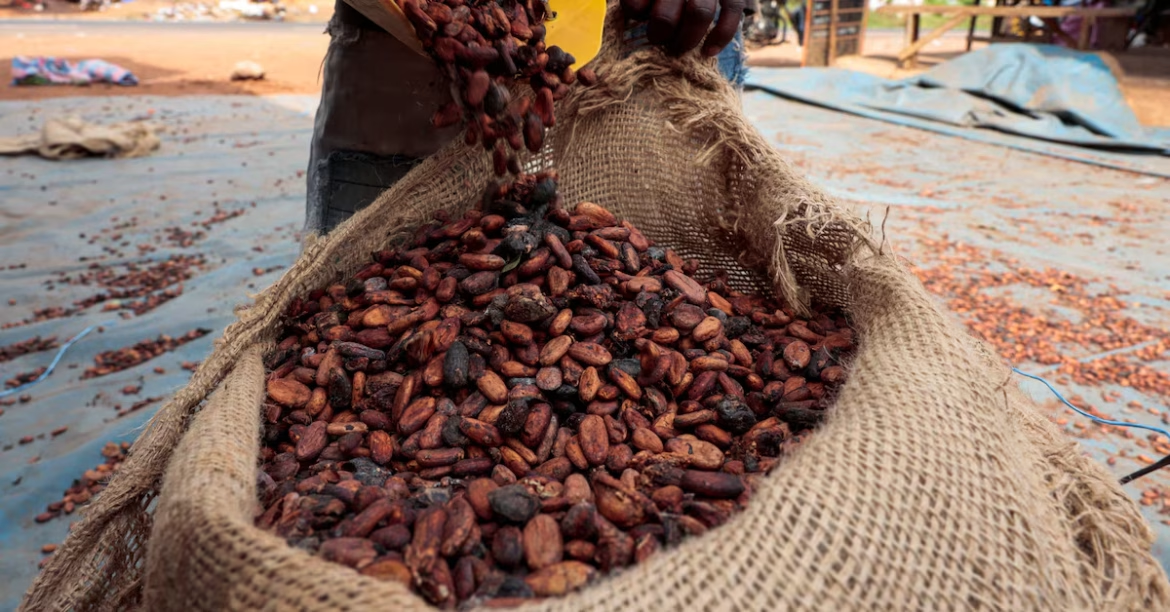
West Africa’s cocoa industry is facing mounting pressure to prove that its beans are not linked to deforestation as the European Union prepares to apply its revised anti-deforestation rules from December 30, 2026, exposing exporters and hundreds of thousands of smallholder farmers to higher compliance costs and potential disruption in one of the world’s most important cocoa-producing regions. The challenge is particularly acute in Nigeria, Côte d’Ivoire and Ghana, where complex supply chains, dispersed farms and limited digital infrastructure make it difficult to trace cocoa back to individual plots.
The EU Deforestation Regulation, or EUDR, requires companies placing covered commodities on the European market to demonstrate that they are deforestation-free and produced in accordance with relevant laws in the country of origin. Cocoa is among the commodities covered by the regulation, alongside coffee, palm oil, rubber, soy, cattle and wood. Under the revised timetable, the rules will apply to medium and large operators from December 30, 2026, while most micro and small operators receive an additional six months.
For West Africa, the regulation is more than a European environmental requirement. It is becoming a trade, rural development and supply-chain governance issue. The region produces about 70% of the world’s cocoa beans and ships roughly two-thirds of its cocoa to the EU, according to data cited by Reuters. Any difficulty in establishing compliant supply chains could therefore affect export earnings, farmers’ market access and the availability of cocoa for European processors.
Nigeria illustrates the scale of the challenge. The country has about 300,000 predominantly small-scale cocoa farmers, according to the Nigerian Export Promotion Council. Industry estimates cited by Reuters suggest that farmers producing more than half of Nigeria’s cocoa could initially struggle to meet the European requirements. For growers operating far from formal markets and digital services, farm-level geolocation and documentation can represent a significant new administrative and financial burden.
The immediate requirement is traceability. Exporters need to establish where cocoa was produced, map farms and maintain information that allows European buyers to demonstrate compliance. This is particularly difficult where cocoa passes through multiple intermediaries before reaching exporters. In Côte d’Ivoire, the world’s largest cocoa producer, only about half of cocoa could be traced to its farm of origin, according to a study by Trase cited by Reuters.
The cost of building these systems is already being felt by exporters. Nigerian exporter Sunbeth Global told Reuters it had mapped 124,000 hectares covering about 60,000 tonnes of cocoa in its supply chain over three years, spending between $30 and $70 per tonne. The company has also deployed field agents, established a sustainability team and worked with data-verification specialists. Another major Nigerian exporter, Starlink Global and Ideal, reported spending between $40 and $80 per tonne on mapping and traceability since 2023.
For companies operating on relatively narrow margins, the question is who ultimately pays for that transition. Exporters may have to absorb the costs, pass them to farmers, negotiate higher prices with European buyers or find efficiencies elsewhere in the supply chain. Sunbeth’s management told Reuters that discussions with European offtakers had produced resistance to transferring the additional compliance costs, leaving the company to absorb part of the burden through reduced margins.
That dynamic matters for farmers because compliance requirements can create a divide between producers who are integrated into formal, well-resourced supply chains and those who are not. Larger exporters may have the financial capacity to deploy mapping teams, digital platforms and field officers, while smaller buyers and fragmented farmer networks may struggle to establish equivalent systems. If compliant cocoa becomes more valuable, farmers connected to traceable supply chains could benefit from stronger market access, while others could face exclusion from the EU market.
The regulation also raises questions about how sustainability standards are implemented across African agricultural economies. The EU’s objective is to reduce deforestation associated with its consumption of imported commodities, and the regulation requires products entering the bloc to meet defined environmental and legal standards. The European Commission says the revised framework was designed to simplify implementation and reduce administrative burdens while maintaining the regulation’s deforestation objectives.
For producing countries, however, compliance will depend partly on the capacity of national institutions to provide reliable land-use information, enforce environmental and labour laws and support farmers with the data required by international markets. The EUDR explicitly includes a legality requirement, meaning exporters must demonstrate not only that cocoa is deforestation-free but that it was produced in accordance with relevant laws in the country of production.
This creates an opportunity for stronger agricultural governance, but also exposes institutional weaknesses. Land records, farm boundaries, farmer identification systems and supply-chain data are not uniformly developed across West Africa. Improving them could serve purposes beyond European market access, including better agricultural planning, improved land-use management and more targeted delivery of extension services and climate finance.
The timing is significant because West African cocoa farmers are already operating under pressure from climate variability, ageing trees, disease, rising input costs and changes in global cocoa markets. Additional compliance costs could become another constraint unless governments, exporters, development finance institutions and buyers coordinate investment in traceability infrastructure and farmer support.
Ghana’s recent policy debate illustrates how governments are also responding to domestic pressures around the protection of agricultural land. A proposed law would restrict the conversion of cocoa farms and strengthen controls over cocoa-producing land, partly in response to concerns about mining and other competing land uses.
The broader economic issue is whether sustainability requirements can be converted into productive investment rather than becoming another cost imposed on producers. Digital mapping, satellite monitoring, farmer registries and traceability platforms can improve transparency, but their value depends on whether farmers and local institutions have access to the technology, skills and financing needed to use them effectively.
There is also a potential market advantage for exporters that successfully establish credible supply chains. Sustainability consultant Nicko Debenham told Reuters that a shortage of compliant cocoa could persist for roughly two years after implementation, potentially giving exporters with traceable supplies greater bargaining power and access to premiums from chocolate manufacturers.
That possibility, however, does not remove the underlying development challenge. If premiums remain concentrated among exporters and intermediaries while farmers bear the cost of compliance, the transition could deepen existing inequalities within the cocoa value chain. If instead traceability is accompanied by investment in farmer productivity, income resilience and environmental management, the same infrastructure could strengthen the sector’s long-term competitiveness.
 For West Africa, the EUDR therefore represents a test of whether international sustainability rules can be integrated into commodity systems without weakening the livelihoods and export economies that depend on them. The region’s ability to meet the new requirements will depend not only on exporters’ willingness to map farms, but on the capacity of governments, buyers, financial institutions and technology providers to build traceable supply chains at a scale that reaches the smallholder farmers at their foundation.
As Europe tightens the environmental conditions attached to access to its market, cocoa-producing countries face a broader strategic question: how to turn compliance with global sustainability standards into stronger agricultural institutions, better land governance and greater value for producers. For an industry that underpins millions of rural livelihoods and a significant share of West Africa’s agricultural exports, that question extends well beyond the European border.


