


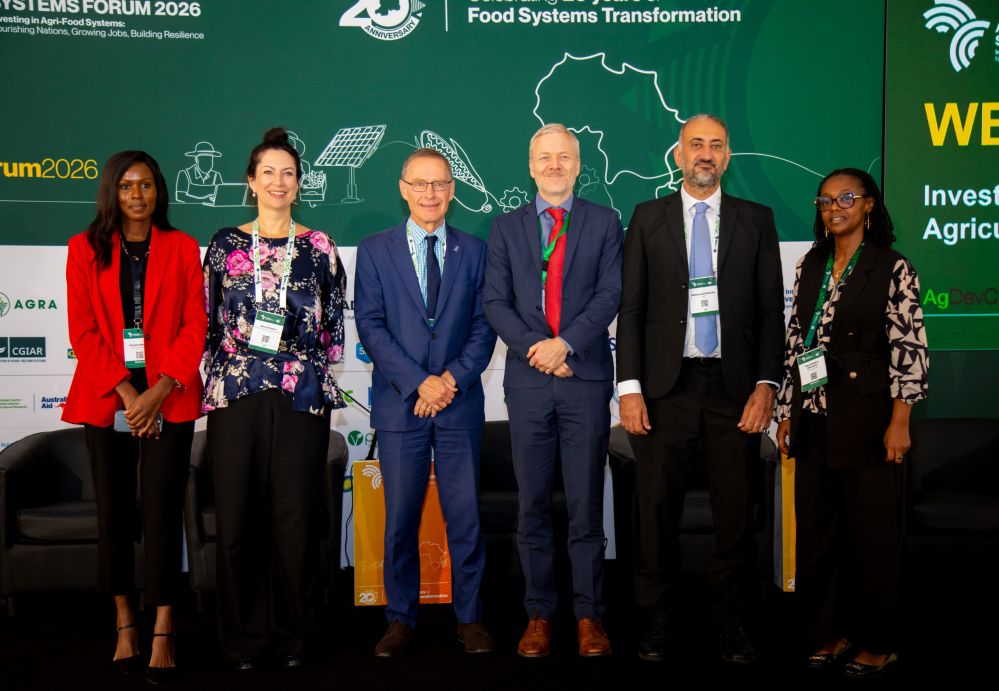
The International Fund for Agricultural Development (IFAD) and AgDevCo Ventures Limited have signed a $10 million financing agreement to back early-stage agribusinesses in five East African countries, targeting businesses that sit between farmers and markets and are often underserved by conventional lenders. The 12-year initiative, signed in Kigali on September 3, is expected to support up to 15 enterprises in Ethiopia, Kenya, Rwanda, Tanzania and Uganda, indirectly reach almost 128,000 smallholder farmers and create about 2,900 full-time jobs.
The deal comes against a much larger financing shortfall. AGRA estimates that Africa faces an annual agrifood financing gap of about $180 billion, including roughly $65 billion for small and medium-sized agribusinesses. The shortage affects companies involved in input supply, aggregation, processing, logistics and market access, limiting their ability to expand even where demand for food and agricultural services is rising.
The IFAD-AgDevCo facility is structured around a problem that has become increasingly important to African food systems: early-stage agribusinesses frequently fall between conventional commercial lending and traditional development finance. They may have viable business models and strong links to farmers but lack the collateral, operating history or financial records required by banks to obtain growth capital.
The new financing is intended to address that gap by combining IFAD funding with AgDevCo’s long-term, risk-tolerant capital and technical assistance. The objective is not simply to provide working capital, but to help companies increase productivity, expand market access and improve environmental and social practices while making them more attractive to additional private investors.
That blended-finance structure is important because agricultural businesses face risks that conventional lenders can find difficult to price. Revenue can fluctuate with weather, commodity prices and seasonal production cycles, while enterprises buying from thousands of smallholder farmers may need to finance crops or inputs well before receiving payment from downstream buyers.
For an early-stage processor, aggregator or input supplier, that timing mismatch can become a constraint on growth even when underlying demand is strong. Patient capital can give businesses greater flexibility to build supply networks, invest in equipment, develop distribution channels and establish relationships with farmers before they are able to demonstrate the financial track record normally expected by commercial banks.
AgDevCo has been building this investment model across Africa. The organisation says it invests through debt, mezzanine finance and equity while providing technical assistance to agribusinesses. Its 2025 annual report said it had $368 million under management across 38 companies in 12 sub-Saharan African countries and had launched AgDevCo Ventures to make smaller investments of between $1 million and $3 million in early-stage businesses.
The new IFAD financing therefore fits into a wider effort to create a pipeline of businesses capable of attracting larger amounts of commercial capital as they mature. For farmers, the importance of the investment will depend less on the number of enterprises financed than on the strength of their links to rural producers. IFAD expects the programme to reach nearly 128,000 smallholder farmers indirectly. The focus on businesses operating across production, input supply, aggregation and processing means the intended impact sits along several points of agricultural value chains rather than being confined to farm-level production.
This matters because the ability of farmers to increase production does not automatically translate into higher incomes. Farmers also need reliable access to inputs, buyers, storage, processing and transport. Agribusinesses operating between the farm and the consumer can provide some of that infrastructure, turning fragmented agricultural production into commercially viable supply chains.
The financing challenge is particularly relevant to Africa’s rapidly changing food markets. AGRA estimates that 64% of African livelihoods depend on agrifood systems, which generate nearly a third of the continent’s GDP. At the same time, Africa’s agricultural gross value added per worker remains significantly below the global average, while large productivity gaps persist in major crops.
The implication is that agricultural transformation cannot rely exclusively on increasing farm production. It also requires investment in the businesses that move agricultural products from farms into domestic, regional and international markets. Midstream businesses are particularly important in this regard. Processors can extend the shelf life of agricultural products, aggregators can consolidate production from dispersed farmers, logistics companies can reduce market-access constraints and input suppliers can improve farmers’ access to seeds, fertiliser and other technologies.
Yet these companies often face a financing paradox. They can be too small or too young for conventional institutional lending while being too commercial for grant-based development programmes. The result is a gap where businesses with potential to generate jobs and connect farmers to markets struggle to secure the capital required to reach scale.
The IFAD-AgDevCo arrangement is designed to operate in precisely that space. The programme will also prioritise locally owned businesses and enterprises led by women, while seeking to expand opportunities for young people and smallholder farmers. The inclusion criteria reflect a wider concern within African agricultural development that capital should not only increase production but also broaden participation in agricultural value chains.
That focus is significant for East Africa, where agriculture remains closely linked to employment and household incomes. In many rural economies, small and growing businesses provide the connection between producers and formal markets, but ownership and access to finance remain uneven. The employment component of the programme is also material. IFAD estimates that the initiative could create approximately 2,900 full-time jobs over 12 years. The figure is modest compared with Africa’s broader employment challenge, but it reflects the multiplier effect that can emerge when investment reaches businesses rather than individual projects alone.
A successful processor, for example, can employ workers directly while creating demand for agricultural products from farmers, transport services from logistics operators and inputs from suppliers. The economic effect can therefore extend beyond the balance sheet of the company receiving the investment. The geographic focus gives the initiative a regional dimension. Ethiopia, Kenya, Rwanda, Tanzania and Uganda have different agricultural systems and investment environments, but all face challenges around financing, productivity, market access and climate resilience. The choice of five countries also gives the programme an opportunity to test whether a financing model for early-stage agribusinesses can be adapted across different regulatory and market conditions. The results could influence how development finance institutions structure similar facilities elsewhere on the continent.
That matters because the $10 million commitment is small relative to the financing gap it is designed to address. Even if the full programme reaches its targets, it will not materially close a $180 billion annual continental shortfall. Its wider significance lies in whether it can demonstrate that risk-tolerant capital and technical support can improve the bankability of agribusinesses sufficiently to bring in additional private investment. This is consistent with the logic of blended finance. Development institutions provide capital or risk-sharing mechanisms that commercial investors may not initially be willing to provide, while private capital is expected to enter once businesses and markets demonstrate stronger risk-adjusted returns.
The approach also aligns with the African Union’s agricultural policy framework. The Comprehensive Africa Agriculture Development Programme (CAADP) calls on African governments to allocate at least 10% of national budgets to agriculture and rural development and targets agricultural growth of at least 6% annually. The framework also emphasises rural infrastructure, market access, food supply, research and technology adoption.
The newer CAADP Strategy and Action Plan for 2026-2035 recognises that public investment in agriculture remains below the levels required across much of the continent and places greater emphasis on mobilising private-sector investment and strengthening agricultural value chains. That policy direction makes private capital increasingly important. Public budgets alone are unlikely to provide the infrastructure, working capital and enterprise finance needed to transform Africa’s food systems. Development institutions therefore face pressure to use limited concessional resources to unlock larger pools of private investment. But attracting private finance will require more than reducing risk. Agribusinesses also need predictable policy environments, reliable infrastructure, functioning markets and financial information that allows investors to assess businesses efficiently.
AGRA has previously identified weak information and costly due diligence as barriers to agri-SME finance. Its work on bankability metrics was designed to help lenders assess agricultural SMEs more consistently and reduce some of the information gap between entrepreneurs and financiers. This is an important consideration for the IFAD-AgDevCo programme because technical assistance will be as relevant as the capital itself. Early-stage enterprises may require support with financial management, governance, environmental and social standards, market development and operational systems before they can attract larger commercial investments.
Climate risk adds another layer. African agriculture remains highly exposed to drought, floods, changing rainfall patterns and land degradation. The African Union’s agricultural framework explicitly identifies climate change and environmental pressures as risks to the sector and places resilience and sustainable natural-resource management within the continent’s agricultural transformation agenda.
For agribusinesses, climate resilience can have direct commercial implications. A processor dependent on a single crop or region can face supply shortages after a drought, while an input supplier can see demand collapse if farmers experience repeated production losses. Investments in diversified sourcing, water management, storage, climate-smart technologies and stronger supply chains can therefore function as business-risk management as well as environmental measures.

The IFAD-AgDevCo financing explicitly includes strengthening environmental and social practices among its objectives. That requirement places sustainability within the operating model of the enterprises rather than treating it as a separate reporting exercise. For Africa’s food systems, that distinction is important. The continent’s financing challenge is not simply about producing more food. It is about building businesses and infrastructure capable of moving food efficiently, reducing losses, connecting farmers to markets and maintaining supply through increasingly volatile environmental and economic conditions.
The five-country programme will ultimately be judged by whether the enterprises it backs become commercially stronger, whether additional private capital follows and whether the benefits reach farmers beyond the companies’ immediate operations. A $10 million facility cannot resolve Africa’s agrifood financing deficit. But if risk-tolerant capital can help early-stage businesses cross the financing gap between start-up and commercial scale, it could provide a model for mobilising significantly more capital into a sector that remains central to employment, food security and rural economic development.
The immediate significance of the IFAD-AgDevCo agreement is therefore not its size but its position in the financing chain. By targeting businesses that conventional lenders often overlook, the initiative is testing whether development finance can help build a stronger pipeline of African agribusinesses capable of attracting commercial investment.
For East Africa, where the programme begins, the outcome will be measured not only in dollars deployed but in businesses expanded, farmers connected to reliable markets, jobs created and food systems made more resilient. The broader test for African finance is whether those results can be converted into investable track records that bring private capital into agriculture at a scale closer to the continent’s needs.


