


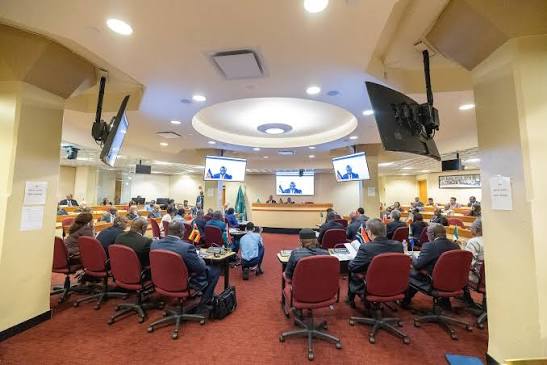
Africa’s climate adaptation agenda is facing a widening financing gap as funding flows weaken while the cost of building resilient economies continues to rise, putting greater pressure on governments and development institutions to convert international climate commitments into investable projects. Speaking in New York on September 22, Kenya’s President William Ruto said African countries face an annual climate adaptation finance shortfall of between $200 billion and $400 billion, arguing that the immediate challenge is no longer the volume of climate pledges but the ability to turn them into actual funding and projects.
The warning comes as African governments prepare for the next phase of global climate negotiations, with the continent seeking a stronger focus on adaptation finance, investment and implementation. According to The Star, Ruto told the Committee of African Heads of State and Government on Climate Change that official development assistance declined by 23% in 2025, while initial pledges to the ninth replenishment of the Global Environment Facility stood at $3.9 billion, below the $5.33 billion secured under the previous replenishment.
 For African economies, the significance of the financing gap extends beyond climate policy. Adaptation spending is increasingly tied to the resilience of infrastructure, agricultural production, water systems, energy networks and urban economies. When financing for these investments is delayed, governments can face higher costs from climate-related disruptions, while households and businesses absorb losses through damaged infrastructure, interrupted production and rising operating costs.
The scale of the challenge is also reflected in the African Development Bank’s latest assessment. Its 2026 Annual Development Effectiveness Review estimates that Africa faces an overall climate financing gap of more than $213 billion a year through 2030. Adaptation finance reached about $25 billion, representing roughly one-fifth of estimated requirements, while mitigation finance remained substantially below the level needed to support the continent’s transition.
The numbers point to a structural problem in which climate investment competes with other development priorities for scarce public and external capital. African governments are simultaneously under pressure to expand electricity access, improve transport networks, strengthen health and education systems, manage debt and create employment. Climate adaptation therefore has to be incorporated into these investments rather than treated as a separate category of expenditure.
That is particularly important for infrastructure. Roads, bridges, drainage systems, water infrastructure and electricity networks are long-term assets whose economic value can be undermined by floods, droughts, heat and other climate-related stresses. Designing infrastructure to withstand those risks can require higher upfront investment but may reduce future reconstruction costs and economic disruption. The financing challenge is determining how those additional costs can be incorporated into public investment programmes and private-sector projects without making essential infrastructure unaffordable.
Agriculture presents another direct connection between adaptation finance and economic stability. Across much of Africa, changes in rainfall, prolonged droughts and extreme weather affect agricultural output, household incomes and food prices. Investment in irrigation, climate information, resilient seed systems, storage, insurance and agricultural value chains can therefore have economic as well as environmental returns. Yet many of these projects generate benefits over longer periods, making them difficult to finance through conventional commercial lending alone.
The weakness of concessional finance adds another layer to the problem. African countries with limited fiscal space cannot simply replace declining grants and low-cost development finance with commercial borrowing without considering debt sustainability. Higher-cost financing can increase the burden on public budgets, particularly where projects do not generate direct revenues with which to service debt.
This makes the structure of climate finance increasingly important. The African Development Bank has identified high financing costs, limited domestic financial capacity and insufficient private-sector participation among the barriers preventing Africa from scaling investment in climate-related projects. Its African Green Banks Initiative, for example, is intended to strengthen domestic financing ecosystems and help channel private capital towards climate and green investments.
Read also: https://www.the-star.co.ke/news/2026-09-23-ruto-africa-faces-sh52tn-climate-funding-gap
The issue is not simply whether private capital exists, but whether African projects can be made sufficiently investable. Investors typically require predictable revenues, credible regulation, reliable data and mechanisms for managing political, currency and project-development risks. Climate adaptation projects can be particularly challenging because many of their economic benefits are indirect. A flood-resistant drainage system, for example, may prevent losses rather than generate a conventional revenue stream.
That creates a role for development finance institutions and public-sector risk-sharing mechanisms. Guarantees, concessional capital, project-preparation facilities and blended-finance structures can potentially help reduce risks and bring projects to the point where commercial investors can participate. The African Development Bank has increasingly used such mechanisms to support climate and infrastructure investment, including its Climate Action Window, which provides concessional resources for climate-resilient investment in low-income and vulnerable African countries.
Domestic financial markets will also become more important if Africa is to reduce its dependence on external climate finance. Green bonds, sustainability-linked instruments, local-currency financing and other capital-market structures can provide additional channels for investment, although their effectiveness depends on credible institutions, sufficient market depth and investor confidence.
For governments, this places climate finance within a wider public-finance challenge. The question is not only how much money can be raised, but whether financing can be aligned with national development plans, whether projects can be implemented efficiently and whether public institutions can measure their economic and climate outcomes. Weak project preparation or fragmented implementation can leave available capital underused even when financing commitments have been made.
The Adaptation Fund illustrates the distance between global commitments and actual resources. According to The Star, the fund secured about $138 million against a $300 million target, while African leaders have been calling for the international commitment to increase adaptation finance to translate into more predictable resources.
The timing adds significance to the debate. African governments are preparing their positions ahead of COP31 in Türkiye, while Addis Ababa is due to host COP32. The sequence gives African countries an opportunity to push for greater emphasis on adaptation, but the effectiveness of that agenda will depend on whether international commitments are accompanied by financing mechanisms that can reach projects and institutions on the ground.
There is also a growing economic argument for treating adaptation as an investment rather than solely as a cost. The African Development Bank estimates that climate-related losses could impose significant economic costs on vulnerable African economies if adaptation investment remains insufficient. At the same time, the Bank estimates that Africa faces a much broader structural financing gap spanning infrastructure, energy, climate adaptation, food systems and social investment.
This means climate finance cannot be isolated from Africa’s wider development-financing architecture. The same capital that supports resilient roads can improve trade connectivity; investment in reliable water systems can strengthen urban productivity; and climate-resilient agriculture can reduce food-system risks. The challenge is designing financial instruments and public investment systems that recognise these overlapping returns.
The immediate test for African governments and their international partners is therefore increasingly one of delivery. Climate pledges can establish political direction, but they do not build a drainage network, finance drought-resistant agriculture or strengthen an electricity grid until the money reaches a credible project and the institutions responsible for implementation can deploy it effectively.
 For Africa, closing the adaptation gap will consequently require more than larger headline commitments. It will require a financing architecture capable of combining concessional resources, domestic capital, development finance and private investment while keeping debt sustainability and institutional capacity in view. As climate risks become more closely linked to economic performance, the ability to turn climate finance into productive and resilient assets will become an increasingly important part of the continent’s broader development strategy.


