


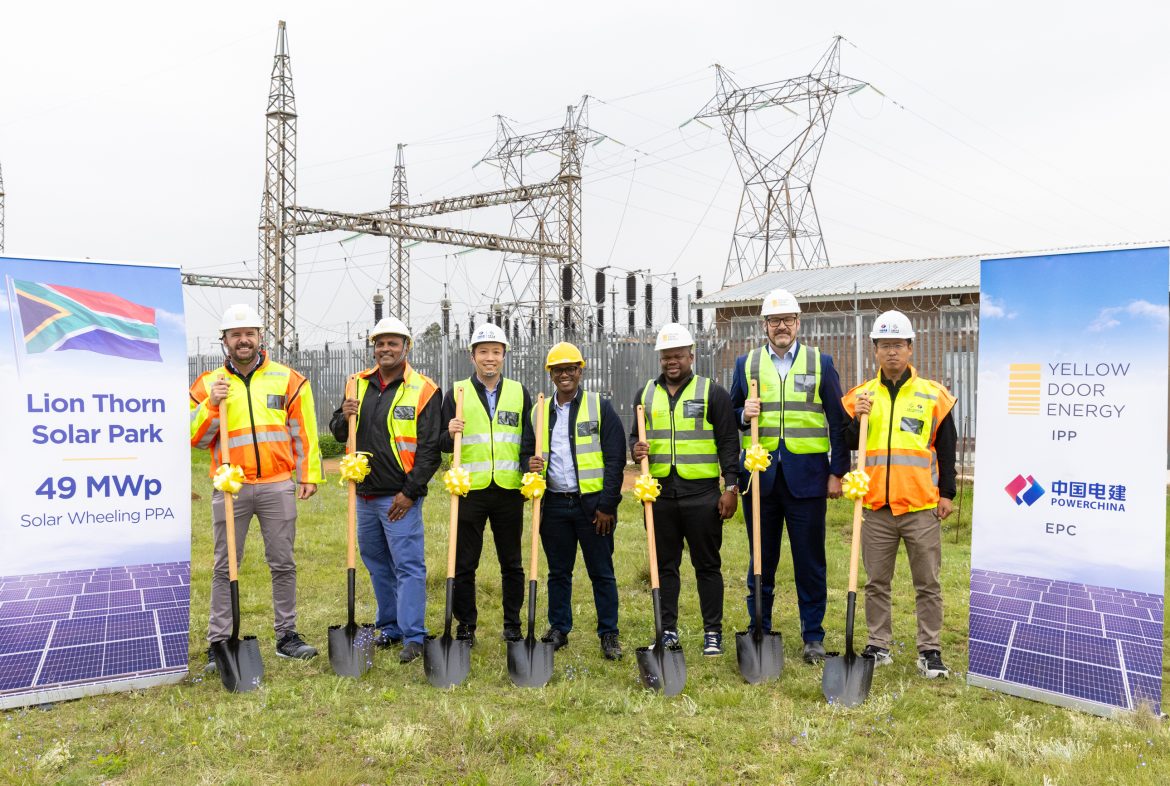
Yellow Door Energy has begun construction of the 49 MWp Lion Thorn Solar Park in South Africa’s North West province, moving the project from financial close into delivery as private renewable-energy investment continues to expand beyond traditional utility procurement.
The solar park, located near Leeudoringstad in the Maquassi Hills Local Municipality, is expected to enter commercial operation in 2028. PowerChina has been appointed as the engineering, procurement and construction contractor, while Nedbank Corporate and Investment Banking provided the project financing that enabled construction to proceed. The project reached financial close in August 2026.
Lion Thorn has secured long-term power purchase agreements with PPC, the South African cement and construction materials producer, and POWERX, a private electricity trader licensed by the National Energy Regulator of South Africa (NERSA). The dual-offtake structure provides a contracted market for the electricity while allowing the project to serve businesses through South Africa’s growing wheeling market.
Once operational, the project is expected to generate approximately 115 GWh of renewable electricity in its first year and avoid an estimated 104,190 tonnes of carbon emissions annually. It is also expected to create employment and procurement opportunities during construction and operations, with the developers placing emphasis on local workers, suppliers and skills development in Maquassi Hills and surrounding communities.
The significance of Lion Thorn extends beyond its generation capacity. Solar wheeling allows electricity produced at a renewable-energy facility to be transmitted through the existing grid to customers that may be located elsewhere, creating a route for companies to procure renewable power without developing their own generation facilities.
That model has become increasingly important in South Africa as businesses seek greater control over electricity costs, supply and emissions while the country’s power market undergoes structural change. The Electricity Regulation Amendment Act, which took effect in 2024, has supported the development of a more competitive electricity market and opened additional opportunities for independent power producers and private traders.
Yellow Door Energy has already used the wheeling model in the North West. In 2025, it signed a 24.5 MWp power purchase agreement with POWERX for the Naledi Ya YDE Solar Park in Leeudoringstad. That project was designed to provide renewable electricity to POWERX customers across South Africa through the Eskom grid.
Lion Thorn builds on that model at a larger scale and illustrates how private electricity markets are developing around contracted corporate demand. Instead of relying solely on large centralised procurement programmes, renewable developers can increasingly structure projects around industrial and commercial customers willing to commit to long-term power purchases.
For PPC, the agreement provides another source of renewable electricity as the cement producer works to reduce the emissions intensity of its operations. Cement production is among the more energy-intensive industrial activities, making access to predictable renewable electricity relevant not only to environmental targets but also to longer-term energy procurement strategies.
POWERX provides a different route to the market by aggregating demand from customers that may not be large enough to contract directly with a utility-scale generator. Its participation therefore broadens the potential customer base for private renewable projects and supports the development of electricity trading outside the traditional utility model.
The growth of such projects is already reflected in South Africa’s private generation market. NERSA-registered private generation projects represented an estimated R158 billion in investment and 7,464 MW of generation capacity in 2025, according to industry data cited in reporting on the Lion Thorn financing.
The expansion is also changing the role of banks and infrastructure investors in the country’s energy transition. Lion Thorn’s financial close demonstrates how long-term PPAs can provide the contracted revenue framework needed to finance utility-scale renewable projects, while established grid infrastructure provides the route to customers.
For the North West, the project also brings a local economic dimension. Construction is expected to generate demand for contractors, equipment and skilled labour, while longer-term operations will create additional employment and procurement opportunities. The extent of the local benefit will depend on how much of the project’s supply chain and workforce can be sourced within Maquassi Hills and neighbouring communities.
Lion Thorn is therefore part of a wider shift in South Africa’s electricity market in which renewable generation is increasingly being developed around private demand. The project does not remove the need for grid investment or broader electricity-sector reform, but it shows how PPAs, private trading and wheeling can connect new generation with customers without requiring every business to build its own power plant.
As construction begins, the focus now moves from securing finance and offtake agreements to delivering the plant, connecting it to the grid and maintaining the generation levels required under its contracts. If completed as planned, Lion Thorn will add nearly 50 MWp of solar capacity while strengthening a market in which businesses are becoming increasingly active participants in South Africa’s energy transition.


