


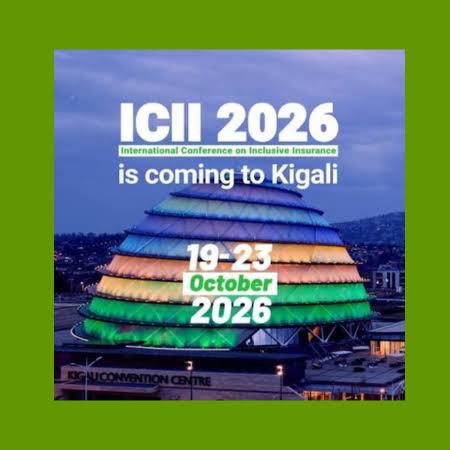
Rwanda will host the International Conference on Inclusive Insurance 2026 (ICII 2026) from 19 to 23 October in Kigali, bringing together insurance companies, regulators, policymakers, development institutions and researchers to address the limited availability of affordable insurance for low-income households and underserved businesses. The conference comes as climate-related disasters, health emergencies and economic shocks increase the need for financial protection across emerging markets, where insurance coverage remains insufficient for much of the population.
The five-day gathering is expected to attract around 500 experts, with more than 80 speakers participating in 24 sessions covering insurance business models, climate and disaster risks, digital solutions, customer needs, gender, health, consumer education, policy and regulation. It is hosted by Rwanda’s Ministry of Finance and Economic Planning (MINECOFIN), the National Bank of Rwanda (NBR), Access to Finance Rwanda (AFR), the Rwanda Insurers Association (ASSAR) and the Rwanda Insurance Brokers Association (RIBO), in cooperation with the Munich Re Foundation and the Microinsurance Network.
The central issue facing participants is how to expand insurance beyond established customer segments and develop products that low-income households, informal workers, smallholder farmers and small businesses can afford and use effectively. Insurance can help policyholders absorb unexpected costs, recover after disasters and reduce the need to sell productive assets or rely on high-cost borrowing when a shock occurs. Yet coverage remains limited in many low-income markets, leaving families and businesses exposed to risks that can reverse years of economic progress.

According to the conference organisers, nearly nine in 10 people in low-income countries lack adequate insurance coverage. The gap is particularly consequential where households depend on climate-sensitive livelihoods, have limited savings or operate businesses with little capacity to withstand interruptions. When floods, droughts, illness or property damage occur, the absence of insurance can transfer the financial burden directly to households, businesses and governments.
For African economies, the protection gap has implications beyond individual financial security. Uninsured agricultural losses can affect food supply and rural incomes, while uninsured small businesses may struggle to reopen after disasters. Public authorities can also face increased pressure to provide emergency assistance and finance reconstruction after major shocks. Insurance cannot eliminate these risks, but well-designed products can distribute some of the financial losses and support faster recovery.
Rwanda provides a relevant setting for these discussions because it has expanded access to formal financial services while continuing to face challenges in insurance uptake. The figures supplied by the conference organisers indicate that 96% of the adult population, equivalent to 7.8 million people, is financially included, while approximately 27%, or two million adults, use insurance products. The difference highlights an important distinction: access to a bank account or other financial service does not automatically translate into protection against illness, climate events, accidents or loss of income.
The country is implementing the National Insurance Strategy 2026–2035 and the National Inclusive Insurance Roadmap 2024–2029, which seek to strengthen the insurance sector and improve access to client-centred products. The policy challenge is to ensure that expansion reaches underserved groups and produces coverage that delivers practical value when claims arise. This requires attention to product design, pricing, distribution, customer understanding and the ability of insurers to settle legitimate claims efficiently.
Rwanda’s financial inclusion experience also illustrates why insurance needs to be integrated into wider financial services and development programmes. Products distributed through banks, microfinance institutions, savings and credit cooperatives, mobile platforms and agricultural value chains can potentially reach customers who do not routinely purchase insurance through traditional brokers. However, the effectiveness of these channels depends on whether customers understand what is covered, what exclusions apply, how premiums are collected and what evidence is required to make a claim.
Digital solutions are expected to feature prominently at ICII 2026. Mobile technology and digital distribution can lower some administrative costs, simplify enrolment and make insurance accessible to customers in geographically dispersed areas. Digital data may also support product design and claims assessment, including in agriculture and climate-risk insurance. But technology alone cannot resolve affordability problems or create trust. Poor connectivity, limited digital literacy, unsuitable products and unclear claims processes can still prevent customers from benefiting.
Climate and disaster risk will be another major theme. Across Africa, agricultural production, informal commerce and household incomes are often exposed to weather variability and extreme events. Insurance products designed for these risks can help provide compensation after defined losses or weather conditions, potentially allowing households and businesses to resume economic activity sooner. Their performance depends on sound risk assessment, reliable data and clear links between insured events and payouts.
Climate-related insurance also presents design challenges. In index-based products, for example, payments are triggered by a specified indicator, such as rainfall levels, rather than an assessment of each individual loss. This can speed up claims but may leave customers without a payout even when they experience damage, or trigger payments when their actual losses are limited. Such mismatches can undermine confidence if products are not carefully designed and explained. The conference’s focus on customer needs and evidence-based approaches is therefore relevant to the long-term viability of climate insurance.
The agenda will also examine gender and health, reflecting the different risks and barriers faced by women, informal workers and households with limited financial resources. Inclusive insurance requires more than reducing premiums: products need to reflect how customers earn, save, manage risk and access services. For some groups, irregular income, documentation requirements or limited access to trusted distribution channels can make conventional insurance difficult to use. Better customer research and simpler product structures may help insurers address these constraints while maintaining financial sustainability.
The conference will bring together experiences from Africa, Asia, and Latin America and the Caribbean, allowing participants to compare policy approaches and business models across emerging markets. Preliminary insights from the Microinsurance Network’s 2026 Landscape of Microinsurance will also be presented, offering an overview of global microinsurance coverage and how the sector is responding to increasingly interconnected risks. The organisers say the programme is intended to move beyond general discussion by examining practical examples, evidence and approaches that can be adapted to local conditions.

Rwanda’s Minister of Finance and Economic Planning, Yusuf Murangwa, said hosting the conference offers an opportunity to strengthen collaboration around financial resilience as economic shocks, health emergencies and climate-related disasters continue to affect households, businesses and communities. Dirk Reinhard, chair of the ICII 2026 steering committee and vice-chair of the Munich Re Foundation, similarly highlighted the need for cooperation between governments, donors, development institutions and insurers to address the protection gap.
Laura Elena Rosado, acting chair of the Microinsurance Network’s board and head of strategy, performance management and impact at AXA EssentiALL, has emphasised that financial health depends not only on access to financial services but also on the ability to withstand unexpected setbacks. That distinction is important for insurers and policymakers assessing whether broader financial inclusion is translating into greater resilience.
Ultimately, the expansion of inclusive insurance will depend on whether providers can build commercially sustainable models that deliver meaningful protection to customers who have traditionally been excluded from formal coverage. Regulators will need to support market development while protecting consumers, and insurers will need to balance affordable premiums with reliable claims management and sound risk pricing. Development organisations can help strengthen data, technical capacity and distribution, but lasting expansion requires products that customers trust and are willing to retain.
As ICII 2026 convenes in Kigali, the focus will be on translating policy commitments and industry experience into practical approaches that expand insurance access. For Rwanda and other emerging markets, the measure of progress will not simply be the number of people enrolled in financial services, but the number who can obtain suitable protection and recover financially when a shock occurs.


