


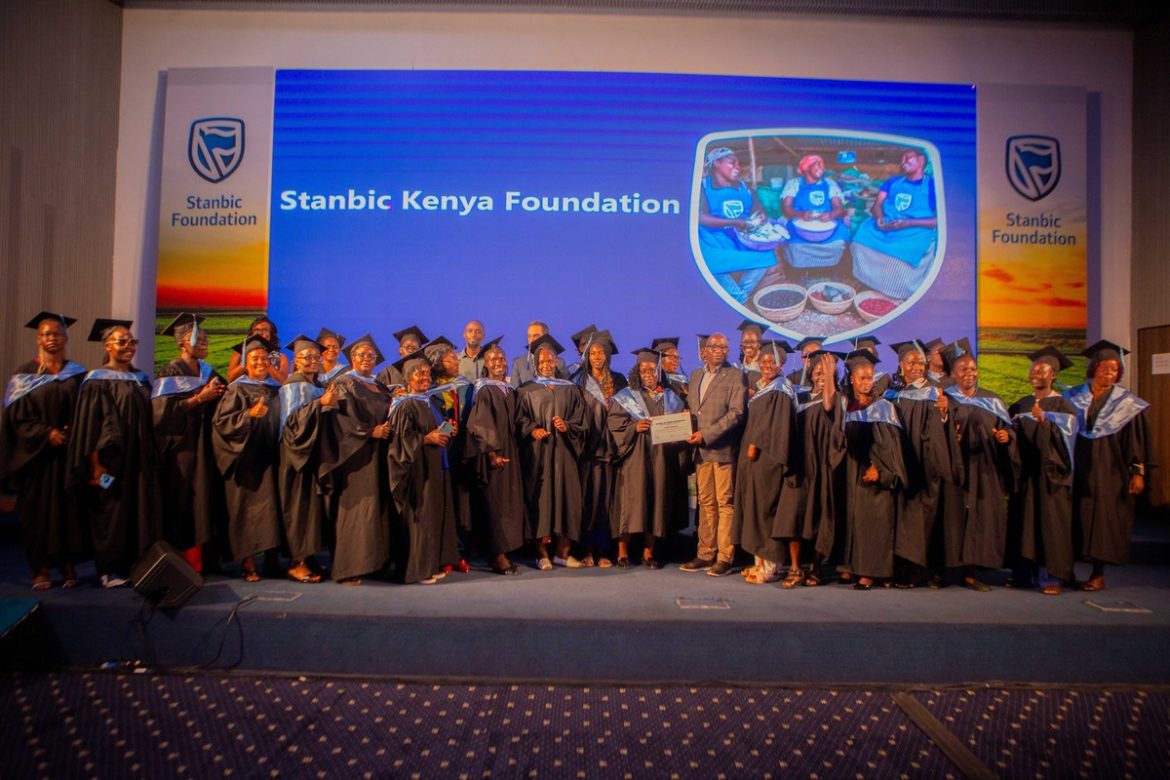
Stanbic Kenya Foundation and the German development agency Deutsche Gesellschaft für Internationale Zusammenarbeit (GIZ) have graduated 351 entrepreneurs under the Women Employment for the Green Transformation (WE4D) programme, expanding efforts to strengthen small businesses, create jobs and support greener economic activity across 10 counties in western Kenya.
The programme combines business training, access to finance, market linkages and support for green job creation, with the aim of helping small and medium-sized enterprises (SMEs) improve their competitiveness and expand their operations. Its latest graduation highlights the role of enterprise development initiatives in linking women’s economic participation with employment growth and environmentally responsible business practices.
According to the programme figures provided at the graduation, WE4D has reached 706 business owners and supported 2,378 jobs. Young people account for 1,591 of those jobs, while people with disabilities hold 32. Women represented 85% of the 351 entrepreneurs in the graduating cohort, underlining the programme’s focus on increasing women’s participation in enterprise and the wider economy.

The initiative covers Kisumu, Kericho, Kisii, Nyamira, Homa Bay, Uasin Gishu, Bungoma, Busia, Kakamega and Vihiga counties. Agriculture and agro-processing account for the largest share of participating businesses, while other enterprises operate in aquaculture, manufacturing, sustainable tourism, the circular economy and natural health solutions.
These sectors offer opportunities to connect business growth with more efficient resource use and local value addition. Agricultural and agro-processing enterprises, for example, can create employment through processing and distribution, while circular economy businesses can develop commercial uses for materials that might otherwise become waste. The extent of their environmental and economic contribution, however, will depend on whether enterprises can maintain viable operations and reach consistent markets.
Michael Mutiga, Chief Executive of Stanbic Bank Kenya, said the programme was designed to help women- and youth-led businesses improve productivity, adopt climate-conscious practices and become more prepared to attract investment.
“By helping women- and youth-led businesses raise productivity, adopt climate-conscious practices and become investment-ready, we are supporting decent jobs, stronger local value chains and more resilient county economies,” Mutiga said, adding that growing enterprises could extend their impact beyond their immediate communities as they access wider markets.
The emphasis on investment readiness reflects a persistent challenge for small businesses: training alone may not be enough to support expansion. Enterprises often need reliable financial records, formal registration, sound governance and evidence of demand before they can access appropriate financing or secure larger supply contracts. Improving these capabilities can help businesses demonstrate their performance to lenders, buyers and potential investors.
Beneficiaries have reported improvements in business formalisation, financial management, record keeping, governance and staff management. Some have also secured new customers, supply contracts and export opportunities, expanded their operations or created additional jobs. These reported outcomes suggest that enterprise support can help businesses move from informal or limited operations towards more structured growth, although the durability and scale of the gains will depend on market conditions and continued access to finance.
Mercy Githanji, Executive Director and Head of Stanbic Kenya Foundation, said the foundation’s work focuses on economic empowerment, financial and digital inclusion, and climate resilience. She said the next priority was to help graduating enterprises access markets, financing, technical expertise and opportunities to scale.
For businesses in western Kenya, market access can be as important as business skills. Agricultural producers and processors need dependable buyers, distribution channels and supply arrangements, while manufacturers and circular economy enterprises must demonstrate product quality, reliability and competitive pricing. Linking entrepreneurs to buyers and established value chains can help turn improved management practices into revenue and employment.
The programme’s green economy focus also raises questions about how smaller enterprises can adopt climate-conscious practices without undermining their financial viability. Businesses may need investment in more efficient equipment, improved production processes, waste management, water conservation or climate-resilient inputs. Such changes can improve resource efficiency and reduce exposure to environmental pressures, but the upfront costs can be difficult for small firms to absorb without appropriate finance and technical support.
WE4D supports enterprises developing solutions in climate-smart agriculture, waste valorisation and value addition. These activities can create opportunities to generate income from resources more efficiently, improve productivity and strengthen local supply chains. They also connect enterprise development with broader sustainability priorities, particularly where climate risks, resource constraints and waste management challenges affect business performance.
The programme is commissioned by Germany’s Federal Ministry for Economic Cooperation and Development (BMZ) and co-funded by the European Union and the Norwegian Government. GIZ’s wider WE4D initiative works across several African countries to improve women’s employment and economic opportunities, particularly in businesses and value chains contributing to the green transformation. Its approach combines skills development, enterprise competitiveness and partnerships with companies and other institutions.
Partnerships are central to this model because many of the barriers facing small businesses cannot be resolved by one organisation alone. Banks can help improve access to financial services and suitable financing; development agencies can provide technical assistance; county governments can connect initiatives to local economic priorities; and industry bodies can support standards, production capabilities and market linkages.

For counties in western Kenya, the potential benefits extend beyond the individual businesses receiving support. Stronger SMEs can create jobs closer to where people live, expand demand for local suppliers and increase economic activity in agricultural and emerging green sectors. However, the distribution of these benefits will depend on whether businesses can grow beyond the programme period and whether opportunities reach groups facing additional barriers to employment and enterprise development.
The reported employment figures provide an indication of the programme’s reach, but they also highlight the importance of tracking outcomes over time. Sustained job creation depends on factors including business survival, revenue growth, the quality and security of employment, and the ability of enterprises to retain workers as they expand. Further evidence on the duration of jobs supported, business performance and access to follow-on finance would help establish how far the programme’s initial gains translate into lasting economic impact.
The graduation of 351 entrepreneurs marks a milestone in efforts to strengthen women’s participation in Kenya’s green economy. The next test will be whether the businesses can convert improved management, new market connections and climate-conscious practices into sustained growth. If that transition is supported by suitable financing, technical expertise and reliable demand, the programme could contribute to stronger local value chains and


