


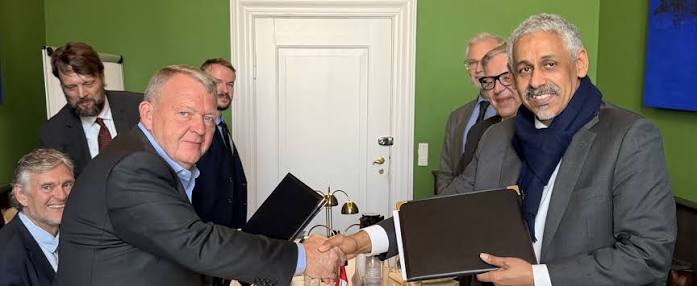
The African Development Bank Group and Denmark have agreed to strengthen cooperation on green investment and private capital mobilisation across Africa through 2030, as mounting development needs and tighter access to concessional funding increase pressure on governments and development institutions to find new sources of finance for infrastructure, energy and climate resilience.
The partnership, formalised through a memorandum of understanding signed in September by African Development Bank Group President Sidi Ould Tah and Danish Foreign Minister Lars Løkke Rasmussen, will focus on mobilising private investment through blended finance, guarantees and risk-sharing arrangements. According to the Bank, the cooperation will also draw on the expertise of Denmark’s Export and Investment Fund and Impact Fund Denmark to identify opportunities where public and private capital can support development priorities.

The agreement comes as African countries face the challenge of financing economic transformation while managing debt-service obligations, infrastructure deficits and growing exposure to climate risks. For many governments, the cost and availability of long-term financing will influence the pace at which they can expand electricity access, strengthen water systems and develop infrastructure needed to support industrial growth.
Under the agreement, the two partners intend to build on existing cooperation in renewable energy, climate adaptation, water security and green infrastructure. They will also exchange economic analysis, policy research and technical expertise, while exploring programmes that support employment, expand opportunities for young people and strengthen resilience in countries affected by fragility and conflict.
A central feature of the arrangement is the use of financial instruments designed to attract investors who might otherwise consider development projects too risky. Blended finance combines concessional or public funding with commercial capital, while guarantees and risk-sharing mechanisms can reduce investors’ exposure to particular financial or project risks. If structured effectively, these instruments can help projects secure financing without requiring governments or development banks to fund the entire investment themselves.
However, mobilising private capital does not automatically make projects affordable or commercially viable. The effectiveness of the partnership will depend on the projects selected, the allocation of financial risks and the extent to which investment produces measurable economic and environmental benefits. For African countries, the terms of financing will remain important, particularly where infrastructure projects generate public benefits but cannot recover their full costs through user charges or commercial revenues.
The Bank said the partnership would build on a relationship that has supported African development and climate initiatives for more than a decade. In 2011, Denmark provided 300 million Danish kroner as a founding contribution to the establishment of the Sustainable Energy Fund for Africa, which supports the development of sustainable energy markets and investment.
Denmark has also contributed to the African Development Fund, the Bank Group’s concessional financing window serving low-income African countries. The country was among the first to announce a pledge to the Fund’s seventeenth replenishment, committing 1.17 billion Danish kroner, a 40 per cent increase over its contribution to the previous replenishment, according to the Bank.
The distinction between concessional and commercial finance is significant for countries with limited fiscal space. While private investment can expand the pool of capital available for development, poorer and more climate-vulnerable economies may still require grants and concessional loans to finance essential services and projects with limited immediate financial returns. The partnership’s development impact will therefore depend partly on how it complements existing public and concessional funding rather than displacing it.
Energy investment illustrates the scale of the challenge. Reliable and affordable electricity is essential for manufacturing, agricultural processing, digital services and the development of mineral value chains. Renewable energy projects can help diversify electricity supply and reduce exposure to fuel-price volatility, but they require investment in generation, transmission, distribution and storage, alongside regulatory frameworks that support reliable power markets.
Water security and climate adaptation present a related financing problem. Investments in water supply, flood protection and resilient infrastructure can reduce economic losses and protect communities, but their benefits often extend beyond the revenue streams available to private investors. Public institutions and development finance partners will remain important in structuring projects that balance financial viability with access, affordability and long-term resilience.
The agreement also provides for continued exchanges of economic analysis and technical knowledge, as well as regular strategic consultations to identify specific programmes and projects. Discussions are expected to continue on the secondment of Danish-funded specialists to the Bank, potentially strengthening the technical capacity available to prepare and assess investments.
For African economies, the immediate test will be whether the framework produces a pipeline of bankable projects with clear financing structures, credible implementation plans and transparent performance measures. Project preparation, predictable regulation and sound public financial management will be necessary to convert broad commitments to private capital mobilisation into investments that can be implemented at scale.
The partnership reflects a wider shift in development finance as traditional concessional resources face competing demands and development institutions seek to attract more commercial investment. Yet private capital is not a substitute for public finance, particularly in markets where infrastructure gaps, currency risks and limited purchasing power constrain investment.

The agreement establishes a framework for cooperation through 2030, but the scale of investment it ultimately supports will depend on the projects developed and the financing arrangements secured. Its significance for Africa will be measured less by the volume of capital announced than by whether that capital expands productive capacity, improves essential infrastructure and strengthens resilience without adding unsustainable financial burdens to governments and communities.


