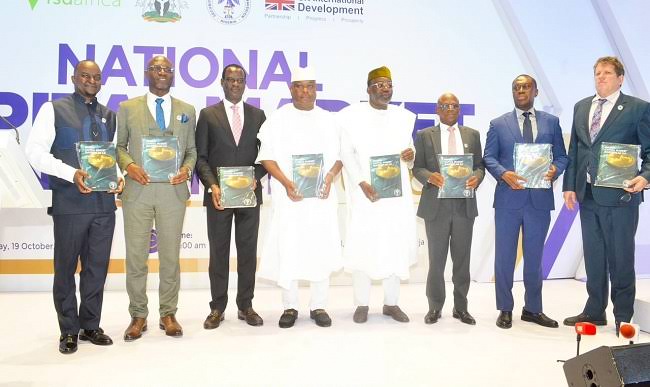
Nigeria has launched a ten-year capital market reform roadmap and a national savings plan aimed at mobilising domestic and international investment, expanding access to long-term financing and supporting its ambition to build a US$1 trillion economy by 2030.
The Nigeria Capital Market Masterplan 2.0, covering 2026 to 2036, was launched on 19 October 2026 at a national capital market event in Abuja. The initiative seeks to make the country’s financial markets more diverse, efficient and transparent while strengthening Nigeria’s position as a regional financial hub. It places domestic savings, private investment and capital-market reforms at the centre of efforts to finance businesses, infrastructure and broader economic development.
The launch brought together Vice President Kashim Shettima, Finance and Coordinating Minister of the Economy Taiwo Oyedele, representatives of the United Kingdom government and Mark Napier, chief executive officer of FSD Africa. The Securities and Exchange Commission (SEC) Nigeria developed the masterplan with technical support from FSD Africa, funded by the UK Government. The support also enabled a consortium led by Genesis Analytics and Bourse Consult to develop the roadmap and its implementation framework.

The initiative comes as Nigeria seeks to expand the role of its capital markets beyond traditional fundraising and provide businesses, state governments and infrastructure developers with a broader range of financing options. A deeper capital market can connect investors seeking returns with companies and public institutions requiring long-term funding, reducing exclusive reliance on bank lending and government borrowing.
Speaking at the launch, SEC Director-General Dr Emomotimi Agama said the masterplan was designed to develop the market to a scale commensurate with the country’s economic ambitions.
“Every great economy has, at its heart, a capital market that turns the savings of ordinary people into the factories, roads, homes and businesses that create jobs. Nigeria has the people, the enterprise and the ambition. What we are now building is a market to match them,” Agama said.
The simultaneous launch of the National Savings Scheme reflects the government’s intention to strengthen the domestic foundations of investment. Agama said savings were central to building a capital market capable of financing national development, arguing that greater participation by Nigerian households and institutions could help mobilise resources for productive investment.
The policy direction is significant because the availability of domestic capital can influence how economies finance infrastructure and business expansion. Reliance on external investment exposes countries to shifts in global financial conditions, investor sentiment and currency movements. Mobilising local savings through credible investment products can broaden the pool of funds available to businesses and public projects, although the extent of this benefit will depend on whether savers have confidence in the market and access to suitable products.
FSD Africa chief executive Mark Napier said Nigeria’s economic scale and regional importance created an opportunity to direct more domestic and international capital towards businesses, infrastructure and sustainable growth. He pointed to the organisation’s work in Zambia and Ethiopia, where support for financial-market architecture and regulatory reforms had helped address constraints to capital mobilisation, including financing for renewable energy.
The UK Government’s support for the Nigerian initiative forms part of a wider bilateral economic partnership. Peter Vowles, the UK High Commissioner to Nigeria, was represented at the launch by Paul Healey, head of Green Growth and Private Sector Development at the British High Commission. Healey said the reform programme was intended to connect investment with commercial opportunities in businesses and infrastructure, while strengthening financial links between the two countries.
FSD Africa’s involvement has focused on connecting capital-market development with Nigeria’s broader economic priorities, including infrastructure, small and medium-sized enterprise growth, financial inclusion and sustainable development. These areas require financing that can remain available over longer periods and support projects whose returns may emerge gradually rather than immediately.
The masterplan identifies five pillars for reform: improving regulatory clarity and enforcement; modernising market infrastructure; broadening the range of issuers and financial instruments; diversifying the investor base; and strengthening institutional and professional capacity. Each pillar is supported by a sequenced implementation plan with designated responsibilities, timelines and measures of success.
Proposed reforms include making it easier for businesses and state governments to raise capital, increasing participation by retail and diaspora investors, attracting more foreign institutional investment, strengthening sustainable finance and supporting the development of digital and tokenised assets. Together, these measures are intended to broaden the range of financing available and improve the market’s ability to channel funds into productive economic activity.
The plan also sets measurable ambitions for expanding investment pools. According to FSD Africa, Nigeria aims to increase collective investment scheme assets under management from US$5.6 billion to US$56 billion over ten years, while raising annual diaspora investment channelled into capital markets from US$4 billion to US$10 billion. It also seeks to increase the share of institutional portfolios invested in non-sovereign assets from approximately 40% to 50%. These are targets rather than achieved outcomes, and their delivery will depend on investor participation, the availability of suitable investment opportunities and confidence in the market’s regulatory framework.
Sustainable finance is another area where the masterplan could have implications beyond the financial sector. Long-term investment is needed for renewable energy, climate resilience, transport, housing and other infrastructure that supports economic activity. Capital markets can help finance such projects through instruments including green bonds and other sustainability-linked products, provided that disclosures are credible, projects are properly assessed and investors can evaluate the risks and expected returns.
For small and medium-sized enterprises, improved access to capital could support business expansion, technology adoption and job creation. However, smaller firms may face barriers to issuing securities, including the cost of compliance, limited financial reporting capacity and the requirements associated with reaching investors. The effectiveness of the reforms will therefore depend partly on whether new financing channels are practical and affordable for businesses outside the largest corporate segment.
The masterplan builds on an earlier capital-market strategy that recorded an overall activity completion rate of 63%, according to the information released alongside the new roadmap. Financial inclusion, regional integration, sustainable finance and mobilisation of capital towards priority sectors remained areas requiring further progress. The experience highlights a central challenge for the new programme: setting a comprehensive reform agenda is only one part of the task; implementation, coordination and measurable results will determine its economic contribution.
Investor confidence will also be important. A larger market requires effective regulation, reliable trading and settlement infrastructure, transparent disclosures and safeguards against misconduct. Expanding participation among households and diaspora investors will depend not only on new products but also on whether people understand the risks, can access credible information and trust the institutions managing their investments.

The regional dimension is another priority. Nigeria intends to strengthen cooperation with other African markets through cross-border capital raising, listing frameworks and closer alignment with initiatives under the African Continental Free Trade Area. Greater interoperability between markets could help businesses reach a wider investor base and allow capital to move more efficiently across borders. Achieving this will require cooperation among regulators, exchanges and other financial institutions, alongside progress on differences in market rules and infrastructure.
The launch of the Nigeria Capital Market Masterplan 2.0 and the National Savings Scheme therefore marks the beginning of a decade-long reform effort rather than the completion of one. Its contribution to Nigeria’s US$1 trillion economy ambition will depend on the ability to turn savings into productive investment, make financing more accessible to businesses and infrastructure developers, and ensure that the market operates with the transparency and reliability needed to attract long-term capital.
As implementation begins, progress will be measured not simply by the expansion of market assets or the number of reforms introduced, but by whether investment reaches productive sectors, creates economic opportunities and strengthens the capacity of Nigerian businesses and institutions to finance growth. The challenge is to build a capital market that can mobilise more resources while ensuring those resources translate into sustainable economic activity.