


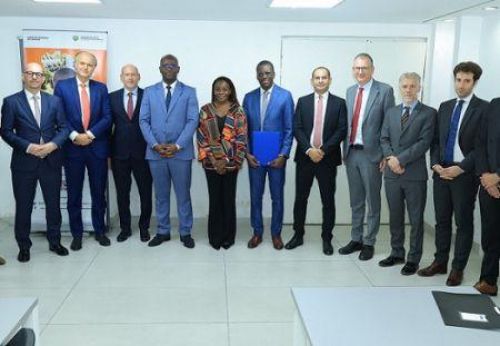
AXIAN Energy and its development partners have secured up to €55.5 million (approximately US$62.3 million) in long-term financing from Dutch development bank FMO for a 50-megawatt-peak (MWp) solar power plant in northern Côte d’Ivoire, strengthening investment in the country’s renewable energy capacity as it works to diversify electricity generation and meet rising demand.
The financing agreement for the Kong Solaire project was signed on 16 October 2026 by the project partners, including AXIAN, Ivorian renewable energy developer Africa Via and the Private Infrastructure Development Group (PIDG) through its development arm, InfraCo. The plant is already under construction near the town of Kong and is scheduled to begin operations in 2028.
FMO’s financing will cover the project’s long-term debt requirements over a period of up to 20 years. According to the lender’s project information, the facility comprises a €50.5 million senior secured loan for the solar plant and a separate €4.5 million loan for the associated transmission infrastructure. The structure reflects the need to finance both electricity generation and the infrastructure required to connect new capacity to the national grid.

Once operational, Kong Solaire is expected to generate approximately 96 gigawatt-hours (GWh) of electricity annually. The power will be sold to state-owned electricity company CI-ENERGIES under a 25-year power purchase agreement, providing a long-term contractual framework for the sale of the plant’s output. Project partners estimate that the facility could supply electricity equivalent to the needs of around 240,000 people and avoid approximately 54,000 tonnes of carbon dioxide emissions annually. These figures are projections and will depend on the plant’s performance after commissioning.
The transaction highlights the role of development finance institutions in mobilising capital for utility-scale renewable energy projects in markets where long construction periods, financing costs and perceived investment risks can limit private-sector participation. By providing long-term debt, FMO is helping finance a project that will sell electricity under a contract extending beyond the repayment period of the loan.
That distinction matters for infrastructure investment. Solar plants require substantial upfront expenditure, while revenue is earned over many years through electricity sales. Long-term financing can help align debt repayment with the period over which a project generates income, although the final economics also depend on construction costs, operating performance, payment reliability and the terms of the power purchase agreement.
Kong Solaire’s ownership structure combines local development expertise with regional investment and infrastructure financing. Africa Via holds a 51% stake in the project company, Kong Solaire SAS, while InfraCo owns the remaining 49%. AXIAN Energy holds a 55% stake in Africa Via, giving it an indirect interest of approximately 28% in the solar project.
For AXIAN Energy, the agreement builds on a series of financing partnerships supporting its expansion across African electricity markets. The company has set a target of reaching 2 gigawatts (GW) of installed renewable energy capacity by 2030. Achieving that ambition will require a pipeline of projects at different stages of development, alongside access to capital capable of supporting construction and long-term operations.
One of its significant recent developments is the NEA Kolda solar project in Senegal, which combines 60 MWp of solar generation with a 72-megawatt-hour battery energy storage system. AXIAN announced financial close for the project in March 2026 following an earlier financing arrangement involving FMO, the Emerging Africa & Asia Infrastructure Fund (EAAIF) and German development finance institution DEG. The project is expected to generate about 91 GWh of electricity annually, with battery storage designed to help supply power during evening peak periods and support grid stability.
The Kolda and Kong projects illustrate two complementary approaches to renewable energy development in West Africa. Kong will add utility-scale solar generation connected to the Ivorian grid, while Kolda combines solar power with battery storage to help manage when electricity is supplied. The distinction is important as electricity systems accommodate greater volumes of variable renewable generation.
AXIAN has also received support from commercial lenders as it expands its energy portfolio. In June 2026, the group signed a US$60 million financing agreement with Mauritius Commercial Bank to support its wider growth. The combination of development finance and commercial lending may help the company diversify its funding sources as it pursues projects in multiple markets. However, reaching its 2030 capacity target will depend on converting development plans and financing commitments into operating assets.
For Côte d’Ivoire, the Kong project comes amid a broader effort to diversify the electricity mix and expand generating capacity. The country has historically relied substantially on natural gas-fired thermal generation, alongside hydropower. Its National Energy Compact sets a target of increasing the share of renewables in the energy mix to 45% by 2030, while expanding electricity access and attracting additional private investment.
Government planning also anticipates continued growth in electricity demand, driven by economic activity, industrial development and expanding access. Meeting that demand will require investment not only in generation but also in transmission and distribution networks. New solar capacity can diversify supply, but its contribution depends on whether the grid can accommodate the electricity produced and deliver it reliably to consumers.
The northern location of Kong is also significant for regional electricity development. Expanding generation outside the main coastal economic centres can support a more geographically distributed electricity system, provided transmission infrastructure keeps pace with new capacity. The separate financing for the project’s transmission assets reflects the importance of connecting the plant to the national grid rather than treating generation capacity as a standalone measure of progress.
The project’s expected climate benefits are linked to the electricity it will generate and the power sources that generation may displace. The estimated avoidance of 54,000 tonnes of carbon dioxide annually is a forecast, not a verified reduction already achieved. Actual emissions benefits will depend on the plant’s output and the generation mix against which its electricity is compared once it enters service.

The development also demonstrates the importance of long-term power purchase agreements in attracting financing for independent power projects. A 25-year agreement with CI-ENERGIES gives the project a defined buyer for its electricity, helping establish a revenue framework that lenders can assess. The quality of that arrangement, including payment performance and the allocation of risks, will influence the project’s financial resilience over its operating life.
For development lenders, projects such as Kong offer a way to support national energy priorities while encouraging private investment in infrastructure. Yet the wider impact will depend on implementation: construction must be completed on schedule, grid connections must be ready, and the plant must deliver the expected output. Financing is a major milestone, but it does not by itself guarantee that electricity will be delivered on time or at the expected cost.
Kong Solaire therefore represents both a new renewable energy investment and a test of Côte d’Ivoire’s ability to translate its energy ambitions into functioning infrastructure. For AXIAN Energy, it is another step towards its 2 GW target. For the country, the project’s eventual contribution will be measured by the electricity it supplies, the reliability of its grid connection and the extent to which new renewable capacity supports a more diversified and resilient power system.


